U.S. Undersecretary of Defense for Policy Elbridge Colby attends an International commemorative ceremony for the 82nd anniversary of the World War II “D-Day” Normandy landings in Langrune-sur-Mer, northwestern France, of June 6, 2026. (Photo by LOU BENOIST / AFP via Getty Images)
The COPA initiative allows for the issuance of cash bonuses up to $2,500 to eligible troops to “recognize exceptional contributions rooted in novel actions, inventions, or technical…
The contract marks the latest signal for the Army’s expansion of NGC2, an ecosystem of interconnected hardware and software underpinned by Anduril’s Lattice software platform.
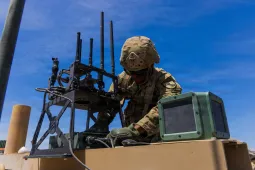
U.S. Soldiers assigned to 3rd Squadron, 2nd Cavalry Regiment practice target lock-on against an incoming drone during Project Flytrap at Joint Multinational Readiness Center, Hohenfels Training Area, Hohenfels, Germany, June 9, 2025. (U.S. Army photo by Spc. Elijah Magaña)
Delivered through the service’s Digital Capabilities Contracting Center of Excellence (DC3oE), the award allows select Army organizations to use Kaizen’s application layer system, one meant to streamline…
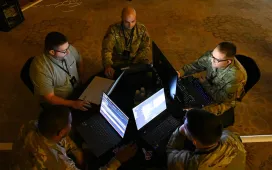
U.S. Army Soldiers and a DOD contractor assigned to the Regional Cyber Center-Southwest Asia, attempt to win a challenge for points at the 10th annual Best Cyber Warrior Competition in the CENTCOM area of responsibility, Oct. 29, 2024. (U.S. Army photo by Spc. Dean John Kd De Dios)
While the new program is meant to galvanize cyber skill development through escalating pay rates, the initiative is expected to bring significant pay cuts for cyber troops…
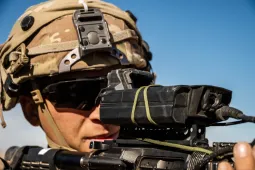
Spc. Brandon Mack, a small unmanned aircraft system operator assigned to 1st Battalion, 8th Cavalry Regiment, 2nd Armored Combat Brigade, 1st Cavalry Division, looks through his SMASH 2000L optic, a counter-sUAS tracking scope developed by SMARTSHOOTER, during rotation 26-02 at the National Training Center, Fort Irwin, California, Nov. 2, 2025. (U.S. Army photo by Spc. Julian A. Winston)
So far, however, less than one percent — $50 million — of the ten new awards have been obligated, officials said, with the rest contingent on congressional…
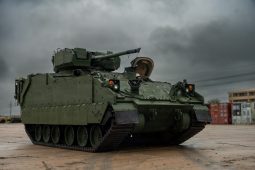
The 1st Cavalry Division tests prototypes of the new Armored Multi-Purpose Vehicle (AMPV 30mm), April 30, 2026, on Fort Hood, Texas. (U.S. Army photo by Spc. Michelle Lessard-Terry)
“We’re demonstrating how a proven combat vehicle platform can continue to evolve as the battlefield and technology change, without requiring the Army to start over every time…
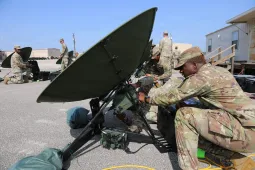
Soldiers from the 57th Expeditionary Signal Battalion-Enhanced (ESB-E), 11th Corps Signal Brigade (BDE), train on expeditionary geosynchronous Earth orbit (GEO) satellite terminals as part of their new command and control network baseline equipment package. (U.S. Army photo by Amy Walker, Project Manager C2 Transport, CPE C2IN)
The fielding comes after two Army divisions experimented with NGC2 for more than a year and nearly two months after the service tested the architecture at a…
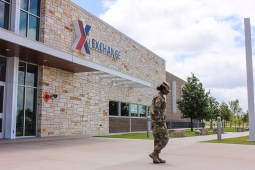
A spokesperson for AAFES told DefenseScoop that it had notified all customers with an account at its online exchange store about the messages and posted warnings on…
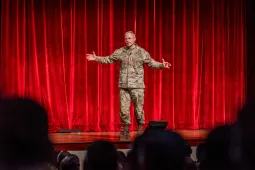
Gen. Christopher C. LaNeve, U.S. Army Vice Chief of Staff, delivers a presentation on strategic focus during the first day of the annual Maneuver Warfighter Conference, Sept. 15, 2026, in Marshall Auditorium at Fort Benning, Georgia. (U.S. Army photo by Joey Rhodes II)
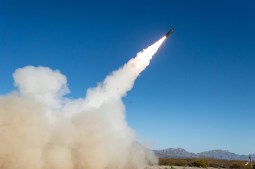
The Precision Strike Missile (PrSM) fired from a U.S. Army M270A2 and HIMARS at White Sands Missile Range, New Mexico. (Official U.S. Army photo by Christopher Bohn)