The appointment comes amid a push by the department to modernize its IT and cybersecurity tools, streamline procurement, and figure out the way ahead for the controversial…
US President Donald Trump and Secretary of Defense Pete Hegseth salute as a US Army carry team carries the flag-draped transfer case containing the remains of Sgt. Michael Emmanuel Swinton, 30, of Fayetteville, North Carolina, during a dignified transfer solemn event for US service members killed during operations in the Middle East, at Dover Air Force Base in Dover, Delaware, on July 22, 2026. Swinton was killed in action on July 19 at at Erbil Air Base in Iraq. (Photo by SAUL LOEB / AFP via Getty Images)
While ubiquitous connectivity is often taken for granted in today’s world, it will be essential to driving the Navy’s adoption of advanced technologies like autonomy and AI,…
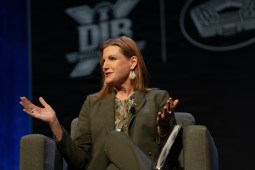
In the fireside chat, “When the Math Doesn’t Math: Reframing CMMC to Deliver at the Speed of Relevance,” Kirsten Davies, Chief Information Officer for the Department of War, and James Mismash, Deputy Assistant Secretary of War for Industrial Base Growth, discussed the Department’s efforts to modernize its digital infrastructure, reduce compliance friction, and create a more secure and agile ecosystem that enables industry to deliver capabilities to the warfighter faster. Photo taken Aug. 26, 2026. (Courtesy Photo)
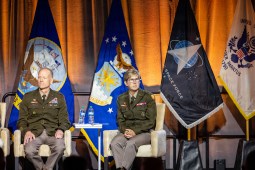
NETCOM Commanding General Maj. Gen. Jacqueline D. McPhail (right) also participated in “AI, ADOCs, and All Things Cyber” discussion at the annual TechNet Augusta conference. (Army photo)
The point, according to the NETCOM commander, was so that “theaters in crisis can focus on the crisis, and theaters outside of that crisis can focus on…
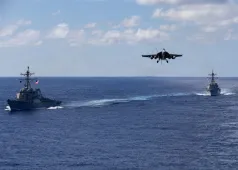
The Arleigh Burke-class guided-missile destroyers USS Mahan (DDG 72), left, and USS Bainbridge (DDG 96) sail in formation as an F/A-18 Super Hornet, assigned to Carrier Air Wing Eight embarked aboard USS Gerald R. Ford (CVN 78), descends on final approach to land on the aircraft carrier, Nov. 13, 2025. (Photo by Petty Officer 2nd Class Triniti Lersch)
A bid protest filed by GDIT claimed that DISA did not conduct adequate market research before awarding a sole-source contract to Leidos for the program.
Department of War Chief Information Officer Kirsten Davies delivers remarks at a CIO town hall at the Mark Center, Alexandria Va., Feb. 10, 2026. (DoD photo by U.S. Navy Petty Officer 1st Class Alexander Kubitza)