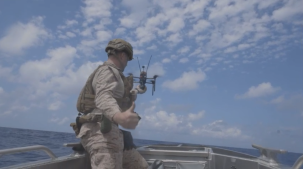
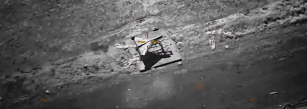
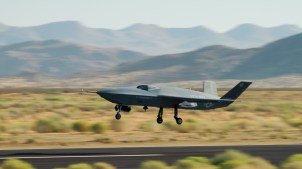
Screenshot from a video of U.S. Marines with Expeditionary Operations Training Group, III Marine Expeditionary Force testing Marine-Build drones off the coast of Naval Base White Beach, Okinawa, Japan, March 22, 2026. The training was part of the EOTG Unmanned Systems Branch, which seeks to teach Marines in basic drone operations, capabilities, and assembly. (U.S. Marine Corps video by Cpl. Giovanni Navarrette)
Marines with III Expeditionary Operations Training Group out of Okinawa, Japan, designed the unmanned surface vessel themselves, officials said, then blew it up with a drone.
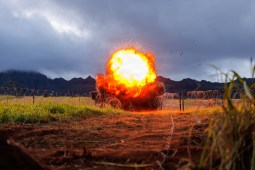
U.S. Soldiers assigned to the 95th Clearance Company, 84th Engineer Battalion, 130th Engineer Brigade, 8th Theater Sustainment Command, conduct live-fire and breach training during a demolition range on Schofield Barracks, Hawaii, March 26, 2026. The training enhanced Soldiers’ proficiency in obstacle reduction and explosive breaching, strengthening combat readiness and engineer capabilities in support of operations across the Indo-Pacific region. (U.S. Army photo by Sgt. Devin Davis)
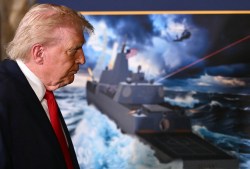
US President Donald Trump leaves after announcing the US Navy’s new Golden Fleet initiative, unveiling a new class of warships, at Mar-a-Lago in Palm Beach, Florida, on December 22, 2025. (Photo by ANDREW CABALLERO-REYNOLDS / AFP via Getty Images)
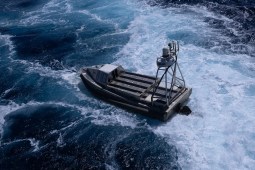
A U.S. Navy Global Autonomous Reconnaissance Craft (GARC) maneuvers in the Atlantic Ocean during UNITAS 2025, the 66th iteration of the world’s longest-running multinational maritime exercise. (Official U.S. Navy photo)
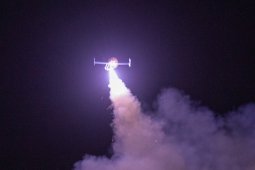
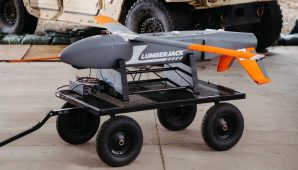
During the recent Operation Lethal Eagle, Northrop Grumman demonstrated its new Lumberjack drone and its ability to conduct autonomous target detection via the Maven Smart System.
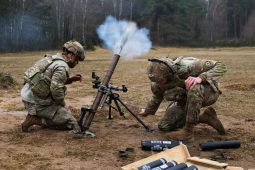
U.S. Army Staff Sgt. Freddy Muñoz and Sgt. Kory Millsap, assigned to 3rd Squadron, 2d Cavalry Regiment, engage a target using an M224A1 60mm Lightweight Mortar System from a conventional setup at Grafenwoehr Training Area, Germany, March 17, 2026. (U.S. Army Reserve photo by Sgt. Addison Shinn)
Blast overpressure, as the effect is called, is the sudden, volatile expansion of air from not only explosions, but weapon systems commonly used by ground troops.