U.S. Army Staff Sgt. Steven Walker and Sgt. Siegfred Velarde, 1st Space Brigade, U.S. Army Space and Missile Defense Command, plot points before a land navigation event during the USASMDC Best Squad Competition at Fort Bliss, Texas, July 29, 2026. (U.S. Army photo by Pfc. Lamar Green)
The Pentagon is pursuing multiple initiatives to enhance its space posture, including the Proliferated Warfighter Space Architecture and the Space Data Network.
Lt. Gen. David Miller takes part in a panel discussion at the Air, Space and Cyber Conference at National Harbor, Md. Sept 23, 2025. (U.S. Air Force photo by Andy Morataya)
The nomination comes about two weeks after Secretary of the Air Force Troy Meink announced that the U.S. military now has “on-orbit space control weapons."
As the Space Force prepares to launch the first Airborne Moving Target Indicator prototypes, the service is also working on its Ground Moving Target Indicator constellation —…
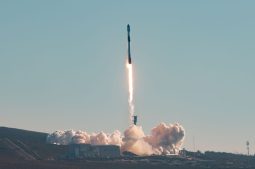
SpaceX Falcon 9 launches the Space Development Agency T1TL-C mission to low-Earth orbit from Space Launch Complex 4E at Vandenberg Space Force Base, Calif., Oct. 15., 2025. Beginning in 2027, T1 will provide initial warfighting capability to deliver regional persistence for tactical military data channels, along with advanced missile tracking and missile warning, and beyond-line-of-sight targeting plus demonstration of UHF and S-band tactical satellite communications. (U.S. Space Force photo by 2nd Lt. Andrew Taller)
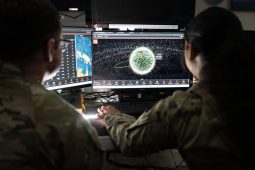
U.S. Space Force Guardians assigned to Space Delta 5 monitor computer workstations Dec. 18, 2025, at Vandenberg Space Force Base, Calif. (Photo by David Dozoretz)
Troy Meink appears before the Senate Armed Services Committee for his nomination to be secretary of the Air Force in Washington, D.C., March 27, 2025. (DoD photo by EJ Hersom)
Director of Golden Dome for America (GDA) Gen. Mike Guetlein receives a briefing on the Terminal High Altitude Area Defense (THAAD) system at a THAAD site in Dededo, Guam, July 16, 2026. Task Force Talon, composed of Soldiers from the 38th Air Defense Artillery Brigade and the Guam National Guard, operates the THAAD missile defense system to protect the U.S. territory in the Western Pacific. The site assessment directly supports the rapid development of GDA as a next-generation, layered defense capability designed to protect and shield the Homeland against advanced ballistic, hypersonic, and cruise missile threats. (U.S. Navy photo by William J. Busby III)