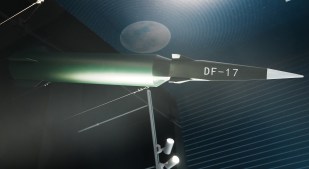
The DF-17 hypersonic medium range conventional ballistic missile model was exhibited at the Hangzhou Innovation Research Institute of Beihang University in Hangzhou, Zhejiang Province, China on May 10, 2026. (Photo credit: CFOTO/Future Publishing via Getty Images)
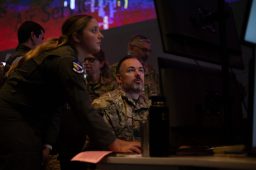
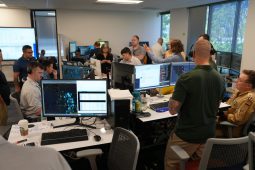
U.S. Air Force airmen, U.S. Space Force guardians, and industry partners participate in the Department of the Air Force’s Multi-Decision Advantage Sprint for Human-Machine Teaming experiment led by the Advanced Battle Management System Cross-Functional Team in partnership with the Air Force Research Lab, the U.S. Space Force, and the 805th Combat Training Squadron, in Las Vegas, Nev., May 13, 2026. This user-producer co-creation environment allows operators to provide immediate feedback to developers, significantly accelerating the software development cycle for the joint force. (The image has been cropped to focus on the subjects.) (U.S. Air Force photo by Deb Henley)
The Multi-Decision Advantage Sprint for Human-Machine Teaming wargame demonstrated that AI tools can significantly improve the Air Force's command-and-control operations.
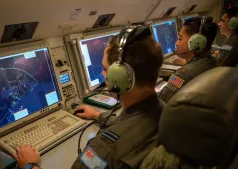
U.S. Air Force Maj. Oliver Ngayan, 2 Squadron E-7A Wedgetail air battle manager, performs a system check at Royal Australian Air Force Base Darwin, Australia, July 18, 2024. (U.S. Air Force photo by Tech. Sgt. Jimmie D. Pike)
"Over the last few years, we’ve built out the necessary software, hardware and network infrastructure — now it’s time to test it,” Secretary of the Air Force…
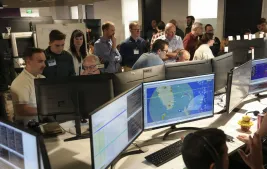
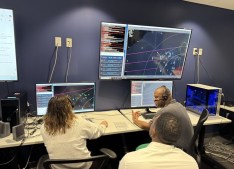
U.S. Air Force Airmen and members of the Royal Air Force participate in the Shadow Operations Center-Nellis Capstone (ShOC-N) experiment event at Nellis Air Force Base, Nevada, Nov. 17-21, 2025. (U.S. Air Force photo by Airman 1st Class Jennifer Nesbitt) (Documents blurred for security purposes.)
“This integration revealed new insights on how AI and machine learning can support diverse tactics and align exercises with [Combined Joint All-Domain Command and Control] goals,” 805th…
The 805th Combat Training Squadron and members of industry gather to participate in the second Decision Advantage Sprint for Human-Machine Teaming wargame in July 2025. (U.S. Air Force photo by Debora Henley.)
The Air Force's second Decision Advantage Sprint for Human-Machine Teaming wargame focused on testing AI-enabled microservices for "match effectors" tasks.
System Delta 85 will focus on delivering capabilities under the mission area for battle management, command, control, communication and space intelligence.
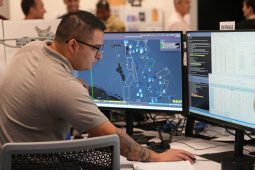
An air battle manager participants in the 805th Combat Training Squadron’s second Decision Advantage Sprint for Human-Machine Teaming wargame in July 2025. (U.S. Air Force photo by Debora Henley.)
"We’re physically … stressing the battle managers into making decisions, and then having companies observe what they’re doing and then trying to develop microservices that improve the…
U.S. Air Force air battle managers participate in the Department of the Air Force’s Advanced Battle Management System Cross-Functional Team first Decision Advantage Sprint for Human-Machine Teaming, or DASH, experiment, recently held at the Howard Hughes Operations, or H2O, Center in Las Vegas, Nev., April 8, 2025. This two-week event brought together operational warfighters and industry and Shadow Operations Center-Nellis software developers to prototype microservices aimed at accelerating and improving decision-making in high-tempo battle management scenarios framed by the Transformational Model. (U.S. Air Force photo)
The Air Force's Transformational Model for Decision Advantage is serving as the foundation for a number of ongoing experiments focused on supporting the Pentagon's broader Combined Joint…
U.S. airmen participate in the Tactical Operations Center-Light experiment at the 805th Combat Training Squadron, also known as the Shadow Operations Center – Nellis, Capstone 24A experimentation event at Nellis Air Force Base, Nevada, June 28, 2024. (U.S. Air Force photo by Keith Keel)
An F-16 Fighting Falcon from Eglin Air Force Base flies over a high school football game in Niceville, Fla., Sept. 24, 2021. (U.S. Air Force photo by Master Sgt. Tristan McIntire)