U.S. Undersecretary of Defense for Policy Elbridge Colby attends an International commemorative ceremony for the 82nd anniversary of the World War II “D-Day” Normandy landings in Langrune-sur-Mer, northwestern France, of June 6, 2026. (Photo by LOU BENOIST / AFP via Getty Images)
The COPA initiative allows for the issuance of cash bonuses up to $2,500 to eligible troops to “recognize exceptional contributions rooted in novel actions, inventions, or technical…
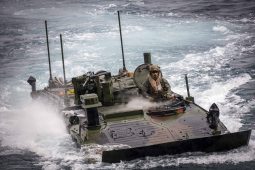
U.S. Marines assigned to Battalion Landing Team 2/4, 13th Marine Expeditionary Unit, conduct amphibious combat vehicle qualifications, during routine operations and integrated training off the coast of California, June 24, 2026. (U.S. Marine Corps photo by Sgt. Mary R. Jenni)
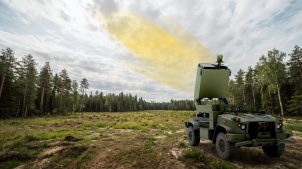
The Marine Corps plans to integrate an unspecified number of Pulsar-L systems into its Amphibious Combat Vehicle fleet at a time when armored vehicles have proven vulnerable…
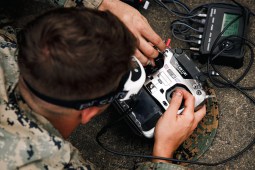
U.S. Marine Corps Lance Cpl. Christian Gillham, a mortarman and team leader with 3rd Littoral Combat Team, 3rd Marine Littoral Regiment, 3rd Marine Division, flies a first-person view unmanned aircraft system for a long-range simulated strike during the Marine Corps Attack Drone Competition at Marine Corps Base Quantico, Virginia, Aug. 11, 2026. (U.S. Marine Corps photo by Cpl. Joshua Barker)
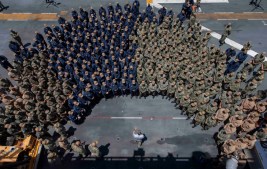
Hung Cao, Acting Secretary of the Navy (SECNAV), speaks to the crew of Wasp-class amphibious assault ship USS Makin Island (LHD 8) during an all-hands call on the flight deck, Aug. 7, 2026. SECNAV was recently in San Diego visiting various commands to speak with Sailors and their families, focusing on his top priority, “taking care of our people.” (U.S. Navy photo by Mass Communication Specialist Seaman Pheona David)
Hung Cao warned sailors, Marines and Navy civilians about a "deliberate effort to gather intelligence, test our defenses, disrupt our operations, and intimidate our force."
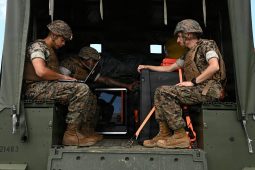
U.S. Marines with Intermediate Repair Company, 3rd Maintenance Battalion, 3rd Marine
Logistics Group, prepare to test print on-the-move capabilities during Valiant Shield 26 on Camp
Kinser, Okinawa, Japan, June 22, 2026. (U.S. Marine Corps photo by Cpl. Rachel
Mason)
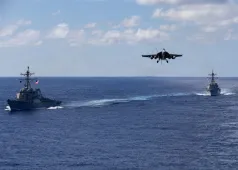
The Arleigh Burke-class guided-missile destroyers USS Mahan (DDG 72), left, and USS Bainbridge (DDG 96) sail in formation as an F/A-18 Super Hornet, assigned to Carrier Air Wing Eight embarked aboard USS Gerald R. Ford (CVN 78), descends on final approach to land on the aircraft carrier, Nov. 13, 2025. (Photo by Petty Officer 2nd Class Triniti Lersch)
After Marine Corps testing, Epirus hopes the service will adopt HAVOC “more widespread” and has prepared its facilities for low-rate production amid business with the Army and…
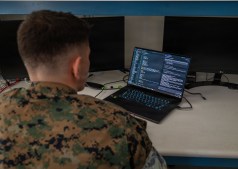
While developing Odyssey, NPS computer science student U.S. Marine Corps Capt. Kyle Hicks turned to AI to write most of the code powering the application. Hicks’ Odyssey exemplifies the broader applications of AI in the U.S. Department of War, supporting the day-to-day work of service members across the force, from writing awards to managing projects to analyzing data. (U.S. Navy photo by Mass Communications Specialist Seaman Katherine Eldridge)
The hackathon is intended to deliver “tangible products that are useful across the enterprise and immediately deployed or adopted for further refinement,” according to an administrative message.
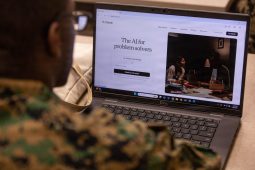
A Marine assigned to Wounded Warrior Battalion West as a recovering service member uses an artificial intelligence (AI) tool for resume writing during aboard Marine Corps Base Camp Pendleton, California, Feb. 26, 2026. (U.S. Marine Corps photo by Cpl. Anthony C. Ramsey Jr.)
A Marine Corps spokesperson said there are no rank requirements to participate in the hackathon and that judges will be a mix of military, government civilian and…
U.S. Marines with Marine Forces Special Operations Command take part in a live fire training exercise at an undisclosed location, March 30, 2026. (U.S. Marine Corps photo by Lance Cpl. Frank Sepulveda Torres)