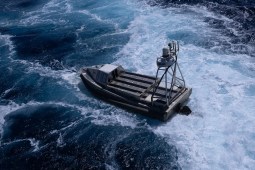
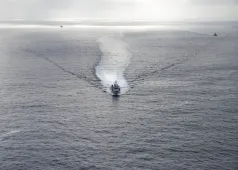
A U.S. Navy Global Autonomous Reconnaissance Craft (GARC) maneuvers in the Atlantic Ocean during UNITAS 2025, the 66th iteration of the world’s longest-running multinational maritime exercise. (Official U.S. Navy photo)
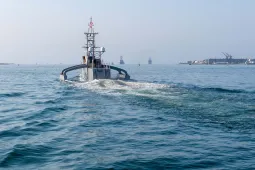
Seahawk, a Medium Unmanned Surface Vessel (MUSV) prototype, departs Naval Base Point Loma, California, Aug. 6, 2025. (U.S. Navy photo by Mass Communication Specialist 1st Class Robert Zahn)
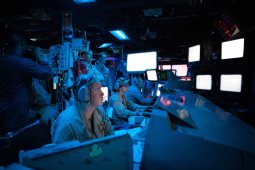
Sailors assigned to the Arleigh Burke-class guided-missile destroyer USS Carney (DDG 64) stand watch in the ship’s Combat Information Center during an operation in the Red Sea to defeat a combination of Houthi missiles and unmanned aerial vehicles, Oct. 19, 2023. (U.S. Navy photo by Mass Communication Specialist 2nd Class Aaron Lau)
Applied Intuition has delivered the first Data Edge Collection Kit to the Navy, which will allow the service to constantly collect AI-ready data from the operational environment.
Lt. Elliot Reed, right, assigned to Air Department aboard the world’s largest aircraft carrier, USS Gerald R. Ford (CVN 78), signals to a Carrier Air Wing 8 F/A-18E Super Hornet, attached to Strike Fighter Squadron 87, as it launches from the flight deck, July 14, 2025. (U.S. Navy photo by Mass Communication Specialist 2nd Class Tajh Payne)
PACIFIC OCEAN (June 22, 2022) The large unmanned surface vessel Nomad, front, medium displacement unmanned vessel Sea Hunter, right, and large unmanned surface vessel Ranger transit the Pacific Ocean to participate in Exercise Rim of the Pacific (RIMPAC) 2022. (U.S. Navy photo by Mass Communication Specialist 1st Class Tyler R. Fraser)