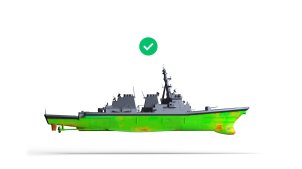
Modern technologies, such as robotics, advanced sensors, and data-driven analysis, fundamentally change how quickly and accurately we can understand the health of ships.
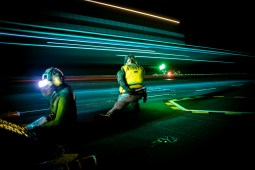
Lt. Elliot Reed, right, assigned to Air Department aboard the world’s largest aircraft carrier, USS Gerald R. Ford (CVN 78), signals to a Carrier Air Wing 8 F/A-18E Super Hornet, attached to Strike Fighter Squadron 87, as it launches from the flight deck, July 14, 2025. (U.S. Navy photo by Mass Communication Specialist 2nd Class Tajh Payne)
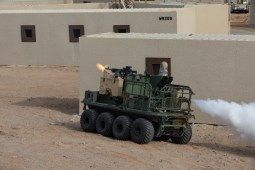
A U.S. Army unmanned, eight-wheeled, all-electric, all-terrain transport vehicles armed with the R600 autonomous weapon system provides support to dismounted Soldiers in an urban environment as part of a human integration experiment at Fort Irwin, Calif., March 17, 2024. (U.S. Army photo by Spc. Samarion Hicks)
As the Army looks to scale its transforming-in-contact initiative to divisions and heavy brigades, it plans to experiment more with robotics and autonomy technology.
Andrew Moore has been hired to serve as the first-ever U.S. Central Command advisor for artificial intelligence, robotics, cloud computing and data analytics.