Lithuania invests in tech to counter intensifying hybrid balloon threats
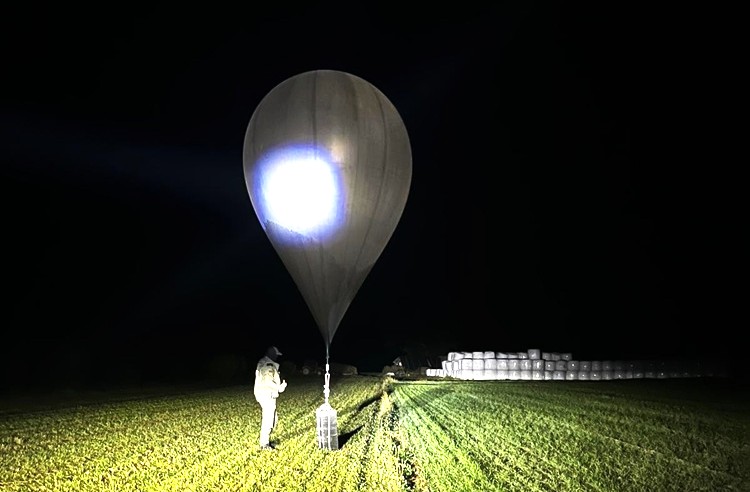
Lithuania’s government is investing heavily in defense technology and surveillance systems via a strategic security plan to thwart what it views as escalating hybrid attacks involving balloons and drones from Russia-allied Belarus, which rejects allegations of wrongdoing.
While those neighboring nations established diplomatic relations in the early 1990s after the Soviet Union dissolved, their modern relationship is increasingly tense. Lithuania declared a national emergency this week, due to threats from meteorological balloons that it says violated its airspace and were sent from Belarus.
“A comprehensive set of measures has been taken to counter and mitigate the threat, based on the safety-first approach,” an official in the Lithuanian Ministry of Foreign Affairs Communication Department told DefenseScoop.
Belarus and Russia share close ties, and the two are deeply integrated politically, economically and militarily. Particularly since Russia’s large-scale invasion of Ukraine in 2022, Lithuania and other European Union countries in the region have accused Russia and Belarus of various instability-triggering hybrid warfare activities — like cyberattacks and manufacturing migration crises by surging people from Africa, Asia and the Middle East to their borders.
In recent years, both Belarus and Lithuania have housed the other’s political opposition figures and exiles. The two countries’ relations seriously soured in 2020, when Alexander Lukashenko was declared winner of the Belarusian presidential election for a sixth term.
Those results were widely condemned and sparked historic anti-government protests in Belarus.
Lukashenko’s primary challenger Sviatlana Tsikhanouskaya and others fled to Lithuania and elsewhere in the wake of that election. In 2021, Belarusian security forces forced the landing of a plane flying over its territory — resulting in Lithuania, Poland and other European Union countries responding with sanctions.
Months later, Belarus allegedly initiated an operation that Lithuania says is still underway today.
“The launch of air balloons, disguised as tobacco smuggling, is just one line of action of an ongoing Belarus hybrid campaign against the EU. Since 2021, Belarus has been instrumentalizing migration to undermine security of the EU’s Eastern border and put our societies and governments under pressure,” the official in the Lithuanian MFA Communication Department said in an interview over email.
More than 1,000 individuals were denied entry to Lithuania so far this year, they noted. Further, in November, Belarus authorities detained EU-registered cargo trucks and banned them from leaving the territory.
The Lithuanian official told DefenseScoop that the intelligence agency known as the Belarus KGB is also after its government’s political opponents and civil society activists who are sheltering in Lithuania, including through acts of vandalism, physical and online aggression, detentions at the border and measures against their relatives remaining in the country — and other moves “to intimidate people and impose acquiescence.”
“The primary objective of these attacks is to get lifted the EU sanctions imposed on Belarus for repression, human rights violations, and complicity in Russia’s military aggression against Ukraine,” the official said. “As long as the reasons mentioned above have not disappeared, Lithuania will continue to support the sanction regime against Belarus.”
There have been multiple reports of dangerous intrusions into NATO airspace since the start of the war in Ukraine.
The national emergency Lithuania declared this week came after the country was forced to repeatedly shut down its main airport, stranding thousands of passengers, due to massive balloons interfering with flight paths. Under the order, its military has additional rights from parliament and the ability to patrol the border area together with other uniformed services.
“Since Vilnius international airport is located only within 30 km [around 19 miles] from the border with Belarus, the balloons frequently approach the safety zone around the airport, posing a risk to aviation safety,” the Lithuanian MFA official told DefenseScoop. “From October to December, the airspace restrictions around Vilnius airport (and once around Kaunas airport) were introduced during the evening peak air traffic hours, on average, on 1 in 4 days, for a total of 15 times. This affected more than 320 flights and over 45,000 passengers — about 5% of the total at Vilnius airport.”

They said that, more recently, the campaign has pivoted to using balloons that are bigger than those of meteorological types — and are filled with more gas to reach higher altitudes and fly longer distances.
“This makes it even more challenging to intercept and locate the balloons. Shooting down balloons while airborne carries a risk of high unintended consequences,” the official explained.
The balloons present the immediate potential to pose harm to civilian aviation safety. They can also be equipped with sensors and other capabilities to probe air-defense gaps or conduct overhead surveillance operations.
According to the official, high numbers of balloons entering Lithuania’s airspace from Belarus have been registered since July 2024 — with a total of 94 cases that month. Since then, the average monthly number of balloons remained high, albeit starkly fluctuating each week, depending on the weather conditions.
“Initially the use of balloons may have been adopted by smuggling networks to transport tobacco across the border to the EU market — [so] the air balloons entering Lithuania’s airspace carry a load of cigarettes. However, in tightly controlled authoritarian Belarus it is hardly possible to launch balloons from areas adjacent to the state border in a regular manner and at massive scale without the acquiescence of local authorities,” the official said.
They noted that the Belarusian regime, “including Lukashenko himself,” have repeatedly denied the smuggling concerns and have not supported actions to stop it.
“The complicity of the state of Belarus became apparent when from [Nov. 30 to Dec. 1] balloons were coming from a particular area in Belarus, [at a time when the wind carried] them exactly towards the Vilnius airport safety zone — and balloons were launched at multiple intervals to keep the air traffic disrupted for as long as possible,” the Lithuanian government official said. “This type of pattern has nothing to do with smuggling. It’s a hybrid attack by Belarus.”
Airport activity was suspended for a total of almost 12 hours during the course of that incident.
In response to questions from DefenseScoop on the balloon-related risk allegations from Lithuania, an official from the Embassy of Belarus in the U.S. said: “The topic is moot. I will provide no comment.”
They referred the publication to a recent statement from Lukashenko denying the Lithuanian government’s accusations and calling them “exaggerated and politicized.”
Meanwhile, during a meeting in Brussels earlier this month, NATO foreign ministers discussed near-term implementation of defense and deterrence moves and the military alliance’s reaction to growing hybrid threats to member nations near Russia.
“We are under attack with the different forms of hybrid activities from Russia, and its accomplice, Belarus, including the GPS jamming and spoofing, [and] launching meteorological balloons that are now disrupting civil aviation operations and pose a real threat to our critical infrastructure,” Lithuania’s Foreign Minister Kęstutis Budrys told reporters ahead of that meeting.
Notably, the Lithuanian Ministry of the Economy and Innovation recently announced and awarded a €1 million (euros) prize fund for commercial projects that involve shooting down balloons with lasers, interceptor drones, a blimp system, or other technological solutions to help secure its airspace.
Three proposals were tapped for further development this month.
“These include the development and application of such technologies as fixed-wing aircraft capable [of operating] at high altitude in combination with high-speed low-altitude airplanes; integrated laser-optical sensors and high-power lasers; artificial intelligence; networked sensors, interception drones and [command and control] hubs; and dirigible type of aerostats,” the Lithuanian MFA communications official said.
Beyond that, the nation is unveiling a range of efforts to protect against hybrid assaults.
Some of those include adjusting its flight paths and shifting capacities, pursuing diplomatic measures, and exploring further sanctions at the international level.
“Lithuania has requested a NATO Counter Hybrid Support Team deployment,” the government official also told DefenseScoop.