British company tops leaderboard for Pentagon’s Drone Dominance Program

A U.K.-based unmanned aerial system manufacturer claimed the top spot in the first round of the Pentagon’s Drone Dominance competition, reaping delivery orders from the Defense Department.
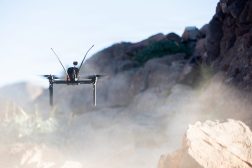
Skycutter, headquartered in London, was one of more than two dozen drone makers selected to participate in the first “Gauntlet” for the Drone Dominance Program, part of an initiative launched by Defense Secretary Pete Hegseth last year to boost the American military’s UAS arsenal.
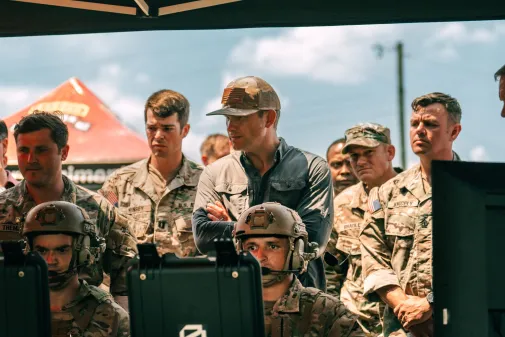
The competitors’ systems were put through their paces beginning in February at Fort Benning, Georgia, where they were evaluated by troops and other officials.
Skycutter came out on top after racking up 99.3 points, about 12 points more than Neros, which came in second place, according to results which were posted Friday on the program’s website.
Skycutter did not respond to questions from DefenseScoop on Monday prior to publication, including about which of their systems participated in the Gauntlet.
The other firms that finished in the top 11 and received UAS delivery orders from the Pentagon were Napatree, ModalAI, Auterion, Ukrainian Defense Drones (UDD), Griffon Aerospace, Nokturnal AI, Halo Aeronautics, Ascent AeroSystems and Farage Precision, according to the program website.
Drone manufacturers that participated in the event but didn’t make the cut for delivery orders included Anno AI, Draganfly, DZYNE Technologies, Ewing Aerospace, Firestorm Labs, General Cherry, GreenSight, Paladin Defense Services, Performance Drone Works, Swarm Defense Technologies, Teal Drones, Titan Dynamics, Vector Defense, W.S. Darley and XTEND Reality.
The Pentagon planned to award a total of approximately $150 million in delivery orders after the first Gauntlet for 30,000 one-way attack drones, which will be delivered to military units over the next five months, Travis Metz, the director of the Drone Dominance Program, told members of the Senate Armed Services Committee last week.
“The Gauntlet I leaderboard is not a statement about the best drones in the industry, or even the best drones in America. It is a snapshot of how the invited vendors performed against the mission vignettes designed by the warfighters. We are not buying drones based on paper requirements. We are buying drones based on how they performed in the missions,” officials wrote on the program’s website, noting that the Defense Department isn’t always comparing “apples to apples” in this effort.
“A fixed-wing drone will perform differently than a quadcopter inside a building. A drone optimized for agility may struggle in a long-range strike. Those differences are a design choice. This Gauntlet was about selecting existing technology to meet the needs of warfighters right now — not expecting all drones to do all things,” officials wrote.
Warfighter feedback factored into the scoring, with consideration given to usability, situational awareness, field practicality and warfighter preferences, according to the website.
“All new systems have a learning curve — the goal is to shorten the training timeline. A high-performance drone that is difficult to operate could score poorly compared to a less capable drone that is easier to use,” officials wrote.
Skycutter’s technology came in third place in the “military operator evaluation” portion of the scoring, behind Napatree and Neros. Skycutter was also ranked highly for its “strong” production capabilities. It came in first place in the “long-distance strike” mission category and second place in the “urban strike” mission category. It was also on the list of firms that demonstrated “partial to full success” in the “kinetic strike” mission category.
The Pentagon plans to hold three additional Gauntlets for the program. The total value of delivery orders and the number of systems purchased is expected to increase for each phase. Companies that didn’t receive delivery orders after the first Gauntlet can still compete for orders in future rounds, including firms that didn’t participate at all in the initial effort.
Hundreds of companies have applied to be part of the Drone Dominance Program, according to Pentagon Chief Technology Officer Emil Michael.