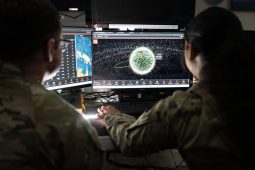
U.S. Space Force Guardians assigned to Space Delta 5 monitor computer workstations Dec. 18, 2025, at Vandenberg Space Force Base, Calif. (Photo by David Dozoretz)
Along with four new portfolio acquisition executives announced Tuesday, the Space Force is in the process of establishing three additional organizations, according to Tom Ainsworth.
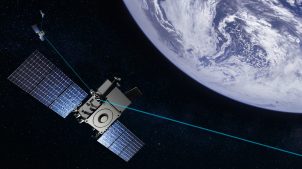
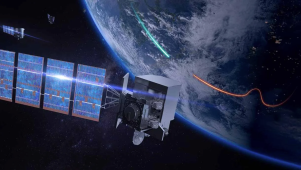
The MEO Epoch 2 mission will provide resilient, space-based missile warning and tracking of ballistic missiles and advanced threats, such as hypersonic glide vehicles. (BAE Systems photo)
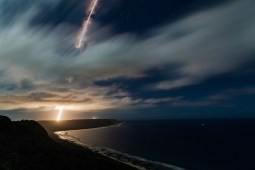
A Standard Missile-3 Block IIA is fired from a Vertical Launching System on Andersen Air Force Base, Guam as part of Flight Experiment Mission-02, on December 10, 2024. (courtesy photo/released)
The organization intends to launch selected sensor and seeker prototypes into space for a demonstration no later than two years after it contracts vendors.
Northrop Grumman’s TRKT3 will build on the Tracking Layer capabilities of Tranche 1 and Tranche 2 with targeted technology enhancements, expanded coverage and increased integration including precision fire-control sensing. (Photo Credit: Northrop Grumman)
The Tranche 3 tracking layer will comprise 72 satellites to provide near-continuous global coverage, with half featuring payloads able to create fire-control data.
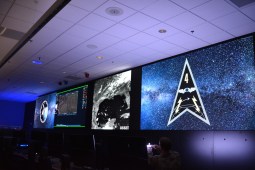
Located in the Mission Control Station at Buckley Space Force Base, Colorado, the Overhead Persistent Infrared (OPIR) Battlespace Awareness Center (OBAC) provides near-real-time OPIR data exploitation products that deliver situational awareness to Space Delta 4 operators and other users. (Space Force photo)
Space Systems Command expects to continue delivering new capabilities for the Future Operationally Resilient Ground Evolution (FORGE) on a yearly basis, according to the program's executive officer.
“Moving forward, we see there are a lot of niche missions where the fine line between what is the tracking mission and what becomes the custody mission…
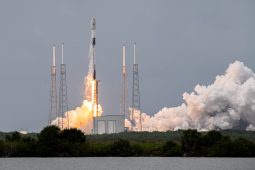
A Falcon 9 rocket carrying 85 commercial and government spacecraft and 3 Starlink satellites launches from Cape Canaveral on June 30, 2021. (U.S. Space Force photo by Airman 1st Class Dakota Raub)
The plan highlights the DOD’s embrace of proliferated low-Earth orbit (LEO) satellite architectures, which officials view as more resilient than the larger, more expensive spacecraft that currently…