The Pentagon is pursuing multiple initiatives to enhance its space posture, including the Proliferated Warfighter Space Architecture and the Space Data Network.
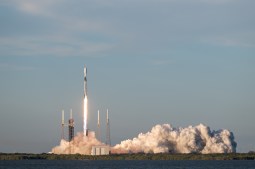
SpaceX Falcon 9 launches the Space Development Agency T1TL-C mission to low-Earth orbit from Space Launch Complex 4E at Vandenberg Space Force Base, Calif., Oct. 15., 2025. Beginning in 2027, T1 will provide initial warfighting capability to deliver regional persistence for tactical military data channels, along with advanced missile tracking and missile warning, and beyond-line-of-sight targeting plus demonstration of UHF and S-band tactical satellite communications. (U.S. Space Force photo by 2nd Lt. Andrew Taller)
Formerly known as MILNET, the Space Data Network Backbone constellation will provide backhaul communications to facilitate data transfer for the Pentagon.
A Space X Falcon 9 rocket launches from Space Launch Complex 40 at Cape Canaveral Space Force Station, Florida, Feb. 14, 2024. The rocket was launched as part of classified mission USSF-124, sending six satellites to orbit – two for the Missile Defense Agency and four for the Space Development Agency. (U.S. Space Force photo by Airman 1st Class Spencer Contreras)
The Space Data Network has multiple components and will support a number of Pentagon-wide efforts, including the Golden Dome for America missile defense architecture.
A Standard Missile-3 Block IIA is fired from a Vertical Launching System on Andersen Air Force Base, Guam as part of Flight Experiment Mission-02, on December 10, 2024. (courtesy photo/released)
The organization intends to launch selected sensor and seeker prototypes into space for a demonstration no later than two years after it contracts vendors.