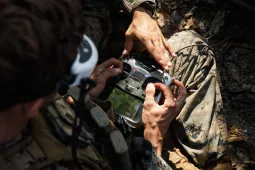
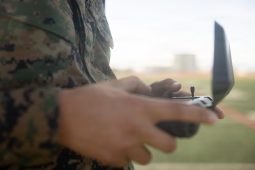
U.S. Marine Corps Staff Sgt. Allen Steele III, a light armored reconnaissance master gunner with LAR Company F, 4th Light Armored Reconnaissance Battalion, 4th Marine Division, conduct a kinetic strike rehearsal during the Marine Corps Attack Drone Competition at Marine Corps Base Quantico, Virginia, Aug. 13, 2026. (U.S. Marine Corps photo by Cpl. Joshua Barker)
Defense officials have touted competitions as a way to test new systems, share tactics across the force, identify talent and grow an institutional focus toward small drones…
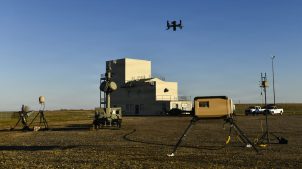
An Anvil drone interceptor launches from its platform in response to a drone threat during an exercise at Minot Air Force Base, N.D., Oct. 24, 2025. The Anvil is an autonomous drone that, when prompted by an operated, can detect, track and classify a threat, and, if required, mitigate the threat with a non-kinetic, low-collateral defeat option. The fly-away kit, shown here, includes the Anvil launch box, mobile sentry trailer; two Wisp wide-area infrared systems; two Pulsar electromagnetic warfare systems; and command-and-control software called Lattice. (Department of Defense photo by John Ingle)
A U.S. Sailor, assigned to Strike Fighter Squadron 31, serves as a medical safety observer on the flight deck of the USS Gerald R. Ford (CVN 78), while underway, March 17, 2026. (U.S. Navy photo)
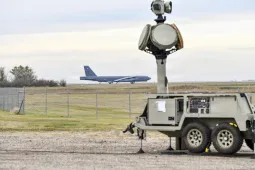
A B-52 Stratofortress from the 5th Bomb Wing taxis at Minot Air Force Base, N.D., Oct. 26. 2025. The U.S. Northern Command Counter-small Unmanned Aerial System fly-away kit, seen in the foreground, and operators were rapidly deployed to the North Dakota base as part of an exercise to demonstrate the command’s ability to quickly support installation commander experiencing a drone incursion. (Department of Defense photo by John Ingle)
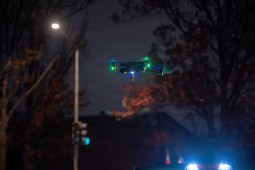
An unmanned aerial system hovers in the airspace above Fort McNair, Washington, D.C., during a Joint Interagency Task Force (JIATF) 401 counter-UAS (c-UAS) exercise Nov. 17-21, 2025. The exercise prepared military personnel to detect, identify, and neutralize such as those seen hovering. (U.S. Army photo by Sgt. Wesley Domalewski)
U.S. Marine Corps Lance Cpl. Lilly Sharma, a small unmanned aircraft system operator, with 12th Littoral Combat Team, 12th Marine Littoral Regiment, 3rd Marine Division, operates a Skydio X2D during a small unmanned aerial systems training (sUAS) on Camp Hansen, Okinawa, Japan, Nov. 6, 2025. (U.S. Marine Corps photo by Lance Cpl. Robert Blanks)
While the military boosts already-established UAS roles and inter-service job transfers, multiple services have begun to put drones into the hands or on the minds of its…
U.S. Marine Corps Cpl. Brian Kimani, a Kenya native, and a crew chief with Alpha Company, 2nd Assault Amphibian Battalion, 2nd Marine Division, launches a RQ-20B Puma unmanned aircraft system during a gunnery qualification range on Marine Corps Base Camp Lejeune, North Carolina, Jan. 23, 2026. (U.S. Marine Corps photo by Lance Cpl. Preston Morris).
In the request for information, officials wrote that the drone should be able to launch from stationary and mobile platforms, such as amphibious ships.
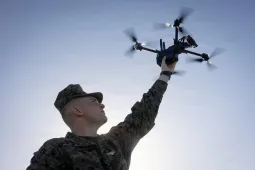
A U.S. Marine with III Marine Expeditionary Force familiarizes himself with maneuvering drones during the Marine Corps Attack Drone Competition on Camp Schwab, Okinawa, Japan, Dec. 7, 2025. During a two-week period, the Marine Corps Attack Drone Team trained and certified 3rd Marine Division Marines as attack drone operators, attack drone instructor, and payload specialist instructors, increasing the Division’s lethality and capacity of trained and certified attack drone operators and instructors. (U.S. Marine Corps photo by Cpl. Joaquin Dela Torre)
U.S. Marine Corps Lance Cpl. Zachary Voorhees, a small unmanned aircraft system operator with 2nd Battalion, 7th Marines operates a Skydio X2D during a small unmanned aerial systems training (sUAS) on Camp Hansen, Okinawa, Japan, Nov. 6, 2025. (U.S. Marine Corps photo by Lance Cpl. Robert Blanks)
Over the last year, the amphibious service has expanded its drone efforts through procurement, training, experimentation and testing in hopes of making unmanned systems ubiquitous across the…