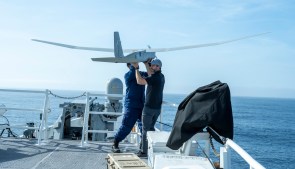
Coast Guard members conduct Unmanned Aircraft Systems (UAS) training aboard Cutter Robert Ward (WPC 1130) off the coast of San Pedro, Dec. 18, 2025. (U.S. Coast Guard photo by Petty Officer 3rd Class Roberto Nieves)
The technologies and services would be intended to help with the surveillance, detection, classification and identification of maritime “targets of interest."
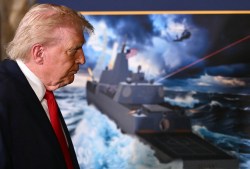
US President Donald Trump leaves after announcing the US Navy’s new Golden Fleet initiative, unveiling a new class of warships, at Mar-a-Lago in Palm Beach, Florida, on December 22, 2025. (Photo by ANDREW CABALLERO-REYNOLDS / AFP via Getty Images)
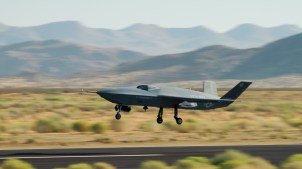
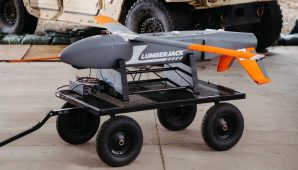
During the recent Operation Lethal Eagle, Northrop Grumman demonstrated its new Lumberjack drone and its ability to conduct autonomous target detection via the Maven Smart System.
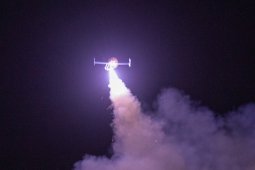
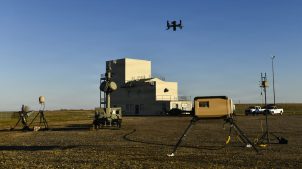
An Anvil drone interceptor launches from its platform in response to a drone threat during an exercise at Minot Air Force Base, N.D., Oct. 24, 2025. The Anvil is an autonomous drone that, when prompted by an operated, can detect, track and classify a threat, and, if required, mitigate the threat with a non-kinetic, low-collateral defeat option. The fly-away kit, shown here, includes the Anvil launch box, mobile sentry trailer; two Wisp wide-area infrared systems; two Pulsar electromagnetic warfare systems; and command-and-control software called Lattice. (Department of Defense photo by John Ingle)
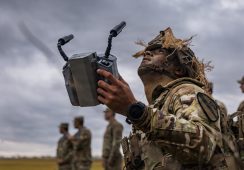
A soldier assigned to 1st Cavalry Division uses a drone on the Hunter/Killer lane during the U.S. Army Best Drone Warfighter Competition on Feb. 18, 2026, in Huntsville, Alabama. (U.S. Army photo by Spc. Michelle Lessard-Terry)
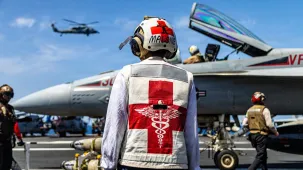
A U.S. Sailor, assigned to Strike Fighter Squadron 31, serves as a medical safety observer on the flight deck of the USS Gerald R. Ford (CVN 78), while underway, March 17, 2026. (U.S. Navy photo)