With Trump-NATO deal on Greenland unclear, experts push allies to expand Arctic drone presence
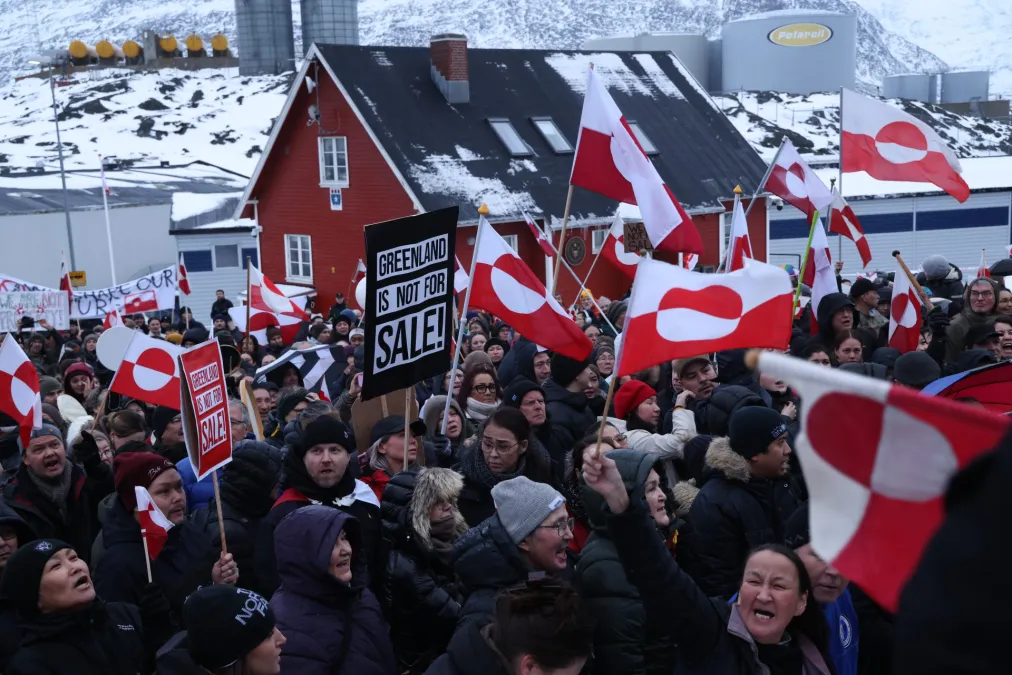
After a renewed push from President Donald Trump for America to annex Greenland from Denmark, NATO reportedly agreed on a “framework of a future deal” this week that could involve potential U.S. rights over the Arctic island’s critical minerals, as well as new collaboration associated with the Trump administration’s proposed Golden Dome missile defense system.
This in-the-works proposal also introduces new potential for NATO to expand its technological presence and influence in Greenland and elsewhere around the High North, according to experts at the Center for European Policy Analysis.
“We knew before recent discussions in the political sphere [that the Arctic] is strategic and important for NATO. It’s no longer an afterthought. Certainly, the events of the last several weeks have brought that to the forefront. But it’s a critical operational area,” Gordon “Skip” Davis Jr. said Thursday.
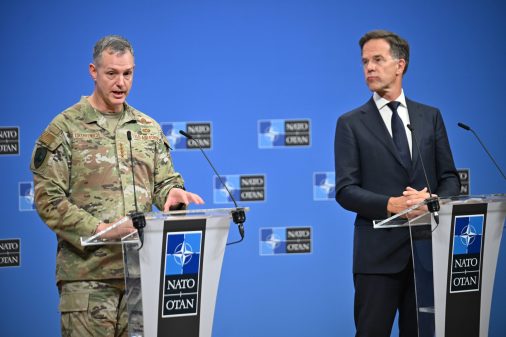
Davis is a retired U.S. Army major who recently served as NATO’s deputy assistant secretary general for the Defense Investment Division and is currently a senior fellow at CEPA. He and a panel of Arctic and defense experts briefed reporters on CEPA’s latest findings in the recently released study, “High Stakes in the High North.”
Consistent with NATO’s format, the panelists used the terms “High North” and “Northern Flank” interchangeably to denote the portion of the strategic Arctic area encompassing the North Atlantic and regions within and close to the Arctic Circle, including the territories of Canada, the U.S., Iceland, Denmark (via Greenland), Norway, Sweden and Finland.
They used “Arctic” and “Arctic region” to reflect all land and ocean in the polar region, including Russian territories.
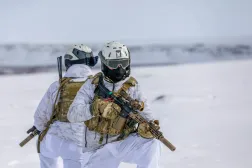
Their report broadly argues that — at a time when melting ice is opening up new sea routes and resource access, militaries are building up and increasingly exercising, and tensions are escalating between multiple big-power rivals operating there — uncrewed systems can enhance NATO’s strategic awareness, secure critical infrastructure, and expand patrols in disputed areas or places where steady physical human presence is not practical.
However, officials warn, multiple factors are contributing to what is currently a “limited” list of options for NATO-certified Arctic-ready drones.
“The challenge for NATO is not inventing new technology. It is maturing so fast, and there’s so many things offered or in-development right now, that the real challenge is integrating and scaling what already exists, and putting that into an integrated structure for credible deterrence and defense,” Davis noted.
Thursday’s briefing came amid heightened geopolitical tensions in the Arctic. China, Russia and the U.S. have been pursuing disruptive and assertive moves around the region, which they view as advantageous for certain raw materials and geographic influence.
While panelists primarily focused on areas of challenges and opportunities for NATO to embed drones into Arctic defense and security operations, they also spotlighted how the platforms can serve as a force multiplier for the alliance against challenges that accompany monitoring and defending sovereignty in the region — and explicitly around Greenland amid Trump’s impending deal.
“The Danes and the Canadians, they’re already doing some patrols. You hang out in the terrain, you ski over it in a specific pattern. Just claiming, ‘this is Canada,’ or ‘this is Greenland, Denmark and so forth.’ Drones can extend that coverage,” said Jan Kallberg, a senior fellow at CEPA and fellow at the Army Cyber Institute at West Point.
He also suggested that underwater, submarine-type drones make sense for NATO to deploy around Greenland to monitor Russia’s Northern Fleet. Because of the nature of intense Arctic environments, military operations there require robust equipment and a specific know-how that only a handful of NATO allies have.
Minna Ålander, CEPA fellow and analyst at the Swedish Institute of International Affairs, pointed out that NATO’s Task Force X has already started experimenting with uncrewed maritime systems to improve the alliance’s ability to track subsea activity and deny acts of hybrid warfare including adversaries cutting underwater cables in the Baltic Sea and Arctic.
“[Beyond Greenland] the North Atlantic is full of really important sort of, like, lifelines of communication and infrastructure. And [certain allies] most definitely do not have the capacity to monitor all of this. So these [uncrewed] systems can really help — especially smaller nations that don’t have the human resources to man monitoring assets and so on. So there is a lot of potential here in those terms,” Ålander said.
On the possibility of growing alliance-enabling missions in Greenland, she pointed to some existing “blueprints.”
“For example, right now NATO is building up the forward land force in Finland, which is, by the way, entirely a European effort. So, it’s going to be a contingency consisting of contributions from the Nordic countries, Canada, Germany, France, the U.K. and Italy. And of course, something like that could be potentially sort of a solution for Greenland as well,” Ålander told reporters.