NATO rewriting integrated air defense plans for the first time in decades, SACEUR says
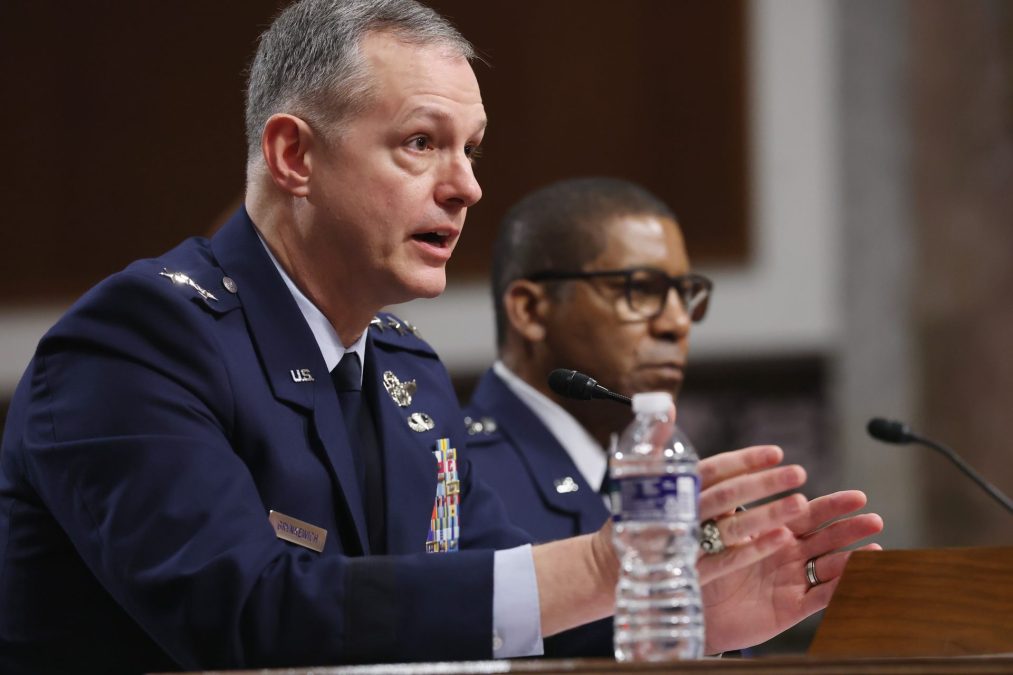
NATO is reshaping its integrated plans for defending alliance territory against drones, ballistic missiles, and other aerial threats, according to Gen. Alex Grynkewich, the Supreme Allied Commander Europe and commander of U.S. European Command.
Testifying before the Senate Armed Services Committee on Thursday, Grynkewich and Gen. Randall Reed, who leads U.S. Transportation Command, shared new details about those and other adjustments the joint force and its allies are making to implement lessons emerging from modern military conflicts erupting in different regions around the world.
“The Russian war economy is in high gear, if you will,” Grynkewich told lawmakers. “So, in terms of missile production and [unmanned aerial vehicle] production, my assessment is that they have the capacity in their defense industrial base to continue with high levels of production.”
This hearing comes as the U.S. and Israel are about two weeks into battle with Iran amid Operation Epic Fury, risks posed by China are intensifying across warfighting domains, and the high-casualty war between Russia and Ukraine enters its fifth year.
There’s been a “fairly robust amount of” so-called hybrid attacks from Russia — including efforts involving sabotage and disruptive information operations — in the Baltics and Poland over the last several months since he’s taken command, the SACEUR noted.
Broadly, such operations enable Russia to stay below the threshold of NATO’s Article 5 collective‑defense clause, while targeting military and civilian infrastructure to gauge allies’ responses and capabilities.
In response to a recent hybrid warfare involving alleged Russian drone incursions into Poland that sparked a potentially historic activation of NATO’s air defenses in September, several allies launched Eastern Sentry to surge weapons and troops to the east.
The alliance’s eastern flank extends from the Baltic Sea in the north to the Black Sea in the south.
“As you probably recall, Dutch F-35s who were operating under NATO command-and-control were able to shoot down several of those drones that came into the Polish airspace. Since then, the alliance has established Eastern Sentry vigilance activity that stitches together a number of disparate air and missile defense capabilities across the eastern flank of the alliance to thicken the lines for defense. And now, we are also in the process of rewriting our standing defense plan for integrated air and missile defense across the alliance,” Grynkewich said. “This is the first time this has been done in decades, and we should be done by this summer.”
The Eucom commander did not elaborate on what NATO’s new integrated air defense plan might alter from previous strategies or introduce.
When asked about the success of Eastern Sentry so far and into the future, Grynkewich said he “would cite as evidence of the alliance’s ability to defend a couple of ballistic missiles that were launched by Iran toward Turkey, and the successful engagement of those ballistic missiles to neutralize that threat.”
Eucom is also supplying lessons learned from air defense and counter-drone operations in Ukraine to U.S. forces in the Pacific and U.S. Central Command in the Middle East.
“We are doing that and deploying capabilities into the Middle East for those purposes,” Grynkewich said.
Separately, U.S. Transcom has also been surging assets to Centcom for Epic Fury.
“We continue to pursue changes in how we operate [through] any opportunity in current operations, exercises and experimentations, as well,” Reed said regarding the command’s capacity to adapt to evolving demands.
Reed noted he’s been working directly with Centcom commander Adm. Brad Cooper “as he continues to prosecute” ops in the mission.
“In the warfighting sense, we are doing all that we can to help him get after the targets that he needs to actually suppress the threats on the [Straits of Hormuz],” Reed said. “There is intense concentration to get to a point where we can get through the straits.”