Navy creating new marketplace for maritime drones as it looks to ‘surge capacity’ for Golden Fleet
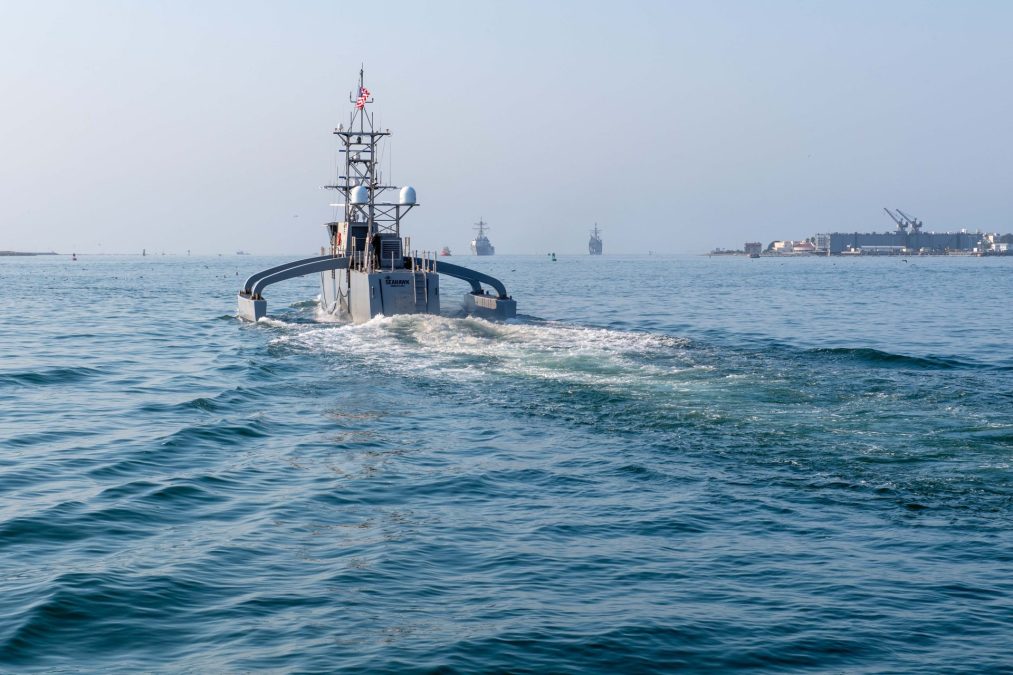
The Navy is setting up a one-stop-shop for medium unmanned surface vessels (MUSVs) that carry swappable, containerized payloads in faster, multi-mission deployments, as it reshapes its model for buying autonomous watercraft that navigate, handle cargo and carry out certain military operations with little to no human input.
Shortly after releasing the MUSV Family of Systems (FoS) program request for prototype proposals on Thursday, Navy officials leading the work briefed a small group of reporters about their plans to replace the Modular Attack Surface Craft (MASC) program with a new “marketplace” that speeds up the adoption of proven, production-ready maritime drone designs.
“We have quite a quantity of small USVs already in our inventory, so MUSV was the next one that we needed to go procure,” Rebecca Gassler, the Navy’s first portfolio acquisition executive for robotic and autonomous systems (RAS), told DefenseScoop. “[But], this is just the beginning of recurring marketplaces for a number of vessels. We have written an acquisition strategy for the complete family of all unmanned surface vessels together.”
This announcement comes the same week that the Army launched its new drone marketplace that is intended to serve as a digital storefront for approved unmanned aerial systems (UAS), and at a time when the U.S. military is broadly pivoting to modernize and accelerate its paths for purchasing robotic systems.
The second Trump administration’s Golden Fleet initiative also hinges on unmanned surface vessels of many brands and variants, which are envisioned to operate alongside a new class of next-generation battleships that would be equipped with hypersonic weapons, electronic rail guns and other cutting-edge capabilities.
“The character of warfare is changing rapidly. The Department of the Navy is adapting its acquisition system to deliver capability to our warfighters faster,” Navy Secretary John Phelan said in a statement. “This new approach will leverage private investment and accelerate the delivery of real capabilities to the Fleet. We will reward the companies who are able to deliver capability at the speed of relevance.”
Potential vendors looking to join the marketplace must respond to the Navy’s solicitation by April 17.
The sea service is eyeing mature MUSV assets that can be quickly and safely integrated into real-world Navy operations. Interested maritime drone providers are asked to submit information regarding the technical design underpinning their products, options for multiple types of business models, details about the systems’ supply chain and sustainment requirements, and a test plan.
Guidance accompanying Thursday’s notice states that companies selected for a potential award for a prototype other transaction agreement will be invited to attend a post-award conference and complete an on-water MUSV test event no later than Sept. 30.
The Navy will conduct tests involving a combination of live contact vessels and simulated data inputs in a designated offshore area. The effort will include three primary phases across a total of six days. Participants will be responsible for contacting local authorities to get approval for all test events.
“So, through the summer the team will be testing the boats,” Gassler said. “And the expectation is that you have to deliver your production vessel — at least the first of them — in [fiscal year 2027], so next year.”
Among multiple other attachments published with the solicitation and guidance is a 46-page test plan overview for the maritime drones that are tapped to participate.
“You can see every behavior that will be tested — down to the very nitty gritty. In this case, you’ll see that there are certain autonomous cases and patterns that the boats must follow,” Gassler said.
She noted that officials expect a number of companies to test “surrogate boats” that demonstrate the autonomy they can offer, but are not yet in full production.
According to the solicitation guidance, a vendor will receive $10,000 for attending the post-award conference, and $15,000,000 after successfully concluding all the Navy’s tests on the water.
In response to reporters’ questions, Gassler declined to share quantity and budget figures for the total MUSVs the Navy is looking to buy. However, she confirmed that funding for the service’s new MUSV arsenal would come from the nearly $5 billion proposed in the One Big Beautiful Bill Act that President Donald Trump signed last year.
“The intent is to qualify as many MUSV vendors as we can and understand the surge capacity that may exist for these types of vessels” over time, Gassler told DefenseScoop.
In their proposals, companies will need to submit MUSV designs that include the capacity to operate autonomously and carry containerized payloads.
Last week, Chief of Naval Operations Adm. Daryl Caudle announced his new “containerized capability campaign plan” that involves shipping containers packed with tailored weapons and deployed on a variety of manned and unmanned maritime vessels. That campaign plan is a key component of the CNO’s broader “Hedge Strategy,” with tailored offsets that can enable the Navy to enhance its combat power and adaptability without long and costly ship overhauls.
“My understanding is that [an MUSV is] a pretty big truck that can float around on the water and do a lot of really cool things,” Capt. Ron Flanders, a public affairs officer for the assistant secretary of the Navy for research, development and acquisition, said at the media roundtable.
Gassler added that these modular containers could transport repair equipment, sensors, drones and other tools in the military’s ever-growing weapons arsenal.
“You could have any number of payloads inside those, and you basically are able to just swap them on. You crane them on and off, just like a container ship. You attach standard connectors and such, and away you go,” she said.
The Navy’s new MUSV marketplace will notably terminate the Modular Attack Surface Craft (MASC) prototyping program that rolled out last year.
Officials told reporters at the roundtable that this pivot will move the service away from single-use or specialized vessels, in favor of mature designs that can pass an on‑water test, obtain a fixed-price reward, and move directly into production or leasing.
“We have a much wider variety of requirements for these vessels and missions that they need to accomplish as part of the Golden Fleet. And so this is a replacement for [MASC],” Gassler said. “We have also realized that, by surveying industry and the investments that were made, that there was significant investment that industry had made that we were not capitalizing on in MASC — and now we can in this marketplace.”
She said that her team contacted representatives from “every single” company that competed for the MASC prototyping effort ahead of announcing its cancellation and this plan for the new MUSV marketplace.
“I don’t think it’s whiplash [for them]. They understand the change in strategy, and all of them have said, ‘We’re all in. We’ll support this, and we understand what you’re doing,’” Gassler said. “It’s actually opening a bigger market for them.”