Pentagon brass tout destruction of Iran’s drone arsenal, but questions linger about what’s left
Iran’s drone arsenal and weapons stockpiles are mostly depleted and its capacity to produce new assets is nearly gone, according to Defense Secretary Pete Hegseth and Chairman of the Joint Chiefs of Staff Gen. Dan Caine.
Those two senior officials supplied updates on Operation Epic Fury Wednesday during the first Pentagon press briefing to follow President Donald Trump’s announcement late Tuesday of a two-week ceasefire between the U.S. and Iran.
They each broadly quantified the destruction of Iran’s military capabilities over the first five weeks of the war.
“Perhaps most importantly, we’ve destroyed Iran’s defense industrial base and their ability to reconstitute those capabilities for years to come. We attacked, along with our partners, approximately 90% of their weapons factories,” Caine said. “Every factory that produced Shahed one-way attack drones was struck. Every factory that produces the guidance systems that go into those drones was struck.”
However, some analysts warned it might be too soon to know the full extent of damage and Iran’s potential to rapidly resupply its armory, particularly without the completion of comprehensive combat assessments.
“Treat these figures with real skepticism,” Kelly Grieco, senior fellow at the Stimson Center, told DefenseScoop.
More to the story
Operation Epic Fury has been billed as a U.S.-led, Israel-coordinated military campaign to annihilate Iran’s leadership, ballistic missile and drone capabilities, naval power, manufacturing capacity and nuclear infrastructure, since it was launched by Trump on Feb. 28.
“Over the course of 38 days of major combat operation, the joint force achieved the military objectives as defined by the president,” Caine said on Wednesday.
Throughout the war, Iran attacked U.S. military facilities and other targets around the Middle East with deadly drone and missile barrages and disrupted at times nearly all maritime traffic flowing on a major global shipping route and chokepoint for oil near the Strait of Hormuz.
Shortly before the expiration of a deadline set by Trump that accompanied a threat to obliterate Iran’s critical infrastructure, America and Iran agreed to a two-week ceasefire late Tuesday.
Brokered by Pakistan, the deal offers a somewhat fragile break in warfare so that deeper negotiations between the nations involved can occur. The ceasefire reportedly includes agreements to suspend strikes in Iran for 14 days and allow for discussions of a settlement that includes nuclear constraints on Iran and sanctions relief, and the opening of the Strait of Hormuz for the entire duration of the truce.
“We welcome the ongoing ceasefire, and as the secretary said, we hope that Iran chooses a lasting peace,” Caine noted. “But, as Secretary Hegseth said — let us be clear, a ceasefire is a pause, and the joint force remains ready if ordered or called upon to resume combat operations with the same speed and precision as we’ve demonstrated over the last 38 days.”
He and Hegseth described how Iran and Israel “decimated” Iran’s combat power since the start of Epic Fury.
They noted that the U.S. struck 13,000 targets, which included more than 4,000 dynamic targets that Caine said “popped up on the battlefield and were immediately addressed thanks to the exceptional command-and-control system and intelligence acumen and agility of our joint force.”
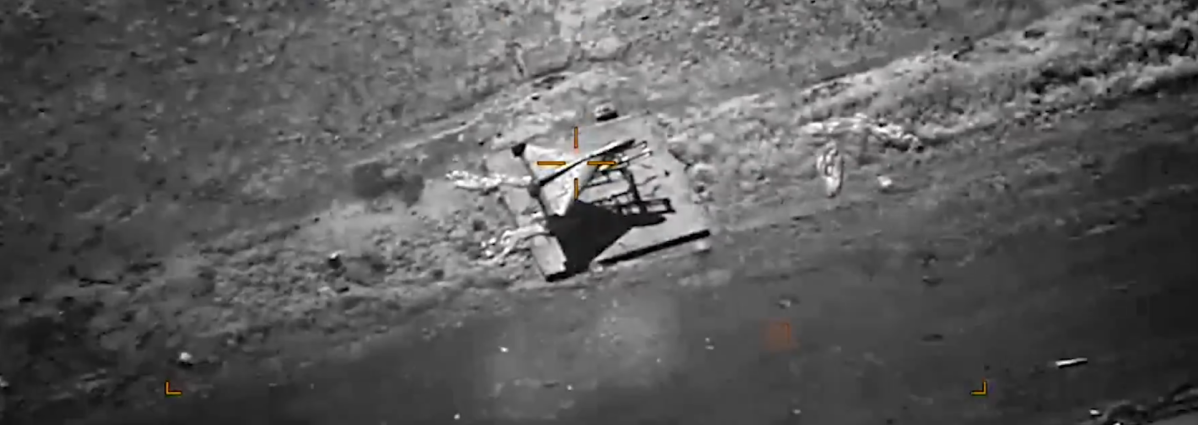
U.S. Central Command “destroyed approximately 80% of Iran’s air defense systems — striking more than 1,500 air defense targets, more than 450 ballistic missile storage facilities, 800 one-way-attack drone storage facilities — all of these systems are gone,” Caine said.
The top American military general also said the U.S. devastated Iran’s command and control and logistical networks and destroyed more than 2,000 C2 nodes, adding that “it is, and we know this, incredibly frustrating right now to be a lower-level Iranian commander trying to fight your fight.”
Echoing Hegseth’s claims that the Iranian Navy now lies mostly at the bottom of the Arabian Gulf, Caine said the U.S. has assessed that more than 90% of Iran’s regular maritime fleet has now been sunk, and more than 95% of its naval mines have been eliminated.
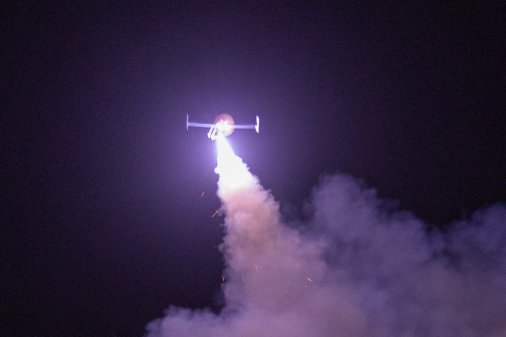
According to the officials, every factory that produced Shahed one-way attack drones was hit, which should impact Iran’s ability to make these low-cost weapons that it has used during the war and supplied to U.S. adversaries.
Iran’s missile industry “is shattered, with more than 80% of their missile facilities gone as well as their solid rocket motor production capability,” Caine also said.
He and Hegseth further estimated that it could take years for Iran to rebuild any major surface combatants, noting that more than 20 naval production and fabrication facilities were damaged or taken out, while nearly 80% of Iran’s nuclear industrial base was hit.
“In last night’s wave of more than 800 strikes, we finished completely destroying Iran’s defense industrial base, a core pillar of our mission objectives. What little they have left buried in bunkers is all they will have,” Hegseth said. “But they can no longer build missiles, build rockets, build launchers or build [unmanned aerial vehicles or] UAVs. Their factories have been razed to the ground, set back in historic fashion.”
Responding to questions from DefenseScoop after the briefing on Wednesday regarding the senior U.S. officials’ assertions about wiping out Iran’s military power and capacity, experts suggested that the figures shared seem feasible, though imperfect.
“Because it’s Gen. Caine, who is and has been pretty measured, I actually think he’s got justification for giving those metrics,” said a former senior defense official who requested anonymity to speak freely. “Now, are they going to be perfect? They’re not. They never will be, but I think they have a pretty good idea of the targets they’ve struck.”
The officials noted that more information will likely follow from Battle Damage Assessments, cyber reviews, Munitions Effectiveness Assessments and other evaluations that are conducted in the immediate wake of combat operations.
“So on the surface of it, I actually think those numbers are reasonable. Of course, what they don’t tell you is the rest of the story, which is, how many drones do they have hidden in mountains still, which is probably thousands? How many suicide boats do they have hidden in caves along the Strait of Hormuz — hundreds, maybe more?” the former senior defense official said. “So there’s always going to be a missing component to those numbers.”
In their view, Iran can’t rapidly rebuild its military arsenal in a way that’s going to match America’s conventional capability.
“This is likely to only accelerate their move to drones, cheap drones — thousands and thousands of cheap drones, suicide boats, mines, and what we would call almost ‘asymmetric warfare.’ I continue to say that we’re fighting one fight, and Iran is fighting an entirely different one, which is more of an economic war than it has been a conventional military fight,” the former senior defense official told DefenseScoop.
They said they fully expect Iran will turn to Russia and China to figure out the types of capabilities they should rebuild to most threaten U.S. interests, “knowing that they cannot send up airplanes against us and their navy can’t go up against us.”
Hegseth and Caine did not share an update Wednesday on U.S. casualties sustained in Epic Fury to date.
According to Navy Capt. Tim Hawkins, U.S. Central Command’s spokesperson, in total 381 U.S. troops were wounded in action as of April 8, with 344 having returned to duty and three currently characterized as seriously wounded.
At least 13 U.S. military personnel have been killed, including six U.S. Army Reserve soldiers who were killed in a drone strike in Kuwait in the early days of the conflict.
“How could Iran not go out and buy 200,000 more drones or build them, get them in, put even more capabilities on them?” the former senior defense official said. “So, we’re going to have to come up with drone defenses. Maybe that’s the big piece of this — yet another wake-up call about the importance of counter-drone systems.”
In a separate conversation with DefenseScoop, Grieco, a senior fellow with the Reimagining U.S. Grand Strategy Program at the Stimson Center and an adjunct professor of security studies at Georgetown University, said the topic of Iran’s capacity to reconstitute its drone arsenal is “where [she is] most skeptical of the briefing” on Wednesday.
“The Shahed drone is intentionally simple — that’s a design feature, not a limitation. Iran has spent years dispersing its production, relying on dual-use components, and developing supply chains that are difficult to fully map, let alone destroy,” she said. “Striking every known factory is not the same as destroying the capability. If the design files, technical knowledge, and supplier relationships survive, and they almost certainly do, reconstitution is a matter of months, not years.”
Putting it another way, a former defense official said it’s clear that producing Shaheds isn’t hard. The war between Russia and Ukraine has demonstrated how commercial off-the-shelf platforms and services can enable anyone — bad actors or otherwise — to operate effectively.
“The problem with the Iranian regime is their ability to attack a very large surface area with any number of vulnerable targets whether in Iraq, Kuwait, Qatar, UAE, Bahrain, etc. That alone enables the [Islamic Revolutionary Guard Corps or] IRGC to degrade or disrupt the global economy. They can create terror instantly at fairly long ranges and I don’t think there is much we can do to mitigate that in the near term,” the former defense official told DefenseScoop.
‘Selling a victory’
More than 50,000 American troops deployed across the Middle East, Europe and stateside have participated in Operation Epic Fury to date.
“Along the way, we consumed more than 6 million meals, and by my estimate, more than 950,000 gallons of coffee, 2 million energy drinks and a lot of nicotine — but I’m not saying that we have a problem,” Caine said on Wednesday. “I’ve laid out the statistics, but it does not truly capture the nature of combat. This is gritty and unforgiving business. It’s chaotic, it’s hot, it’s dark, it’s unpredictable, and there’s always unknowns, and our people proudly walk into those unknowns and continue forward.”
The experts who DefenseScoop spoke to suggested that the press conference was notably silent on certain elements of strategic significance.
“Hegseth and Caine described a devastatingly successful military campaign — and by traditional measures of firepower and target destruction, it may well have been. But the Strait of Hormuz required a ceasefire that left Iran as a gatekeeper of the world’s most critical oil chokepoint. The regime survived. The nuclear knowledge base survived,” Grieco said. “A briefing that leads with 90% of the navy sunk while not addressing any of that is selling a victory, not offering a strategic assessment.”
The U.S. military conducts systematic evaluations of the physical and functional results of military force against targets, which measure how tactical objectives were met and assist decision-making on re-attacking assets.
“Battle damage assessment (BDA) is one of the hardest intelligence problems there is, and history suggests initial claims are almost always optimistic,” Grieco noted. “Knowing you hit a target is different from knowing what was actually in it, whether it was operational, and whether backup systems or redundant facilities existed elsewhere.”
Both she and the former senior defense official pointed to Caine’s account that 2,000 C2 nodes had been destroyed as ambiguous and subject to change.
“[That] is the kind of specific number that sounds precise but may reflect targets struck rather than capabilities eliminated. I’d want to know what the classified confidence levels on these assessments actually are before taking any of these figures at face value,” Grieco said.
A former senior defense official said: “What do you define a C2 node as? I don’t know, a radio-relay tower, or it could be a military headquarters. It could be a lot of different things. But the question is, how critical was that thing?”
In their decades-long military and defense career, the official noted that they became “very, very familiar” with the U.S. military’s approaches for conducting BDAs and other combat-related after-action reviews. Immediate assessments pull from weapons systems that were used, and if necessary more methodical reassessments occur as new intelligence and sources emerge.
“So, all these things have been put in place to say there is a very good, methodical process to try to assess this,” the former senior defense official told DefenseScoop. “And we learned from it time and time again.”