U.S. military to continue dispatching counter-drone capabilities to the Middle East
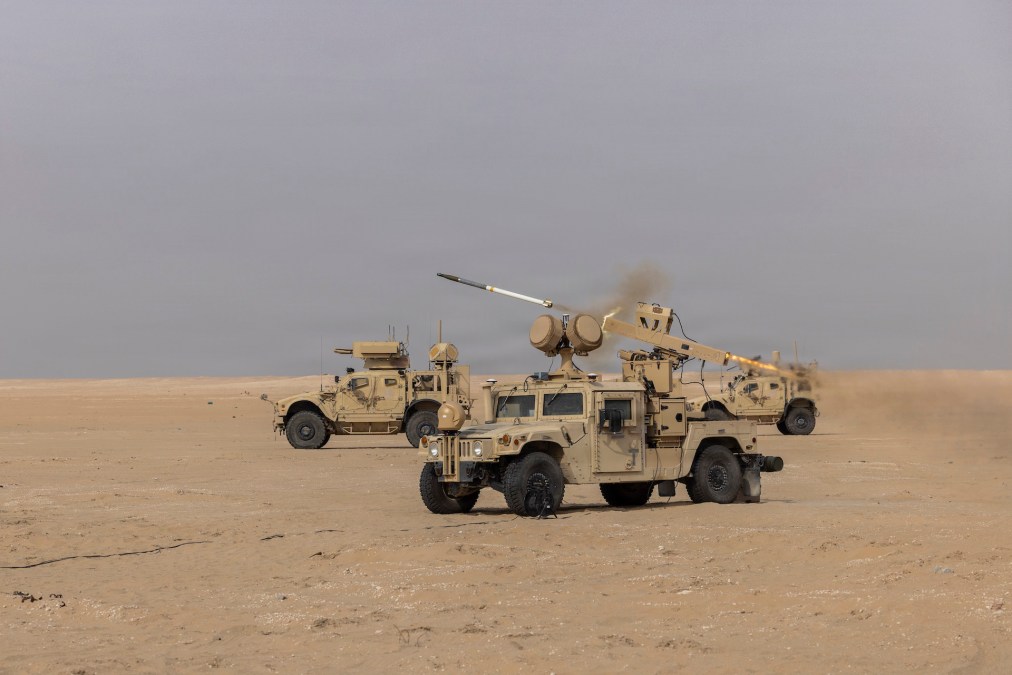
The U.S. military will continue sending counter-drone capabilities to the Middle East in the days and weeks to come, according to a spokesperson for the Pentagon task force responsible for such assets, following a nine-figure C-UAS investment and amid uncertainty about the future of the Iran war.
Multiple experts told DefenseScoop that, despite the overall drone threat being known for years, U.S. military investments in countering them are well overdue. Iran’s low-cost drones, boosted by years of sales to Russia and other countries, are now being met by expensive, hard-to-scale allied counter systems in a conflict that has been largely defined by munition attrition.
Earlier this week, Joint Interagency Task Force 401 — an Army-led entity responsible for building out the military’s counter-drone repertoire — said it had committed more than $600 million in unmanned aerial system defenses for Operation Epic Fury and stateside efforts.
More than half of that sum went toward the U.S. Central Command-led operation during the first month of the war, according to the task force, which will continue to push counter-drone capabilities to the region. While part of that infusion put C-UAS equipment on the battlefield over the last several weeks, the spokesperson did not say by how much or identify the capabilities.
“The $350 million worth of commitments JIATF-401 has made over the last thirty or so days in support of Operation Epic Fury does include capabilities already in the hands of our warfighters in Centcom as well as capabilities not yet fielded or delivered that will continue to flow into theater over the coming days and weeks,” Lt. Col. Adam Scher, the spokesperson said Wednesday. Funding allocations remain “in negotiations until final contracts are signed.”
The Pentagon’s fiscal 2027 budget request proposes a massive increase in counter-drone spending, though Scher said JIATF-401’s recent investment came from fiscal 2026 funding.
Increased investment “is dramatically overdue,” said Tom Karako, director of the Missile Defense Project at the Center for Strategic and International Studies. “But it’s not as if the drone threat snuck up on us. We have seen this coming for a very long time.”
The JIATF-401 announcement came days before the U.S. and Iran agreed to what Trump officials called a “fragile” ceasefire, a so far brittle deal that has wrought competing threats to resume attacks as drones and ballistic missiles continue to wreak havoc across the region.
While Iran’s capabilities are significantly weakened, tens of thousands of U.S. troops remain in the region.
“At this point, we are witnessing a very fragile ceasefire in an attempt to get to a negotiated settlement to the war,” Alex Plitsas, a senior fellow at the Atlantic Council and Middle East expert, said Thursday. “Until that happens, U.S. forces are still vulnerable, and there’s still drones and missiles flying right now.”
Iran has launched thousands of drones during the war, though attacks slowed over the course of the conflict and Gulf countries reported high rates of interception. Those that have evaded air defenses, such as Tehran’s Shahed drone, have caused significant infrastructure damage and death.
In Kuwait, six American troops were killed by an Iranian drone on March 1 and some survivors disputed the Pentagon’s assertion that their position was adequately fortified against the attack, according to CBS News.
Chairman of the Joint Chiefs of Staff Gen. Dan Caine told reporters Wednesday the U.S. military and Gulf countries “intercepted” 1,700 ballistic missiles and one-way attack drones, but did not delineate between the two. A Pentagon spokesperson referred DefenseScoop to his comments and Centcom when asked how many Iranian drones the military has actually shot down.
In response to that question and to an earlier inquiry, a spokesperson for the command said it did not have anything to add about JIATF-401’s investment announcement or whether it resulted in increased protection from — or shootdowns of — enemy drones.
Karako said he suspected Coyote interceptors and Merops systems “have probably been doing the lion’s share of the drone killing that we’ve seen.”
He said those platforms, and probably a handful of others, would likely be bolstered by the recent JIATF-401 investment.
“The expenditure of counter-UAS in the Middle East over the past six weeks, has already galvanized an effort to get as much stuff out as fast as possible,” Karako said about the recent investment. “So from that standpoint, they’re going to be grabbing ‘26 dollars and any other coins in the couch cushions that they can find to get stuff on contract as fast as possible.”
While drone conflict from the Iran war was not a “long-foreseen potential outcome” of protests that erupted in the country earlier this year, Plitsas said, the U.S. military has seen plenty of evidence of UAS employment during the Russia-Ukraine war, and to a lesser extent, the Global War on Terror. And Iran was a major exporter of drones prior to Operation Epic Fury.
“I believe that there should have been larger investments a long time ago in counter-drone technology and warfare. I believe that the U.S. was late to the game for that,” he said, noting that the lack of investment spanned multiple administrations. “Unfortunately, we didn’t have the technology that we needed at the time. They’re trying to race to search for that now.”
“For two-and-a-half decades, the U.S. military was the most experienced on the face of the earth, and within a matter of a couple of years, the Ukrainian and Russian militaries had far more experience in dealing with this type of warfare than the U.S. did,” he added. “And so we’re in a position of playing catch up.”
The “drone problem” for the U.S., as it has been dubbed in some circles, expands beyond the war in Iran and to the American homeland. Karako said the air defense issue has been “artificially divided” between domestic and overseas threats.
Earlier this year, the director of JIATF-401, Brig. Gen. Matt Ross said that part of the task force’s genesis was “to surge against this problem … because we didn’t want to wait for a 9/11 event inside the United States to address the threat of unmanned systems.”
A significant part of JIATF-401’s counter-UAS investment is related to stateside efforts, such as defense of the 2026 FIFA World Cup and other domestic initiatives. And the homeland concern over UAS threats have already played out, most recently with “several unauthorized drone incursions” over Barksdale Air Force Base last month.
“The threat is so ubiquitous and these are high-profile events,” Karako said of the FIFA event, which JIATF-401 said was flowing counter-drone funding to 11 cities across the country. “There’s a lot of overlap and similarity between capability deployed here and capability deployed over there.”
The task force said that it spent more than $20 million on counter-drone capabilities at the southern border, a mission that has revealed its own air defense issues after back-to-back incidents in February caused Texas airspace closures over laser system employment.
Top military officials have called the border a testing ground for such systems. Scher said the task force purchases supported a network of 13 advanced, early-warning sensors, seven “mobile and fixed-site mitigation systems” and over a dozen data transfer platforms, though he did not name the capabilities.
A spokesperson for the military’s southern border task force said troops have employed portable drone devices, such as the Wingman and Pitbull systems, as well as Smart Shooter, a rifle-mounted optic meant to track and help blast drones out of the sky.
“It’s a hard problem. It’s a wicked hard problem,” Karako said of counter-UAS overall. “But at the same time, it’s not bleeding edge rocket surgery to shoot down Shaheds either.”