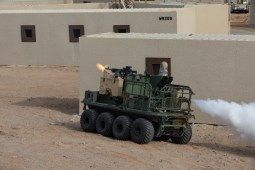
A U.S. Army unmanned, eight-wheeled, all-electric, all-terrain transport vehicles armed with the R600 autonomous weapon system provides support to dismounted Soldiers in an urban environment as part of a human integration experiment at Fort Irwin, Calif., March 17, 2024. (U.S. Army photo by Spc. Samarion Hicks)
While the announcement delivered during the annual AUSA conference in Washington, D.C. said a three-star will head FASCOM, the service did not disclose who that leader will…
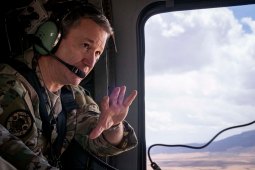
Chairman of the Joint Chiefs of Staff Gen. Dan Caine visits Joint Task Force Southern Border in Sierra Vista, Az. April 19, 2025. DOD photo by Chief Mass Communication Specialist James Mullen)
“We have to assume from now on that our formations will be hunted by autonomous systems, jammed across the spectrum, and tracked in real time," Gen. Dan…
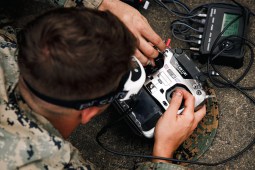
U.S. Marine Corps Lance Cpl. Christian Gillham, a mortarman and team leader with 3rd Littoral Combat Team, 3rd Marine Littoral Regiment, 3rd Marine Division, flies a first-person view unmanned aircraft system for a long-range simulated strike during the Marine Corps Attack Drone Competition at Marine Corps Base Quantico, Virginia, Aug. 11, 2026. (U.S. Marine Corps photo by Cpl. Joshua Barker)
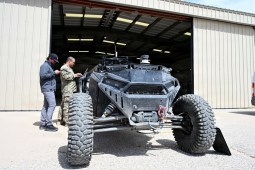
Chief Warrant Officer 2 Zackary Cowher, Cyber Capabilities Developer Technician for Multi-Domain Command – Europe, uploads configuration files to an autonomous land-based vehicle equipped with a tethered UAS quadcopter during Arcane Thunder 26 at Fort Irwin, California, April 18, 2026. (Photo by Master Sgt. John Healy)
U.S. Army Green Berets assigned to the 3rd Battalion, 10th Special Forces Group (Airborne), survey the terrain during military mountaineering training as part of Exercise Diesel 26 at White Sands Missile Range, New Mexico, Feb. 24, 2026. (U.S. Army photo by Sgt. Rhianna Ballenger)
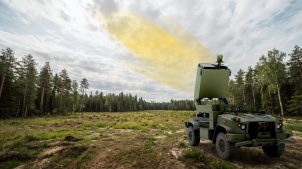
After Marine Corps testing, Epirus hopes the service will adopt HAVOC “more widespread” and has prepared its facilities for low-rate production amid business with the Army and…
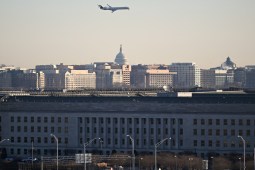
A plane flies over The Pentagon (front) with the US Capitol (C, background) in Washington, DC, on January 11, 2024. (Photo by ANDREW CABALLERO-REYNOLDS / AFP via Getty Images)
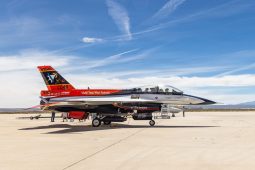
Rachel Kinard, Air Force Test Pilot School director of research, and Lt. Col. Philip Downing, 370th Flight Test Squadron commander, depart for a HAVE HEAT test mission at Edwards Air Force Base, California, April 16, 2026. Leveraging Lockheed Martin’s Infrared Search and Track Legion Pod, during the HAVE HEAT program, the X-62 VISTA platform demonstrated the ability of AI agents to ingest live infrared sensor data, directing the X-62 to autonomously intercept an airborne target in real time. (U.S. Air Force photo by Lindsey Iniguez)
“Our Acuity ISR/Strike software brings collaborative autonomy to Mayhem 10, rapidly delivering next-generation capabilities through platform-agnostic software with operator oversight,” said Jason Brown, general manager of Applied…
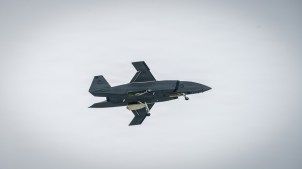
A Boeing Defence Australia’s MQ-28 Ghost Bat, a production representative test aircraft, performs a flyover during Exercise Valiant Shield 2026 over Rota, Commonwealth of the Northern Mariana Islands, June 25, 2026. (U.S. Air Force Senior Airman Adrien Tran)