Marine Corps bets on techy, but human-centric ground warfare for next 15 years
In the Marine Corps’ vision for the next decade-and-a-half of conflict, its ground forces will have drone-busting air defenses at the squad level, specialized “precision strike” troops equipped with whizbang loitering munitions, autonomous robots, and tools to assess units’ own electromagnetic emissions, lest an adversary spot them first.
Underpinning this vision, released Wednesday in a strategic blueprint called Ground Combat Element 2040, is a bet the service is making about how its most central formations will fight over the next 15 years: technology will help, but humans remain at the heart of ground warfare.
The document acknowledges the service will not perfectly predict what the next fight will look like or design the “right” force to meet it from the start. So, it is attempting to cultivate a ground element that can adapt to those uncertainties, while still being able to fight if those technological advantages collapse under enemy force or in the face of “the inherent frictions of warfare.”
The document also makes a firm, “long-range” assessment about the intersection of human decision-making and autonomous processes in its design principles. New technology, though empowering, “never replaces human judgment”, according to GCE 2040.
“There will come a time in a conflict where the robotics and the fast decision making and all of that capability will fail, it will be denied by some adversary action,” Lt. Gen. Jay Bargeron, head of plans, policies and operations for the Marine Corps, told reporters on Wednesday. “And so then it will be, what are the humans capable of?”
But the human-bot decision-making process is already changing rapidly as the services push for “machine speed” actions and orchestration, industry, academia and the military grapple with burgeoning autonomous realities, and adversaries push the boundaries of AI-backed tech.
“I think that’s a reflection of the view today, and not really a prediction about the future,” Mark Cancian, a retired Marine colonel and senior adviser with the Center for Strategic and International Studies, said of the document’s assertion about judgement, citing the current wariness around the fallibility of AI models.
He expects the vision to be revisited every few years (the White House already ordered the Pentagon to conduct such a review about AI), including if autonomy begins to play a much bigger role. For now, it would “set off alarm bells” if the Marine Corps were to project it would use autonomous weapons without human oversight.
“I think that the safe thing is to stick with today’s consensus, and then see where this thing goes,” Cancian said. “Given the consensus today, it was a sensible thing to do.”
In a paper published Monday, Marine Corps War College professor Dr. James Lacey argued that humans will indeed have a crucial place in a war backed by artificial generative intelligence (AGI) should it come to fruition, but that early, decisive engagements will be entirely autonomous and “any military or nation that insists on keeping humans in the loop, or for that matter, on the loop, will lose.”
“There is a chance that AI systems will never achieve AGI or that its arrival may be delayed for decades,” he wrote. “If either were the case, it would make little difference to those planning future conflicts. War is always and everywhere a matter of mathematical attrition, particularly when waged by AI systems unaffected by a sudden loss of will or confidence.”
What if an adversary, like China or Russia, doesn’t abide by the same human-centric playbook the Marine Corps has laid out for itself over the next 15 years?
“There’s no doubt that there are systems out there today that can sort through piles of data, make decisions about fires solutions without a human in the loop,” Bargeron said. If an adversary were to “unleash that on us,” he continued, “it would be at least a momentary advantage on their part.”
“But at some point, that will become denied — it always is the case, and then it’ll be about the human,” he reiterated. “We will try to fully enable the Marine Corps with every piece of technology there is out there, always a human in the loop, applying military judgment, and being ready to continue to outcycle the enemy when that technology fails.”
‘Biggest holes in our swing’
Meanwhile, the Marine Corps is leaning into several key trends, most of which have erupted during the Russia-Ukraine war, that it predicts will be critical through 2040. The vision reinforces the service’s ongoing Force Design revamp and its place as an enforcer in the coastal zone.
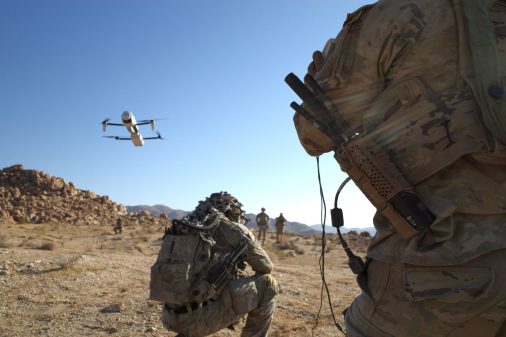
Like other services, the amphibious force has identified drones as its most immediate threat over the next five years, or its “near-term target,” according to the document.
“The ability for our lowest level lowest echelon units — squad, platoon, company — to defend themselves against one-way attack systems is really maybe one of the biggest holes in our swing, and so we’re working hard on that,” Bargeron said.
The Marine Corps is pushing ground-based defenses such as vehicle-mounted MADIS and its lighter cousin the LMADIS, down to its smallest units, according to the general, as the service tests new medium-range interceptors.
It has started new counter-drone training programs, specifically at Twentynine Palms, California, and has started fielding kits so Marines can detect and jam unmanned aerial systems. The Marine Corps recently bought 400,000 rounds of frangible 5.56 to shoot down UAS, Bargeron said.
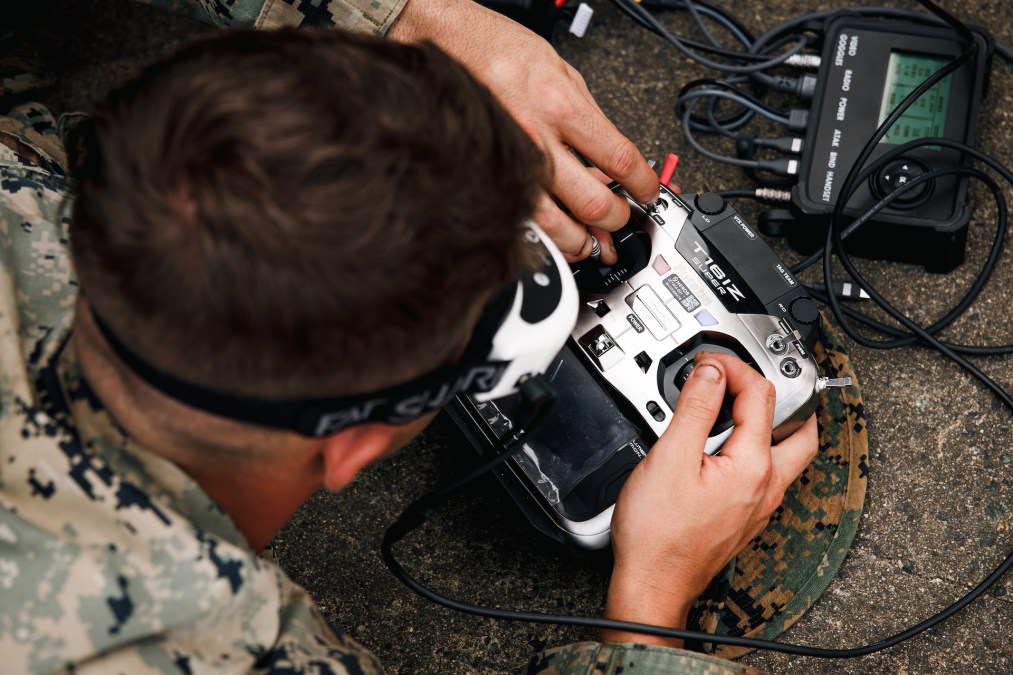
LIkewise, the Marine Corps is working to extend the attack range of its ground combat units. The service has been particularly forward-leaning when it comes to small drones, having spent the last year-plus revamping training, investments and standards to support the technology.
Bargeron said the Corps is eyeing a change to its anti-tank missile gunners, remaking it into a “precision strike” job as part of an effort to give ground units more organic firepower and range, around 20 kilometers. That includes more loitering munitions and mortars for infantry units.
“This is really about buying back, or ensuring we have the right firepower and staying power in those ground combat units to do things like seize and defend a piece of ground when it’s necessary,” he said.
In other cases, too, the document pushes capability and decision-making down to lower levels, including delegation of “broad lethal and non-lethal authorities” to colonel-level commands.
“This is a tension that’s been around for quite a while: the desire to have broad capabilities at very low levels,” Cancian said. “It’s great to push decision making and capabilities down, but you can easily overwhelm that level” with too much technology or expertise requirements.
The document describes a future where autonomous robots take on the most dangerous tasks as part of human-machine teams. In certain instances they will fully replace maneuver elements, according to GCE 2040, something the services are currently experimenting with.
It also calls for a resilient, AI-enabled command and control architecture that the Marine Corps is already testing through Project Dynamis, one backed by rugged, decentralized data processing nodes the service expects to be vital for an expeditionary force.
And for expeditionary units, the document laid a particular emphasis on the electromagnetic spectrum and the need for Marines to dutifully hide their signatures. The war in Ukraine has shown that radio, noise, EM, heat and visual emissions detected by ever-watching technology means those signatures can be targeted in a matter of minutes.
The Marine Corps has recently sought multispectral camouflage garments to help reduce certain signatures. Bargeron said troops were monitoring their own signature and “trying to hide in plain sight,” an allusion to a tactic other services have begun to adopt. Units cycle between different network types, matching emissions that are most common around them.
The Marine Corps expects these nascent manifestations of the GCE vision, as well as other capabilities it says it needs, to herald a resilient ground force “fully enabled by cutting-edge technology,” Bargeron said.
But, he added, “the willpower, discipline, and adaptability of the individual Marine is and always will be our center of gravity.”