The appointment comes amid a push by the department to modernize its IT and cybersecurity tools, streamline procurement, and figure out the way ahead for the controversial…
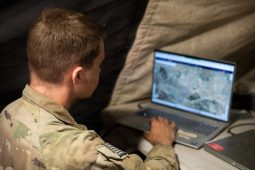
U.S. Army 2nd Lt. Kyle A. Frakes, assigned to 4th Squadron, 10th Cavalry Regiment, 1st Armored Brigade Combat Team, 4th Infantry Division, operates the ADIP software platform during a division reconnaissance and security experiment as part of Project Convergence Capstone 6 at Fort Irwin, California, July 21, 2026. (U.S. Army photo by Staff Sgt. Ger’vonni Straun)
The initiative is intended to speed up the onboarding of defense vendors’ software into the service’s network by using AI to vet prospective industry code in an…
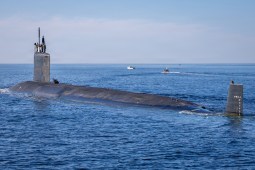
The Virginia-class attack submarine USS North Dakota (SSN 784) has been delivered back to the fleet battle ready, completing a historic first-ever Virginia-class Block III availability at Portsmouth Naval Shipyard, Kittery, Maine Aug. 20, 2026. (U.S. Navy photo by Neil Boorjian)
In the fireside chat, “When the Math Doesn’t Math: Reframing CMMC to Deliver at the Speed of Relevance,” Kirsten Davies, Chief Information Officer for the Department of War, and James Mismash, Deputy Assistant Secretary of War for Industrial Base Growth, discussed the Department’s efforts to modernize its digital infrastructure, reduce compliance friction, and create a more secure and agile ecosystem that enables industry to deliver capabilities to the warfighter faster. Photo taken Aug. 26, 2026. (Courtesy Photo)
A quantum computer at The Air Force Research Laboratory’s Information Directorate in Rome, New York is used to conduct experiments to improve quantum computing and networking. (U.S. Air Force photo / Keith Lewis)
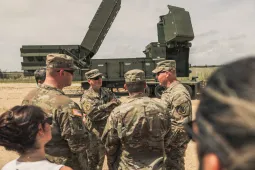
Director of Golden Dome for America (GDA) Gen. Mike Guetlein and Vice Director for GDA Lt. Gen. Brian Gibson receive a briefing on the Lower Tier Air and Missile Defense Sensor (LTAMDS) at North Field, Andersen Air Force Base, July 16, 2026. LTAMDS is the U.S. Army’s next-generation 360-degree air and missile defense radar designed to detect and track advanced ballistic, hypersonic, cruise missile and airborne threats. (U.S. Navy photo by William J. Busby III)
“They were designed to validate software, they were designed to validate sensor-to-shooter linkages that perhaps are different than what today exists,” Lt. Gen. Brian Gibson said.
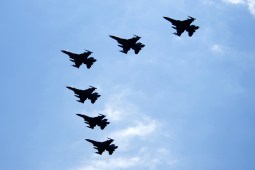
U.S. Air Force F-16 Fighting Falcons assigned to the 31st Fighter Wing perform a flyover above Aviano Air Base, Italy, June 1, 2020. (U.S. Air Force photo by Staff Sgt. Kelsey Tucker)
The Air Force is moving its fragmented scheduling, training and readiness systems into a single enterprise platform known as the Aerospace Readiness Enterprise System.