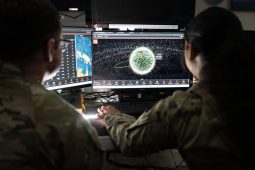
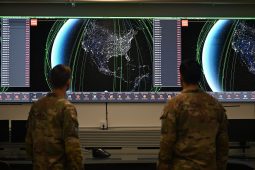
U.S. Space Force Guardians assigned to Space Delta 5 monitor computer workstations Dec. 18, 2025, at Vandenberg Space Force Base, Calif. Space Delta 5 supports and presents combat-ready forces to command and control the Combined Space Operations Center, which closes blue kill chains by delivering space-enabled effects—including GPS, missile warning and electromagnetic interference detection—to the Joint Force. (Photo by David Dozoretz)
Lt. Gen. Gregory Gagnon provided new details about how Space Force guardians supported the joint force during Operation Midnight Hammer and Operation Absolute Resolve.
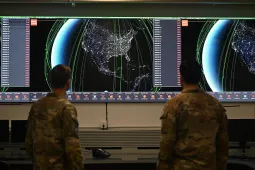
Crews of the National Space Defense Center at provide threat-focused space domain awareness across the nation security space enterprise. The NSDC was originally established in 2015 as the Joint Interagency Combined Space Operations Center and was renamed in 2017 to more accurately reflect its mission. (U.S. Space Force photo by Kathryn Damon)
The Commercial Space Office is entering the next phase of the Commercial Augmentation Space Reserve Program aimed at delivering a minimal viable capability before the end of…
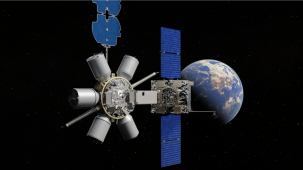
Rendering of Northrop Grumman’s GAS-T design that will leverage an ESPAStar-D satellite platform to add fuel and extend the life of in-orbit assets. (Northrop Grumman image)
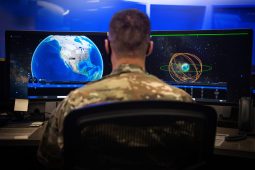
Members of the 18th Space Defense Combat Squadron, a unit assigned to U.S. Space Forces – Space under the USSF Force Generation model, observe orbital data at Vandenberg Space Force Base, Calif., Oct. 4, 2024. (Photo by David Dozoretz)
Members of the 18th Space Defense Combat Squadron, a unit assigned to U.S. Space Forces – Space under the USSF Force Generation model, observe orbital data at Vandenberg Space Force Base, Calif., Oct. 4, 2024. (Photo by David Dozoretz)
Edward Ramey, space domain characterization common operating picture segment (SDCCS) lead integration and training support for the Joint Task Force-Space Defense, looks at a computer screen at Schriever Space Force Base, Colorado, Dec. 19, 2022. (U.S. Space Force photo by Tiana Williams)
The Commercial Integration Cell looks to improve how the Space Force and commercial industry share classified information on threats in the space domain.
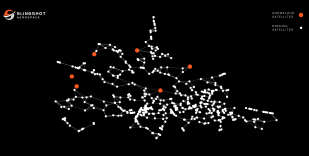
A network diagram of Slingshot Agatha data depicting the relationships among satellites within multiple, real-world, foreign constellations (Slingshot Aerospace image)
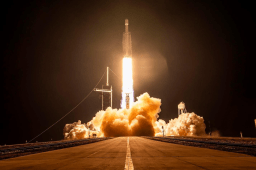
Powered by 27 Merlin engines, generating more than five million pounds of combined thrust, a SpaceX Falcon Heavy rocket lifts off from Launch Complex (LC)-39A at NASA’s Kennedy Space Center, Dec. 28, 2023 at 8:07 p.m. EST, carrying the U.S. Space Force (USSF)-52 mission into Earth orbit. (SpaceX photo)
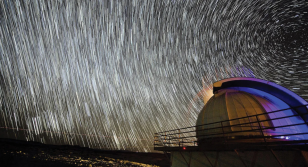
The Ground-Based Electro-Optical Deep Space Surveillance System is responsible for tracking thousands of objects in space. The telescope is positioned at White Sands Missile Range, New Mexico. (Image credit: U.S. Air Force, Tech. Sgt. David Salanitri)
“There are all kinds of uses for AI and machine learning that we tackle, we’re just taking a little more cautious approach right now,” said Col. Zachary…