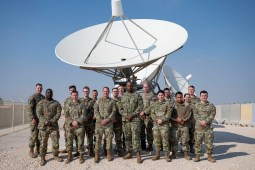
U.S. Navy Fleet Master Chief Lateef Compton, U.S. Central Command senior enlisted leader, visits Airmen and Guardians in the CENTCOM area of responsibility, Jan. 7, 2026. Compton visited multiple sites around the base and had lunch with Airmen and Guardians assigned to U.S. Space Forces – Central. (U.S. Air Force photo by Senior Airman Devlin Bishop)
“We have proven that spacepower produces battlefield success. This means providing effective and well-equipped space forces, in the right quantities, to combatant commands on the front lines…
U.S. Undersecretary of Defense for Policy Elbridge Colby attends an International commemorative ceremony for the 82nd anniversary of the World War II “D-Day” Normandy landings in Langrune-sur-Mer, northwestern France, of June 6, 2026. (Photo by LOU BENOIST / AFP via Getty Images)
The COPA initiative allows for the issuance of cash bonuses up to $2,500 to eligible troops to “recognize exceptional contributions rooted in novel actions, inventions, or technical…
The Pentagon is pursuing multiple initiatives to enhance its space posture, including the Proliferated Warfighter Space Architecture and the Space Data Network.
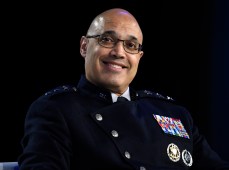
Lt. Gen. David Miller takes part in a panel discussion at the Air, Space and Cyber Conference at National Harbor, Md. Sept 23, 2025. (U.S. Air Force photo by Andy Morataya)
The nomination comes about two weeks after Secretary of the Air Force Troy Meink announced that the U.S. military now has “on-orbit space control weapons."
As the Space Force prepares to launch the first Airborne Moving Target Indicator prototypes, the service is also working on its Ground Moving Target Indicator constellation —…
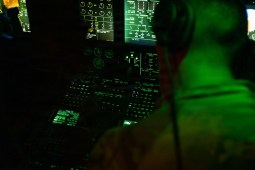
A U.S. Air Force pilot enters data in a C-130J Super Hercules aircraft in the Central Command area of responsibility, March 3, 2026. (U.S. Air Force photo)
“We want industry to understand the mission problem, bring their best ideas, and be prepared to deliver interoperable and adaptive capability," Brig. Gen. Joshua Williams said.
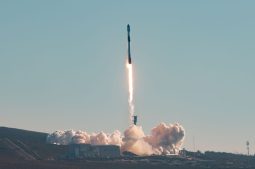
SpaceX Falcon 9 launches the Space Development Agency T1TL-C mission to low-Earth orbit from Space Launch Complex 4E at Vandenberg Space Force Base, Calif., Oct. 15., 2025. Beginning in 2027, T1 will provide initial warfighting capability to deliver regional persistence for tactical military data channels, along with advanced missile tracking and missile warning, and beyond-line-of-sight targeting plus demonstration of UHF and S-band tactical satellite communications. (U.S. Space Force photo by 2nd Lt. Andrew Taller)
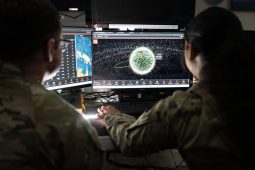
U.S. Space Force Guardians assigned to Space Delta 5 monitor computer workstations Dec. 18, 2025, at Vandenberg Space Force Base, Calif. (Photo by David Dozoretz)
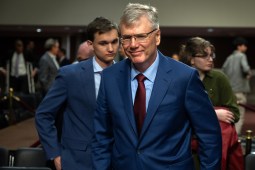
Troy Meink appears before the Senate Armed Services Committee for his nomination to be secretary of the Air Force in Washington, D.C., March 27, 2025. (DoD photo by EJ Hersom)