Trump’s budget supplemental would secure billions for munitions, emerging defense tech
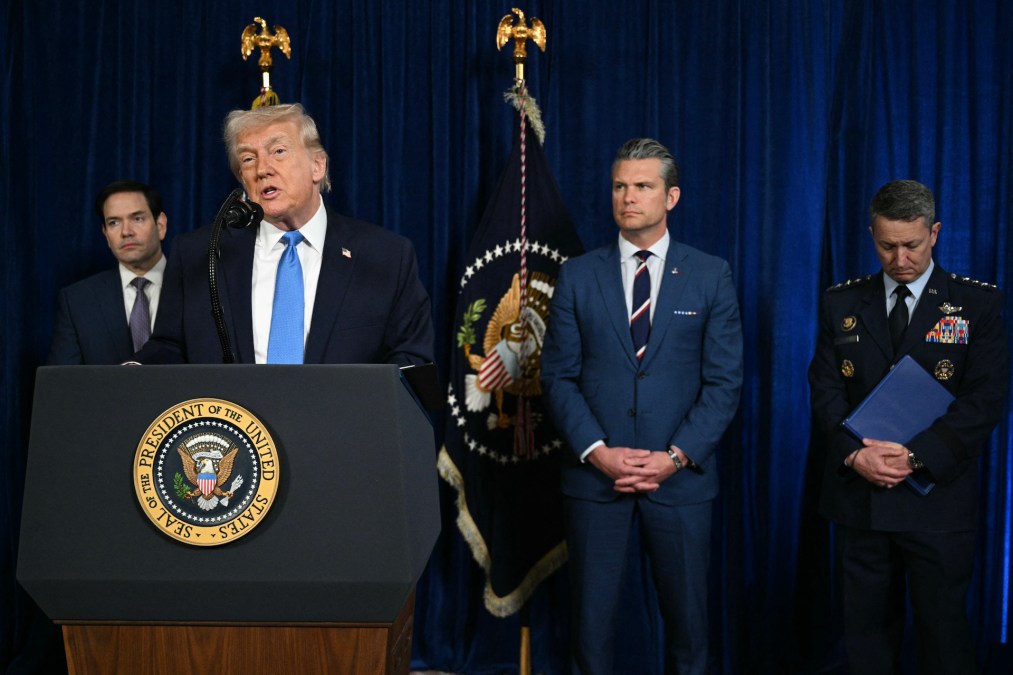
President Donald Trump’s new supplemental spending request includes $67.1 billion to support the Defense Department, featuring funds to advance new capabilities and offset the cost of operations in the Middle East.
The Office of Management and Budget sent the spending package to Congress on Wednesday, requesting a total of $87.6 billion. While the lion’s share of the funds would cover the mounting costs of Operation Epic Fury, the White House is also seeking money for other issues — such as aid to American farmers and responses to the Ebola outbreak in Central Africa.
In a letter sent to Speaker of the House Mike Johnson, R-La., OMB Director Russell Vought urged lawmakers to approve the additional funding as a way to reimburse the Pentagon for the war in Iran.
“Accordingly, the Administration’s request addresses operational costs incurred by the Department of War (DOW) during [Operation Epic Fury], including funding for military personnel and readiness expenses, operational costs to rebuild stocks expended by DOW, classified programs, and other key expenses,” Vought wrote, using a secondary name for the Department of Defense.
The biggest ticket item in the supplemental is a $21 billion request for munitions, which would likely support the Pentagon in replenishing weapons that have been spent during Operation Epic Fury.
Since the conflict began in February, the number of available munitions has been a concern among officials, lawmakers and industry experts. And although Secretary of Defense Pete Hegseth has publicly denied claims of diminishing stockpiles, Trump invoked the Defense Production Act on June 17 to bolster production.
The White House is also seeking over $11 billion to fund emerging technology programs that aren’t directly tied to Operation Epic Fury, such as space capabilities and unmanned systems.
That includes $4 billion for Airborne Moving Target Indication (AMTI) and the Space Data Network (SDN) Backbone — two relatively nascent Space Force programs that hinge on Congress passing another reconciliation package for funding in fiscal 2027.
Space-based AMTI aims to develop a satellite constellation able to continuously detect and follow targets moving through the air, including aircraft and other weapons. The Space Force recently tapped SpaceX for the program, and is banking on $7 billion from reconciliation to begin procurement of the capability in FY27.
As for the SDN Backbone, the service’s request for FY27 seeks over $3 billion across research-and-development and procurement funds that would also come from a reconciliation bill. SpaceX was also recently contracted for the program, which aims to field the foundation of the Pentagon’s next-generation satellite communications architecture.
Other emerging technologies in Trump’s supplemental request include $5.1 billion for “cybersecurity and autonomy” and $2.4 billion for drones. While the supplemental did not name the specific platforms that would directly receive funding if the package is approved, all three capabilities are considered high priorities across the Pentagon.
Notably, the department is spearheading multiple efforts to speed up development, production and deployment of unmanned systems across the services. From the MQ-9 Reaper to the new Low-cost Uncrewed Combat Attack Systems (LUCAS), drones have also played a significant role in U.S. military operations against Iran.
The remaining request for the Defense Department includes $1.7 billion for readiness, $17.3 billion for operational costs, $800 million to support the National Guard; $1.5 billion for fuel, $1.2 billion for unspecified “administration priorities,” and $12.1 billion for other classified programs.
Republicans were quick to support the White House’s supplemental. Rep. Tom Cole of Oklahoma, House Appropriations Committee chairman, and Rep. Ken Calvert of California, head of HAC’s defense subcommittee, said in a joint statement that the request “reflects the reality that our defense strength must be maintained, not merely demonstrated.”
Senate Armed Services Committee Chairman Sen. Roger Wicker, R-Miss., also praised the supplemental request and urged fellow lawmakers to quickly pass the measure.
“This supplemental funding is essential in the near term to maintain readiness through training and military pay. The request would also accelerate immediate production of key capabilities, from exquisite munitions to low-cost hypersonics, strike weapons, and drones,” Wicker said in a statement. “Supplemental resources will help ensure that our forces remain the most capable, lethal, and ready in the world.”
However, Democrats have largely slammed the supplemental package.
“President Trump launched a reckless and costly war with Iran — without authorization from Congress or the support of the American people — that he should never have started, and now, instead of doing anything to help families get by, he is asking taxpayers to pick up the tab and give him billions more to wage wars overseas,” Sen. Patty Murray, D-Wash., ranking member on the Senate Appropriations Committee, said in a statement.
Sen. Chris Coons, D-Del., ranking member of SAC’s subcommittee on defense, also criticized the request and pointed to other needs within the department that require funding.
“The administration also needs to show a serious commitment to funding our military instead of splitting pots of money between supplementals, continuing resolutions, and a doomed reconciliation push,” Coons said. “And most of all, it needs to have clear spend plans for the tens of billions of dollars in military investment, including money for Ukraine, that they received through the last appropriations process and have yet to fully spend.”