An early look at the Pentagon’s plan to deliver AI at scale under Trump
The Trump administration is gearing up to launch an ambitious new plan to spur the military’s near-term adoption of artificial intelligence assets by supplying commercial options directly to users on the ground across three categories that reflect real-world operational needs, according to the Pentagon’s chief technology officer.
Questions have been circulating about the Defense Department’s path ahead for AI since August, when the Office of the Under Secretary of Defense for Research and Engineering assumed the authority, direction, and control of the Chief Digital and AI Office (CDAO) via a major workforce and organizational reshuffle.
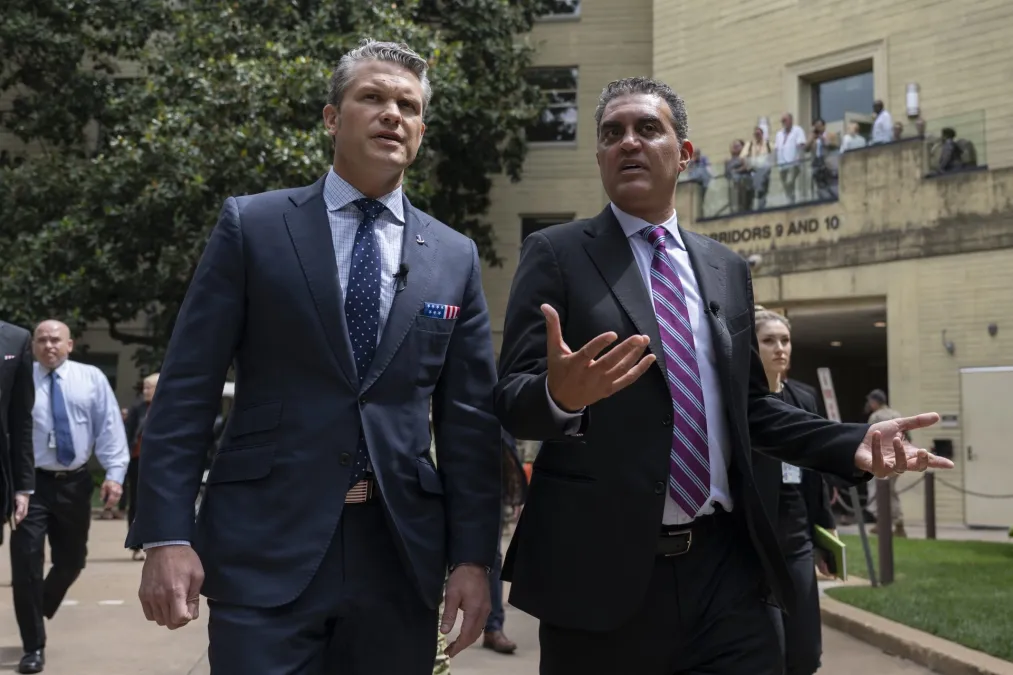
Pentagon CTO and R&E leader Emil Michael shared new details about the DOD’s latest pursuits to reform and accelerate AI integration for in-office functions and modern warfare, during a roundtable with reporters on Monday hosted by the Defense Writers Group.
“My idea is in the next [forthcoming] weeks — so a timeframe of days or weeks — where we’re going to start pushing the deployment of these [AI] capabilities directly to some portion, if not all, of the 3 million users at the Pentagon at different classification levels,” Michael told DefenseScoop. “And once you get it in front of them, people start to learn how to use it.”
The Pentagon has a storied and complex history with AI. Although DOD officials across multiple presidential administrations have prioritized it as a critical emerging technology area in recent years, the department’s AI efforts have simultaneously been hindered by procurement, ethics and personnel challenges.
Its internal AI-pushing hub, the CDAO, achieved full operational capability in 2022. Its creation officially merged several earlier technology-focused organizations at the Pentagon — including the Joint Artificial Intelligence Center (JAIC), Defense Digital Service (DDS), Office of the Chief Data Officer, and the Advana and Maven programs — under the deputy secretary of defense.
Earlier this year, the office was consolidated and moved into Michael’s directorate.
Noting that the CDAO’s approach and mission has shape-shifted a number of times since its early days, he said the “new regime” will be primarily focused on building stronger relationships with major AI companies to quickly deliver models and tools that are tailored for Pentagon-specific use cases.
When the office was initially created, Michael said, AI was not as commercially available for average consumers as it is today.
“Now you have four giant companies: Anthropic, xAI, OpenAI and Google, right? So, you have four investing hundreds of billions of dollars in infrastructure, in research and development, data centers, power cooling chips — you name it. So the explosion of capabilities has been enormous, and we’re just catching up to that. And now that there’s so much money being invested in it, and it’s so proliferated. People are using it on their phones or desktops every day. The familiarity is increasing, and there’s less fear and more excitement about it,” he said. “And now we can take the CDAO and actually try to use it to push the capability into the department for actual use cases.”
Michael didn’t define how the office’s existing deals with those companies will support DOD’s new AI strategy. But under the plan, those use cases will likely be divided into three separate categories.
“One is enterprise, or corporate. So we’re a large organization. How would any large organization use AI for efficiency, to just make the worker more efficient and more productive? Then there’s the intelligence use cases. How do you use it to analyze more intelligence? We have a lot of intelligence that we get from satellites and so on. We don’t analyze all this. A computer probably could do that, because it just needs power and capability to do that. And, [the third is] for warfighting,” Michael said. “For warfighting, it’s logistics, planning, modeling and simulation.”
The vision includes forward-deployed engineers, and other training and resources from the CDAO to propel AI applications.
Michael notably acknowledged that he’s having to “rebuild talent” inside the office to ensure the forthcoming use cases will be successful. He told DefenseScoop that he’s been on a “recruiting binge” to staff the CDAO, which has endured an exodus of senior leaders and other technical employees associated with President Donald Trump’s drastic federal workforce reduction campaign.
The undersecretary dedicates timeslots weekly — during what he calls “recruiting Tuesdays” — for he and his team to email, call and interview potential candidates to join the CDAO, as well as the broader R&E directorate.
At Monday’s media roundtable, Michael emphasized that he is sharply “focused on creating a new environment where Research and Engineering can accelerate our pace and meet the demands of the changing nature of warfare.”
“We’re seeing the weapons and systems needed are dramatically different than they were for the Global War on Terror, where the adversary was an irregular army with sort of crude improvised explosive devices and these sorts of things. Now, you have very sophisticated adversaries in China and a sophisticated war happening in Ukraine and Russia, where you’re having a real change in what the battlefield looks like. You have a robot-on-robot front line now, we’ve never seen before, and that’s why you see this explosion of drone technology,” Michael said.
He continued: “So those changes — combined with the rise of AI and how AI is going to be used for decision superiority for extending human capability beyond what a human analyst can do in any one capacity — all [of these] are new sorts of concepts that are ready for the department to start thinking about in a real way.”