‘Accelerate like hell’: Hegseth moves to reshape DOD’s AI and tech hubs

Defense Secretary Pete Hegseth shared his team’s long-awaited new plans to outpace U.S. adversaries by rapidly advancing the military’s arsenal of AI, drones, hypersonics and other disruptive technologies — and drastically reshaping the Pentagon’s approaches for safely deploying them.
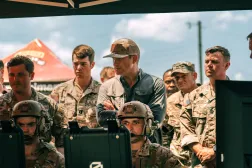
“In short, when it comes to our current threat environment, we are playing a dangerous game with potentially fatal consequences. We need innovation to come from anywhere and evolve with speed and purpose,” he said onstage at SpaceX’s Starbase launch site in Texas, during a tour hosted by its billionaire CEO Elon Musk.
Hegseth’s speech and three accompanying memorandums released Monday reveal the Trump administration’s latest, fast-moving and multifaceted vision to overhaul the Defense Department’s technology enterprise and dismantle perpetual barriers that have historically slowed the military’s commercial capability adoption.
“That old era ends today,” Hegseth said. “We are done running a peacetime science fair while our potential adversaries are running a wartime arms race.”
The ‘innovation operating system’
DOD’s methods, motions and paths toward developing, purchasing and fielding relevant technologies have taken many shapes and gone through multiple organizational realignments in recent decades.
And since President Donald Trump took office last year, rumors have swirled about plans for a fresh round of tech hub shakeups inside the Pentagon under his second administration.
“We must transform how the department fights, buys, and builds,” Hegseth wrote in a new memo published Monday, unveiling his team’s official, near-term strategy.
The revamped structure notably aims to anchor a “unified innovation ecosystem built around six execution organizations” that will now collectively operate under the purview of DOD Chief Technology Officer and Undersecretary for Research and Engineering Emil Michael. Those newer and more legacy entities include: the Pentagon’s Chief Digital and Artificial Intelligence Office (CDAO); Defense Advanced Research Projects Agency (DARPA); Defense Innovation Unit (DIU); Office of Strategic Capital (OSC); Strategic Capabilities Office (SCO); and Test Resource Management Center (TRMC).
Referring to this group as the department’s new “innovation operating system,” Hegseth explained that “DARPA delivers game-changing technology innovation and strategic surprise, DIU delivers scalable products, SCO delivers new ways of fighting, and CDAO and OSC provide data, tests and capital to move at wartime speed.”
As a cohesive hub, they’ll be organized to deliver technology-, product- and operational capability-specific innovation outcomes.
“Every organization in this ecosystem must earn its place by delivering warfighting advantages faster than our adversaries can adapt,” Hegseth told the audience at Starbase.
Pointing to Michael in the front row, the secretary emphasized that the CTO will report to him “every day, and frankly, on whether we are [winning] or losing the technology and innovation competition.” Micheal will have decision authority and lead tech evaluations with a sharp focus on driving real, measurable outcomes.
“Question every requirement, delete the dumb ones, and accelerate like hell,” Hegseth said.
Under the new framework, the Pentagon’s CTO council and Biden-era organizations including the Defense Innovation Steering Group and the Defense Innovation Working Group are being dissolved. Michael is convening a new CTO Action Group (CAG) in their place to inform his decision-making and help eliminate what Trump’s team views as long-standing administrative blockers.
“This is about building an innovation pipeline that cuts through the overgrown, bureaucratic underbrush and clears away the debris — Elon-style, preferably with a chainsaw — and to do so at speed and urgency that meets the moment,” Hegseth said.
To support the CAG, he also directed the military service secretaries to reset their innovation ecosystems and present “Service Innovation Plans” that describe how they will focus the efforts of labs, research enterprises, experimental units and rapid capability offices around the three newly prioritized innovation outcomes.
Those plans are to be delivered to the CTO within 90 days.
Hegseth’s memo on innovation reform additionally states that DIU and SCO, specifically, “will execute with operational independence within the CTO-led ecosystem once fully established.”
The secretary further announced that those two organizations are each being designated as official Department Field Activities, which steer supply or service functions that are shared across the military branches.
Although the two offices are operationally aligned under the CTO and within the R&E directorate, Hegseth noted that DIU’s director will continue to carry out his statutory duties and report directly to the secretary as a principal staff assistant.
At Starbase, Hegseth confirmed that he’s appointing Owen West as DIU’s next permanent chief. West is currently running the secretary’s drone dominance initiative, and previously led DOD activities associated with Trump’s disruptive DOGE initiative to uncover “waste, fraud and abuse” in the federal government and dramatically slash some spending and staff positions to spur savings.
“As a Marine with lots of combat experience, [West] will bring a warfighter’s mentality to DIU’s core mission of transitioning technology to our troops,” Hegseth said.
AI to fight wars
During his speech at Starbase, the secretary also announced that he’s tapped Cameron Stanley to serve as the Pentagon’s next CDAO — confirming DefenseScoop’s exclusive reporting last week about that forthcoming hiring.
“[Stanley] will be leading a new team, many of whom have foregone or left lucrative careers at pioneer companies such as AWS, Databricks, Palantir and Meta to join the fight,” Hegseth said.
The Pentagon’s overarching management, governance and approach to AI has morphed into many forms over the last decade as algorithm-enabled technologies have quickly matured.
In late 2021, senior officials in the Biden administration directed the launch of the CDAO and elevated its elements to report directly to the deputy defense secretary. That AI-accelerating hub combined and consolidated multiple technology-focused predecessor organizations, including the JAIC, Defense Digital Service, Office of the Chief Data Officer, and the Project Maven and Advana programs.
In Texas and through two other memorandums published on Monday, Hegseth spotlighted his team’s broad agenda of initiatives to transform DOD into “an ‘AI-first’ warfighting force across all components, from front to back.”
His directions for the military to quickly unleash still-maturing and sometimes unpredictably dangerous emerging AI assets display a clear contrast from the Biden administration’s past policies that prohibited defense and national security agencies from applying the capabilities in ways that could cause unintended consequences, or present existing and unforeseen threats.
Under his leadership, Hegseth said the Pentagon defines “responsible AI” as “objectively truthful AI capabilities employed securely and within the laws governing the activities of the department.”
“We will not employ AI models that won’t allow you to fight wars. We will judge AI models on this standard alone — factually accurate, mission-relevant without ideological constraints that limit lawful military applications,” he told the audience.
Via a memo that outlines DOD’s latest AI acceleration strategy, Hegseth directed the new CDAO to create benchmarks for model objectivity as a primary procurement criterion within 90 days, and mandated DOD’s undersecretary for acquisition and sustainment to incorporate standard “any lawful use” language into any contracts for AI purchases, within 180 days.
Among other provisions, that guidance also requires the CDAO to execute on a set of outcome-oriented “Pace-Setting Projects” that support the buildout of the foundational AI enablers, such as those limiting full-scale integration and are related to infrastructure, data, models, policies and talent gaps.
Seven initial projects for CDAO prioritization are listed in the memo, including the Pentagon’s controversial new GenAI.mil platform and six newly divulged projects related to speedy experimentation venues, new simulation capabilities, a new network of AI agents and more.
“Barriers to data-sharing, authority to operate or ATOs, test and evaluation, and contracting are now treated as operational risks, not simply bureaucratic inconveniences. We are blowing up these barriers,” Hegseth said Monday. “That’s why today, in my direction, we’re establishing a barrier removal SWAT team under R&E, with the authority to waive non-statutory requirements and escalate to our great Deputy Secretary Steve Feinberg, anything that slows down the acceleration of AI capabilities.”
He additionally called on the Pentagon and Intelligence Community to ensure that all “appropriate data” from the military’s weapons and IT systems is made available for “AI exploitation” in the future, supplying explicit instructions on that.
In a third directive published Monday, DOD outlined a new CDAO campaign to reformat and modernize the Advana program and transition into a construct that separates DOD’s financial data from a new War Data Platform.
“This is not reform for the sake of reform. It never has been. This is about whether our warriors fight with yesterday’s tools or they fight over-matching our adversaries using tomorrow’s technologies,” Hegseth said at Starbase. “We know the threat. We know the opportunity. We know what must be done. We share the urgency now. We will do it — and we must do it at wartime speed.”