Coast Guard hustling to refine and scale genAI ‘Ask Hamilton’ prototype
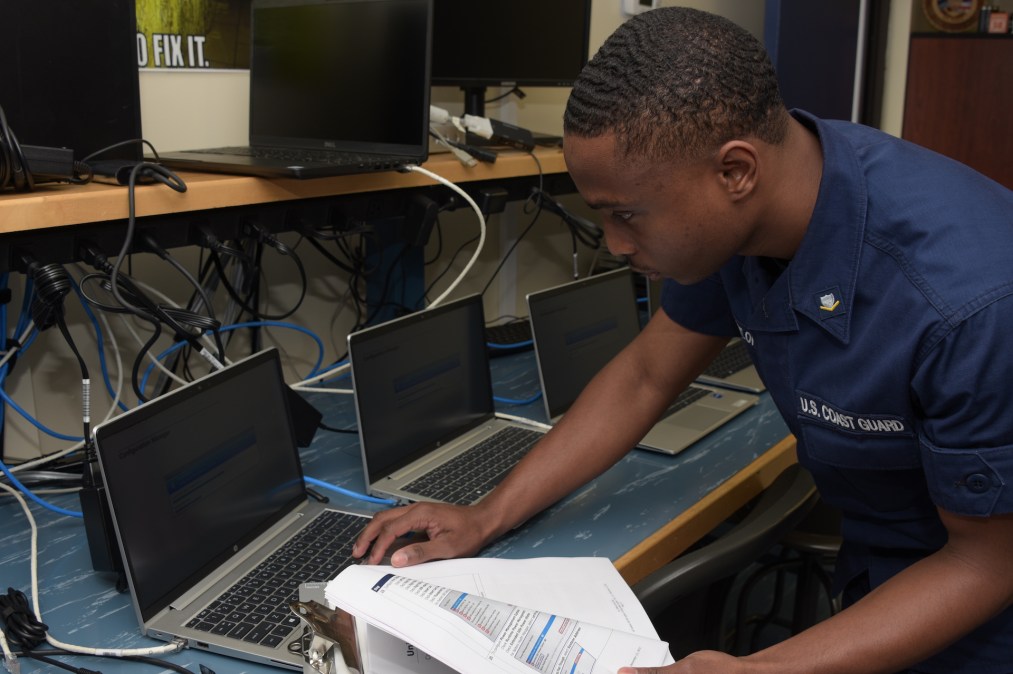
The U.S. Coast Guard is refining and integrating a new generative AI-enabled platform to help personnel quickly retrieve reliable answers from referenceable internal sources via a secure data environment that is configured to support their specific operations.
This prototype system — named Ask Hamilton, in honor of the so-called “father of the Coast Guard” Alexander Hamilton — is being designed to streamline information access and improve user efficiency across typically tedious tasks like marine inspections.
“We have 11 missions. There’s a lot of communities out there. I want to give each of those an opportunity to interact with AI in a very meaningful way. So not a generic chatbot, right? It is something that is very Coast Guard-specific,” Cmdr. Jonathan White, the service’s cloud, data and AI branch chief, said.
Those 11 statutory missions involve a variety of high-stakes homeland security and maritime activities, including search and rescue operations, drug and migrant interdictions, U.S. port security and more.
White shed new light on the making of Ask Hamilton and several genAI use cases the Coast Guard is eyeing, during a panel moderated by FedScoop and a sideline chat with DefenseScoop at an SNGLive event on Wednesday.
Over the last few years, he’s been building out the Coast Guard’s enterprise cloud and data infrastructure.
“And during the midst of this was the AI revolution that we just had,” White noted, referring to the recent generative artificial intelligence boom that fully kicked off around early 2023 as companies started releasing advanced models for widespread, public use.
The rapidly emerging field of genAI and associated large language models — which can generate convincing but not always correct software code, images, audio and other media from human prompts — present both promise and complex risks to U.S. military and homeland security operations.
According to White, the Coast Guard has been “really intentional” about promoting safety guardrails and clear directions about “rules of engagement” when encouraging genAI adoption. He also recognizes a sort of “take-and-give going on,” where the federal government went back and forth on facilitating genAI access “because it was risky.”
“But what I’ve seen [recently] is the rapid replacement of unauthorized solutions with authorized solutions, which is really exciting. It’s happening really, really fast,” White said.
Years back, Coast Guard officials had an idea to create an internal chatbot named Ask Hamilton, but no one had the expertise to produce it at the time.
“So, we resurrected that name when genAI actually became a thing,” White noted. “Then, we put the first prototype together and we kind of paraded that around and said, ‘Look, here’s what the art of the possible is.’ And all this time AI is changing, and the world is changing, and the rules are changing. So, we were able to re-engage at the end of this last fiscal year, and now we’re in a deployment cycle.”
Currently, Ask Hamilton is being developed and fine-tuned to leverage back-end AI that provides users with extremely tailored responses from embedded Coast Guard databases and records using a trustworthy chat interface.
The prototype is intended to mature into full production this year.
“It’s actually exciting, because you’re seeing all these other options — like GenAI.mil — come out and kind of satiate the appetite for AI usage. And then hopefully we just kind of streamline use of the specific solution [Ask Hamilton] as a primary alternative” that’s customized for the Coast Guard, White told DefenseScoop.
In December, Pentagon leadership rolled out the new GenAI.mil platform to supply industry-built AI assets to almost its entire workforce, directly on their government desktops. Google’s Gemini products were the first to be available on the asset, and other commercial capabilities are in the near-term pipeline.
White confirmed that the Coast Guard operates on the Defense Department’s networks, and eagerly reaps the benefits of the department’s investments in enterprise AI solutions, including through GenAI.mil.
He said one big-picture goal is to offer users the option to combine or replace those capabilities with Ask Hamilton.
“I think there’s a long-game here, where those options actually turn into each other. So, they kind of merge into each other, whereas maybe you get rid of the weird frontend that has a lot of user choices going on. Like, ‘Do I use Gemini? Do I use this? What’s the best thing for me?’” White explained. “But then, we in the enterprise IT layer are using the backend, and so we actually present Ask Hamilton in the app you’re using. The idea is don’t go to the AI — the AI comes to you, but it’s Coast Guard AI. So, it’s not a generic experience. It’s a very tailored, very focused experience.”
In response to DefenseScoop’s questions, he pointed to multiple AI use case applications that make sense for the Coast Guard to pursue right now. For example, the engineering community can lean on genAI to review ship drawings and design specifications against Coast Guard and Navy requirements.
“That’s a huge task,” White said. “It takes a huge team to figure that out. If they can do that more efficiently and iteratively, that would be huge.”
Separately, marine inspectors who conduct compliance checks on vessels can apply genAI to drastically reduce the amount of information and public law they have to carry to verify their inspections — and have real-time conversations with a trained chatbot to streamline and validate their findings.
And in White’s view, there’s also a more general use case associated with enabling personnel to more quickly and efficiently identify Coast Guard information that’s often locked away in different PDF documents, message traffic, internal manuals and policies, and other sources.
“We’re also building these ‘user journey maps’ to show what the current user is doing today — and where, when we inject AI into that experience, what are they not doing in the future?” White said. “This [gets after the return on investment or] ROI, right, because we’re able to shorten that chain of events.”
FedScoop’s Miranda Nazzaro contributed reporting.