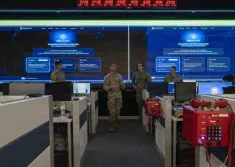
5 out of 6 military branches have elevated GenAI.mil as their go-to enterprise AI platform
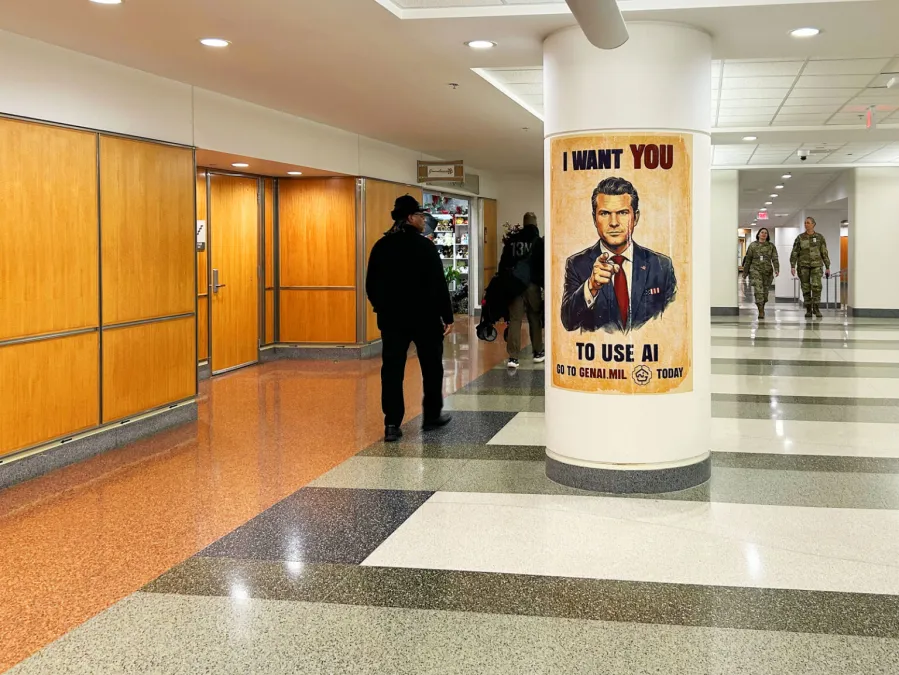
Almost two months after the Pentagon deployed GenAI.mil on government desktops across its sprawling workforce, all but one of the military services have formally declared the asset to be their teams’ AI platform of choice.
In response to questions from DefenseScoop on Monday, a Pentagon official said that there have been “1.1 million unique users” on GenAI.mil to date.
They further confirmed that five of the six military branches have adopted the tool enterprise-wide over legacy systems — noting that it’s just “minus the [U.S. Coast Guard] for now.”
Although the Coast Guard is considered a military service and works with other elements of the joint force, it falls under the Department of Homeland Security, not the Department of Defense.
Generative AI is an emerging, disruptive technology field that applies complex and powerful models to produce code, media and other original, human-like outputs that are based on user prompts, but not always factually accurate. Since commercial genAI products were made widely available to the general public around late 2022 — and met with near-instant hype — experts have warned about severe known and unpredictable threats that the conversational tech poses to humanity, privacy, public trust and democratic processes.
The U.S. military services’ rules and paths to using genAI have largely been fragmented and hindered by data ownership, procurement issues and other challenges.
But last summer, Defense Department leaders announced individual contracts with OpenAI, Anthropic, Google and xAI — each worth up to $200 million — for “frontier AI projects.” The deals were billed as enabling the majority of personnel to access some of the most advanced commercial genAI capabilities developed by the four companies, including large language models, agentic AI workflows, cloud-based infrastructure and more.
Building on that, in December, the DOD revealed plans for a swift and expansive release of GenAI.mil to more than 3 million military members, civilian employees and contractors. Google Cloud’s Gemini for Government products are the first to go live in the one-stop-shop, and others from xAI, OpenAI and Anthropic were said to soon follow.
That fast-paced rollout and integration of the commercial options prompted users and experts to raise multiple security, safety, and ethical concerns in its wake.
Some warned of risks associated with data leakage, the possibility for adversarial “poisoning” of training data, and the seeming lack of rigorous training and evaluation processes ahead of the department-wide mandate from Defense Secretary Pete Hegseth for practically all employees to use it.
Officials also pointed to potential duplication of efforts and investments, as the services previously tapped into earlier purpose-built options — like NIPRGPT, CamoGPT and AskSage — that were trained and authorized on sensitive, unclassified, and some classified military-specific data, respectively, in the years before DOD launched the new commercial platform. In response to multiple inquiries and follow-up questions since then, the department has been broadly unforthcoming about real-world use cases or how it’s resolving certain concerns.
But over the last few weeks, most of the military services have proclaimed their prioritization of GenAI.mil.
The Marine Corps issued a force-wide message last month announcing the hub as its enterprise solution of choice moving forward for its user base.
And in official social media posts last week, the Army, Space Force and Air Force all referred to themselves as “AI-first” organizations that are turning to the new enterprise platform. While the Air Force is sunsetting NIPRGPT in favor of GenAI.mil, the Army will not completely cut off personnel’s access to its preexisting frontier AI models.
Separately, a Navy spokesperson told DefenseScoop on Monday that the sea service is “fully aligned” with the Pentagon’s strategy to become an “AI-first” warfighting force.
“Accordingly, the department has designated GenAI as the mandated platform for mission owners and all Department of the Navy (DON) users,” the spokesperson confirmed.
The Coast Guard is currently developing and refining its own internal, customized Ask Hamilton genAI tool — though insiders are said to have direct access to GenAI.mil on their government-issued devices.