Navy CNO is ‘all ahead flank’ on AI
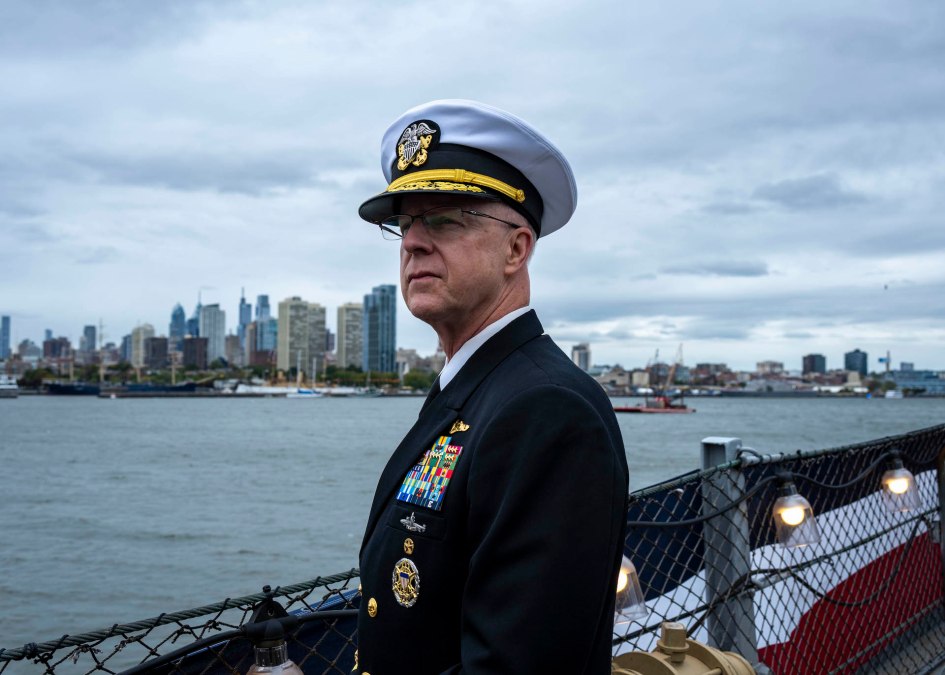
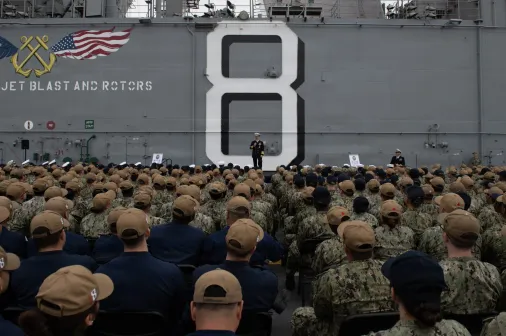
SAN DIEGO — The Navy’s ambitious vision to enable a Golden Fleet of heavily armed, high-tech manned warships accompanied by a vast network of nimble unmanned and autonomous platforms hinges on artificial intelligence.
But according to its highest-ranking officer, the sea service still has much to navigate and a long way to go on its path to securely integrating AI capabilities at scale in support of that initiative.
“I am not satisfied with where we are in our AI journey,” Chief of Naval Operations Adm. Daryl Caudle said on Tuesday. “We’re not there yet.”
In his opening remarks at the WEST conference and during a meeting with a small group of reporters, Caudle shed light on the Navy’s near-term priorities associated with AI adoption. The CNO also discussed his expectations regarding how the technology could impact the service’s workforce requirements as the Golden Fleet emerges.
“I am 100% ‘all ahead flank’ on AI,” Caudle told DefenseScoop, using the nautical term that refers to a ship’s true maximum speed.
On Monday, Caudle unveiled new “Fighting Instructions” to guide how the Navy organizes and functions in an uncertain era that involves ongoing conflicts and intense global competition.
The CNO’s previously unveiled Hedge Strategy marks a key component underpinning those directions. In the simplest form, he noted, the Fighting Instructions provide “a conceptual framework for modern warfare, delivering homeland defense, sustaining our global network of deterrence and preserving our national prosperity.”
It’s designed to be enduring, as he put it, and to offer an approach that can be generally applied to how military leaders “think about the flow of generation and certification of naval forces.” Notably, the CNO’s new Fighting Instructions urge the Navy and defense industrial base to embed AI into core naval functions and establish fleet-wide data standards.
The Trump administration’s Golden Fleet is not explicitly referenced in the new guidance, in an effort to be “agnostic to specifics,” Caudle said. But he added that that initiative absolutely applies, as it acts as the primary force design structure to implement the overarching strategy and structure of U.S. naval power.
AI will be essential to the service’s pursuits to redefine the design, manufacturing and operation of next-generation battleships and enable a hybrid fleet of manned and unmanned vessels.
Caudle told DefenseScoop he sorts AI into three “lenses.”
The first involves capabilities that conduct trend analyses across the entire force. Caudle said he’d like to be able to ask a large language model to give him a sense of high-risk areas that sailors may experience — such as the probability of a certain set of sailors in a specific place to endure a motorcycle accident, or the propensity for service members to make it all the way through deployment without facing a medical issue.
“There’s [another] sector of AI that does things I characterize under ‘facial recognition.’ But that’s just my colloquial way of saying — you see something, and then I can make a decision about what it’s seeing in a very thoughtful way,” Caudle said. “That can be something on the seabed. That can be, of course, targeting. That can be, of course, looking at a license plate coming into a gate to know that I need to pull that car aside because there’s a threat there.”
The third category involves offloading repetitive tasks from sailors.
“If I write a work package to replace a mechanical seal in a pump, and I do that one time and I like it, just dump that into AI and then change a few parameters, and that thing can really create this work package again — and probably even add value to it if I ask the question the right way,” Caudle said.
Later on, in response to a question from an audience member after his keynote, Caudle also pointed to those focus areas.
“There’s the three, kind of, ways I view that — and just we’re not there,” he said. “But we’re going to get there.”
Questions have swirled about the viability, cost, and other major elements that would contribute to the success of the Golden Fleet initiative. Caudle did not directly answer DefenseScoop’s questions regarding how many personnel would man the new 30,000-40,000-ton battleships.
However, he said AI will likely empower sailors and improve decision speed and quality, “more than actually reducing the workforce for at-sea manning levels.”
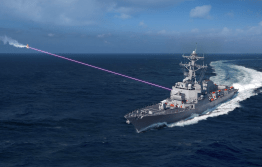
“You can imagine an operational specialist sitting at a screen trying to weed through thousands of contacts, maintaining that common operational picture, and see some type of incoming missile in all that. Now the system is pretty good at that today — but imagine what it could be in the future when properly written algorithms are supporting those decision matrices and then making recommendations on the right capability, like directed energy, all the way to a small missile system, the five-inch gun, SM-2, SM-6 — all the way up in a more integrated and effective way,” Caudle said. “So I mean, the sky’s the limit on how we can employ that.”
It’s more plausible, in his view, that AI will lead to a decrease in the Navy’s manning level for personnel ashore, like jobs associated with financial management and weedy administrative activities.
“Sometimes it reduces jobs in a certain sector. But generally what that does is open the doors for additional jobs somewhere else,” Caudle told DefenseScoop.