Marine Corps fuels high-stakes competition for its Advanced Reconnaissance Vehicle with new deals
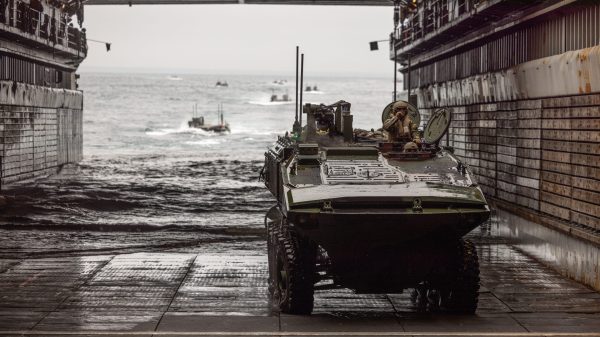
The Marine Corps awarded a second prototyping phase for its Advanced Reconnaissance Vehicle (ARV) program last week, driving an expensive, high-stakes competition between two major defense companies to replace a decades-old platform and shape part of the service’s amphibious repertoire.
The Marine Corps announced April 1 that General Dynamics Land Systems and Textron Systems “will be building and delivering” three pre-production variations of the ARV by 2028: a command and control model with drone capabilities, one with a 30mm autocannon and a third for logistics.
With billions on the line for one company in the end, the announcement marked a notch in the Corps’ effort to replace the GD-produced Light Armored Vehicle (LAV), a platform which entered service in the 1980s and is expected to finish its tour in the mid-2030s in time for the ARV’s full, tech-focused arrival.
A senior representative from Textron expressed confidence to DefenseScoop about the competition and that the company would “ultimately win.” A spokesperson for GD acknowledged the publication’s questions and request for interview, but did not provide either by deadline.
“In the future fight, the Marine Air-Ground Task Force [MAGTF C2] must out cycle the fight for information to shape the battlespace and deliver precision fires,” said Col. Chris Stephenson, program manager for Light Armored Vehicles, according to the release.
Officials said the program used stand-alone other transaction authorities, an acquisition tool the military is increasingly leaning on, to “maintain agility and technical moment” as well as “leverage the competition” from initial ARV program efforts.
Textron also announced April 1 it had completed its build and evaluation period for its 30mm prototype, which is part of its Cottonmouth ARV family of vehicles. The company said it was awarded a $450 million agreement in a separate statement, though characterized it as a pre-production development deal.
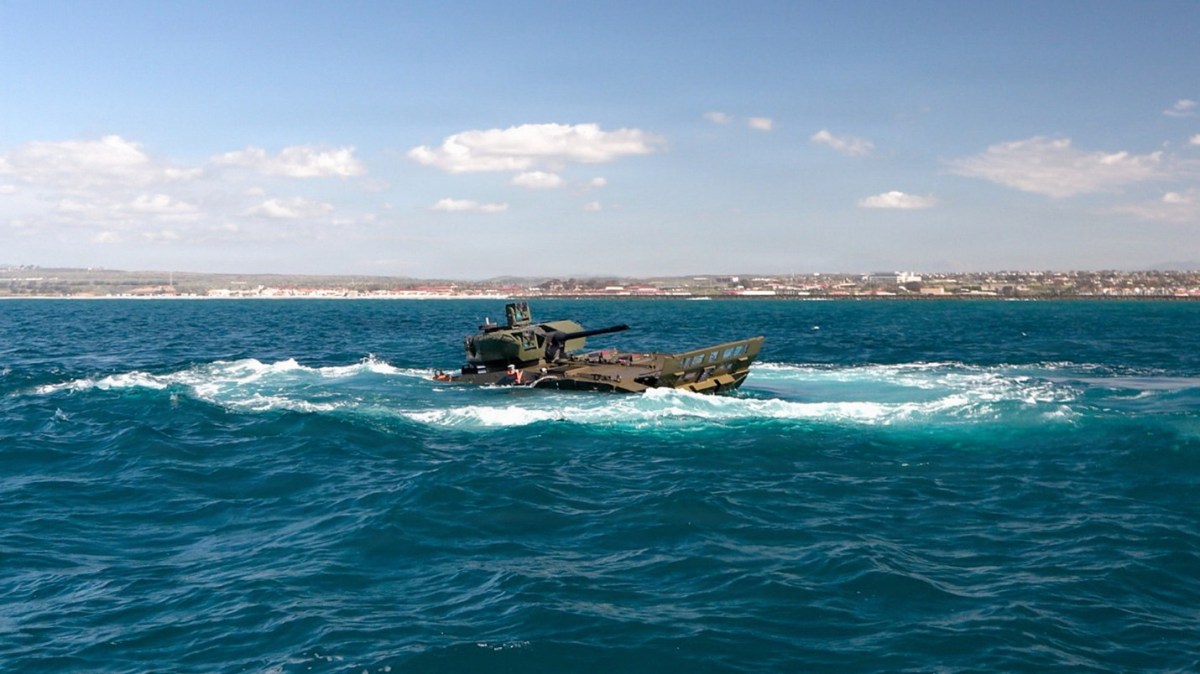
GD said earlier this year it completed additional testing of its own 30mm variant and that it would continue prototype evaluations of both autocannon and command, control, communications, computer, unmanned aerial system (C4/UAS) versions throughout the rest of the year. A spokesperson did not disclose the award amount for the recently announced prototyping phase.
Touting its water testing earlier this year, a GDLS representatives said “we pride ourselves on delivering capabilities that will be durable, reliable and affordable over the program’s life cycle, and we look forward to continuing our long partnership with the Marines and contributing to their effort to make the ARV a transformational reconnaissance capability.”
Born out of the Marine Corps’ sweeping Force Design restructuring, an ongoing effort aimed at making the service sleeker and more complementary to the Navy for global conflict, the ARV concept drew early skepticism from the reorganization’s chief architect.
Then-commandant Gen. David Berger was “unconvinced that additional wheeled, manned armored ground reconnaissance units are the best and only answer,” according to Force Design’s inaugural 2020 document.
Both Textron and GDLS have billed their products as modular, maneuverable and built on wheels meant to traverse land and water so Marines can reconnoiter from multiple environments. Corps officials have emphasized the need for Marine units to navigate an increasingly complex and ever-changing information landscape.
“They’ve made it very clear from day one that they want to be able to integrate and iterate on these vehicles and they want to do that in rapid fashion as technology becomes available,” David Phillips, senior vice president of Textron’s air, land and sea portfolio, told DefenseScoop.
Phillips said that part of the Corps’ program included several tiers of requirements, meaning companies had to assess a “cost-benefit tradeoff” to meet less important requirements. The weight of the vehicle, he said, was a tier one requirement.
Under the recent award announcement, Textron is expecting to deliver 16 “production representative” systems across the three different variants: six 30mm versions, six C4/UAS platforms and four of the logistics models that will go “through extensive testing,” Phillips said.
He said Textron has already established its production line in preparation for full-rate output and because “we need to be able to show the Marine Corps that we are set up, that we have the factory, that we have the staffing, the people in place to be able to produce these exactly as we will in production.”
Phillips said that establishing production “really does reduce my risk when I ultimately win and I have to go produce hundreds of these.” When asked whether that would increase the risk for Textron if it doesn’t win the ultimate bid, he said he’s “more an optimist” and Textron’s production facility “is not dependent just on ARV.”
“We like to think of ourselves as part of the industrial base,” Phillips said. “We look at these things in terms of the longer-term vision and we have to be success oriented,” boosted by “exceptional” prototype performance, “significant investment” in making the first ARV themselves and advanced manufacturing techniques.
Force Design has wrought change for the Corps’ light armored reconnaissance battalions, which relied on the LAV. Now, the service seeks to build mobile reconnaissance battalions, or MRBs intended to shed a “sole reliance” on armored ground vehicles for a unit to get information in multiple, data-heavy domains. The ARV will be central to the MRB.
“This highly contested environment is drastically more complex,” Stephenson said. “And mobile reconnaissance battalions must have a purpose-built capability such as the ARV that can sense, communicate, and fight by incorporating manned and unmanned systems and sustaining effective sensor webs tied to kill chains.”