U.S. deployed ‘armada’ with more than 150 aircraft to recover downed aviator in Iran
The U.S. military surged more than 150 aircraft deep into Iran’s territory this weekend in a search-and-rescue mission President Donald Trump initiated to recover an airman who hid in a mountain crevice for almost 48 hours to evade being captured after ejecting from his F-15E fighter jet that was hit by enemy fire.
When it was struck Thursday night, that F-15E — known by call sign Dude 44 — marked the first confirmed shootdown of an American military aircraft by Iran since the war began a little over a month ago.
“Both members of the crew ejected from the aircraft and landed alive on Iranian soil. I immediately was asked to make a decision. I ordered the U.S. armed forces to do whatever was necessary to bring our brave warriors back home — a risky decision, because we could have ended up with 100 dead, as opposed to one or two,” Trump told reporters on Monday. “It’s a hard decision to make, but in the United States military we leave no American behind.”
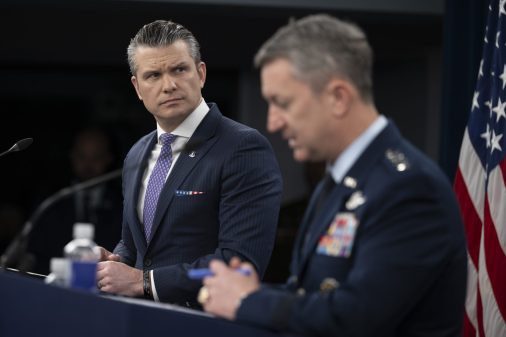
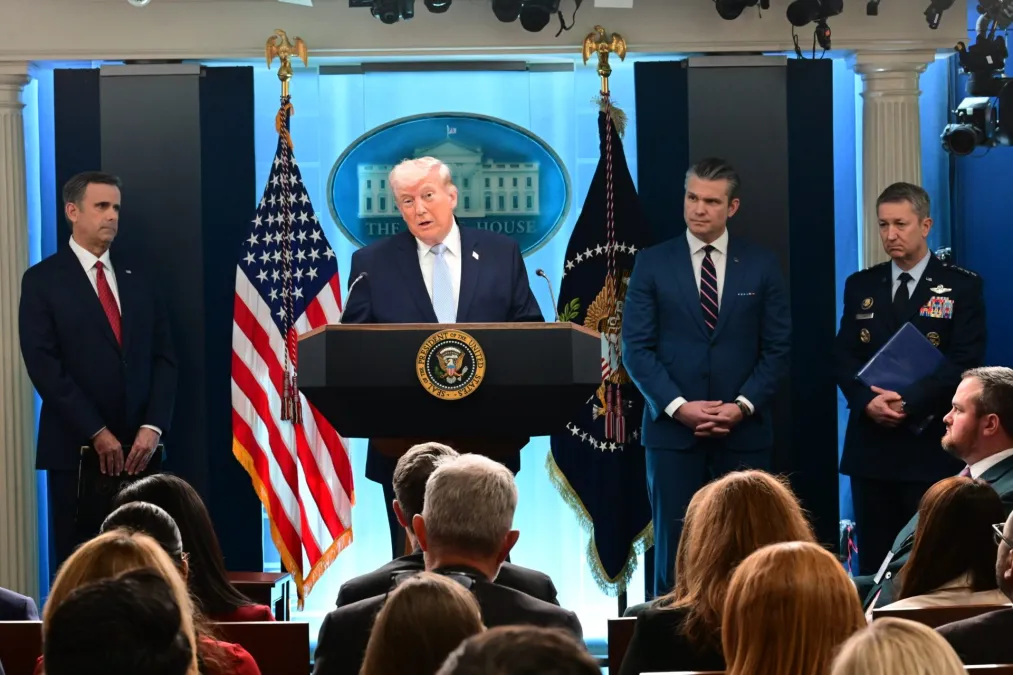
The president discussed what he called this “historic rescue mission” during a press briefing at the White House, alongside Defense Secretary Pete Hegseth, Chairman of the Joint Chiefs of Staff Gen. Dan Caine, and CIA Director John Ratcliffe.
According to Trump, U.S. troops took “no casualties of any kind” in the search and rescue missions, which concluded Easter Sunday.
Since the early days of Operation Epic Fury, the president and his top advisors have repeatedly asserted that Iran’s air defenses are being completely neutralized by U.S. and Israeli forces.
“We took out their anti-aircraft, which is great. We took out their radar. … We took out a lot, but they still have — you know, what hit this one was a handheld shoulder missile, a heat-seeking missile,” Trump said Monday. “But they shot it, and it got sucked in right by the [F-15E’s] engine.”
The fighter jet’s pilot was rescued in broad daylight on Friday, in a seven-hour operation that he noted deployed 21 military aircraft flying at very low altitude in hostile airspace, “being shot by bullets.”
The pilot was extracted by an HH-60 Jolly Green II rescue helicopter, and that mission also involved A‑10 Warthogs and HC‑130 Combat King II variants.
The second crew member, who Trump referred to as a “heroic weapons system officer,” was “in tough shape” after ejecting, according to the president.
The officer “scaled cliff faces bleeding rather profusely, treated his own wounds, and contacted American forces to transmit his location” from a “sophisticated beeper-type apparatus,” Trump said, adding that the technology “amazingly saved his life.”
He also thanked the CIA for supporting the mission and pinpointing the pilot in the rugged mountain terrain with a camera.
“We immediately mobilized a massive operation to retrieve him from the mountain,” Trump told reporters. “The second rescue mission involved 155 aircraft — including four bombers, 64 fighters, 48 refueling tankers, 13 rescue aircraft and more. We were bringing them all over, and a lot of it was subterfuge. We wanted to have [Iranians] think he was in a different location, because they had a vast military force out there. Thousands of people were looking.”
As part of the deception campaign, the CIA deployed human assets and “exquisite” technologies to mislead Iran about the pilot’s whereabouts. U.S. aircraft circled in seven different locations to confuse the Iranian military and trick them into thinking the aviator was elsewhere.
During his remarks, Caine noted that personnel involved “were protected overhead by an air armada — including tactical drones, strike aircraft and others — and the force fought through multiple contingencies, something no other nation, no other military can do and safely return.”
He and the other senior officials also confirmed that the U.S. military intentionally opted to destroy two of its own transport planes that became stranded on the ground in Iran and were equipped with sensitive technologies.
“We blew them up to smithereens, because we had equipment on the planes that, frankly, we’d like to take, but I don’t think it was worthwhile spending another four hours there taking it off,” Trump said.
In the first 37 days of Epic Fury, he noted, the joint force has carried out more than 10,000 flights over Iran, striking more than 13,000 targets.
“Per the president’s direction, today will be the largest volume of strikes since day one of this operation. Tomorrow, even more than today. And then Iran has a choice. Choose wisely, because this president does not play around,” Hegseth said.
In response to the U.S.-led, Israel-coordinated military operation, Iran has brought maritime traffic on a major global shipping route for oil near the Strait of Hormuz to a disruptive standstill.
At the briefing on Monday, Trump said the U.S. has a plan to “decimate” every bridge and power plant in Iran if the strait does not re-open by a deadline he’s set for midnight EDT Wednesday.
“The entire country can be taken out in one night — and that night might be tomorrow night,” Trump said.
“Do I want to destroy their infrastructure? No. It will take them 100 years to rebuild. Right now, if we left, it would take them 20 years to rebuild their country, and it would never be as good as it was,” he also told reporters.