Army will soon deliver first batch of detection tools to help command posts identify their own signal emissions, protect from EMS targeting

ABERDEEN, Md. — The Army will soon field the first batch of a new detection system intended to identify signals emitted from friendly units, service officials said, part of an effort to prevent adversaries from capitalizing on an increasingly observable electromagnetic spectrum to find targets.
The service will deliver nine Spectrum Situational Awareness Systems, or S2AS, to “prioritized Army units” in three weeks, officials told reporters at Aberdeen Proving Ground in Maryland on Thursday. By July 2027, the service expects to have delivered 46 of the systems, which are developed by the Ohio-headquartered 3dB Labs.
Spurred by the Ukraine war, officials have said the electromagnetic spectrum (EMS) has become a progressively deadly domain, where virtually every emission can be detected and targeted by a slew of fast, lethal weapons in a matter of minutes.
After having fought 20 years of the Global War on Terror where radio, microwave and other emissions were much less of a concern, the military is becoming hyperaware of its own EM signatures as it prepares for the modern battlefield.
“It’s meant to look at ourselves,” said Lt. Col. David Picard, product manager for Tactical Spectrum Warfare at APG. Because an adversary can now quickly detect radio waves, microwaves and other emissions produced by military and commercial equipment, “one of the tactics is to reduce our signature as a formation.”
“So how do you know that you’ve reduced your electromagnetic signature?” he said. “You got to measure it, and that’s what this system does.”
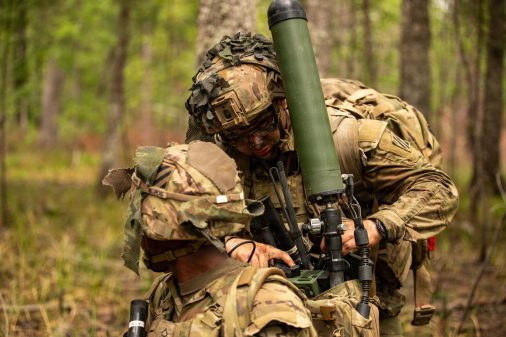
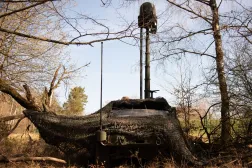
While heavy, two soldiers can carry the S2AS, Picard said, though they can also “strap” it to a vehicle or tripod. One system comes with two nodes, and has handheld detection features, he added. The intent is to place it in an area where it can measure brigade or division command post node readings, or what Picard called “high payoff target[s].”
Officials declined to say which units the technology would be going to. Picard said the system was already in high demand from commanders. The Army announced last year it had awarded 3dB Labs a $6.1 million contract to develop and demo the S2AS platform over a 14-month period.
DefenseScoop reported earlier this summer that soldiers testing the Army’s prototype Next Generation Command and Control ecosystem were adopting a “hiding in the spectrum” tactic. Command post nodes, from which commanders project their forces, were attempting to obscure their own positions by matching their signatures to the most prevalent local emissions.
The S2AS can identify “rogue” signals — cell phones or radio chatter, for example — from units that are breaking friendly emission protocols, Picard said. The tool does not suppress the emission, but simply identifies it.
“Command posts typically give off a pretty significant signature, so we want to make sure that we have good visibility of that as we go forward,” he said.
Once those friendly signatures are spotted, the idea is for signal soldiers to physically travel to the source of the errant emission or — if they’re able to in a sensitive EM environment — communicate it through the C2 ecosystem, officials explained.
Signal officers fresh from tours supporting Ukraine in its fight against Russia said that leaders in the U.S. military are still operating as though the EMS is as “permissive” as it was during the GWOT, DefenseScoop reported.
They also said signal soldiers will have to become some of the most tactically proficient members of the battlefield, hyperaware of every cable that can now be seen from space and ready to displace at a moment’s notice lest they are targeted by the enemy.