Agencies agree to counter unauthorized drones without compromising civilian safety, under new MOU
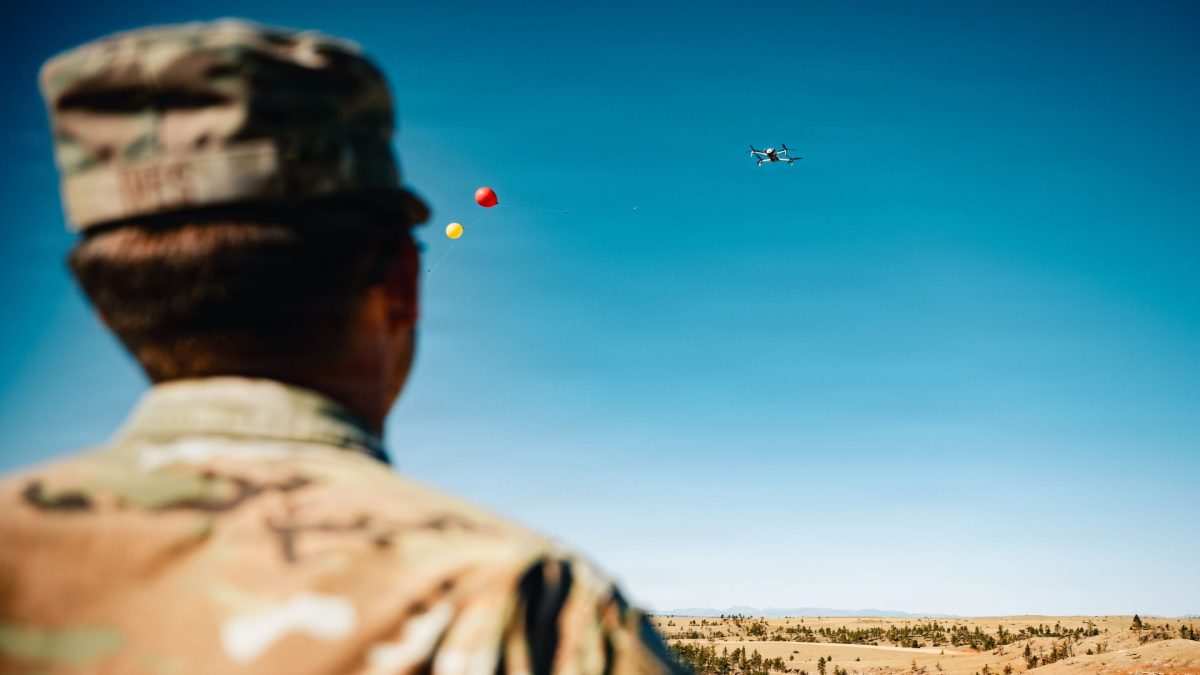
The second Trump administration firmed up an agreement that will further expand ongoing interagency efforts to safely counter and intercept rogue drone threats in civilian airspace.
The departments of Defense, Transportation, Homeland Security, Energy and Justice signed a new memorandum of understanding that outlines a more unified federal process to test and deploy counter-drone technologies in the U.S., according to a press release published Monday.
It comes as the government scurries to respond to a recent surge in unauthorized drone incursions over American military bases and sensitive national security sites — including Fort McNair in Washington, D.C.
“Through this whole-of-government approach, the agencies are strengthening collaboration to adapt to the latest drone threats while ensuring these technologies do not adversely affect aircraft operations or navigation equipment,” officials wrote in the joint statement.
Stopping unmanned aerial systems with jamming and other tech risks disrupting the radars, communications, and GPS of passing commercial airplanes and transportation assets.
But the recent uptick in drone swarms and unapproved flights detected around defense and critical infrastructure has moved the U.S. government, military and law enforcement enterprises to fuse their risk and response strategies.
Officials involved shared updates about this and other elements of their unfolding work at a media roundtable during the Commercial Drone Alliance’s Drone Security Industry and SLTT Grant Forum on Monday.
“We are building a counter-UAS mitigation plan for this country that accounts for the worst possible utilization of a drone — which is having a payload — explosive, or biological, chemical, or even something that although on its surface doesn’t do harm, the panic that would ensue from dropping off [a drone at a large-scale event, it] would create a stampede situation, or panic that would induce violence or induce danger to the community,” said Devin Kowalski, who serves as assistant director of the FBI’s Critical Incident Response Group.
The new interagency MOU unveiled this week was “led by the White House Task Force to Restore American Airspace Sovereignty,” per the release.
President Donald Trump launched that team last year in an executive order that set a formal policy and implementation instructions designed “to protect the public, critical infrastructure, mass gathering events, and military and sensitive government installations and operations from threats posed by the careless or unlawful use of UAS.”
The agencies involved did not publish the text of the signed memorandum of understanding.
When asked for the document and more information about what prompted the agreement, a Pentagon spokesperson told DefenseScoop on Monday that the department had “nothing further to add beyond the release at this time.”
Broadly, that press release indicates that the agencies participating in the new MOU will work with the Federal Aviation Administration and Federal Communications Commission as they develop and integrate new systems that can track, monitor or take control of dangerous drones.
“The FAA will quickly review and conduct safety risk assessments of proposed systems to make sure safety protocols and airspace deconfliction measures are adequate. The FAA will provide any technical data showing unsafe conditions, along with recommended ways to reduce risk,” officials wrote. “If the FAA believes additional risk mitigation is needed it can implement its own protective measures, including restricting airspace.”
Among senior government officials quoted in the announcement, Defense Secretary Pete Hegseth said that the DOD has “demonstrated on the Southern Border that next-generation counter-drone defenses, including high-energy lasers, can be deployed rapidly and safely alongside civilian aviation.”
FedScoop reporter Lindsey Wilkinson contributed to this report.