Army’s TITAN platform moving into production phase with $192M delivery award for Palantir, Anduril
The Army awarded Palantir and Anduril a combined $192 million in delivery orders for the service’s Tactical Intelligence Targeting Access Node (TITAN) program, officials announced Tuesday, pushing the targeting platform into a production phase.
Having been in development for several years, officials have touted TITAN as a “game changing” mobile ground station capable of using artificial intelligence to ingest data from a variety of sensors and package it into target recommendations, specifically for long-range fires.
The Army awarded Palantir a $178.4 million deal in 2024 to deliver 10 TITAN prototypes after the company beat-out RTX for the rights to build the TITAN. Under the latest delivery announcement, the Army expects to receive eight more over the next 18 months, officials said in a press release.
“This effort is the result of soldier feedback we have received over the past four years of prototyping from units utilizing TITAN prototypes in multiple configurations across diverse operating environments,” Col. Jonathan Lipscomb, a project manager for the Army’s intelligence systems and analytics portfolio, said in the release. “It drastically reduces sensor-to-shooter timelines through automated target nominations while fusing the common intelligence picture.”
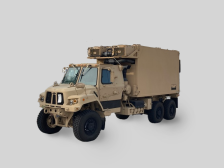
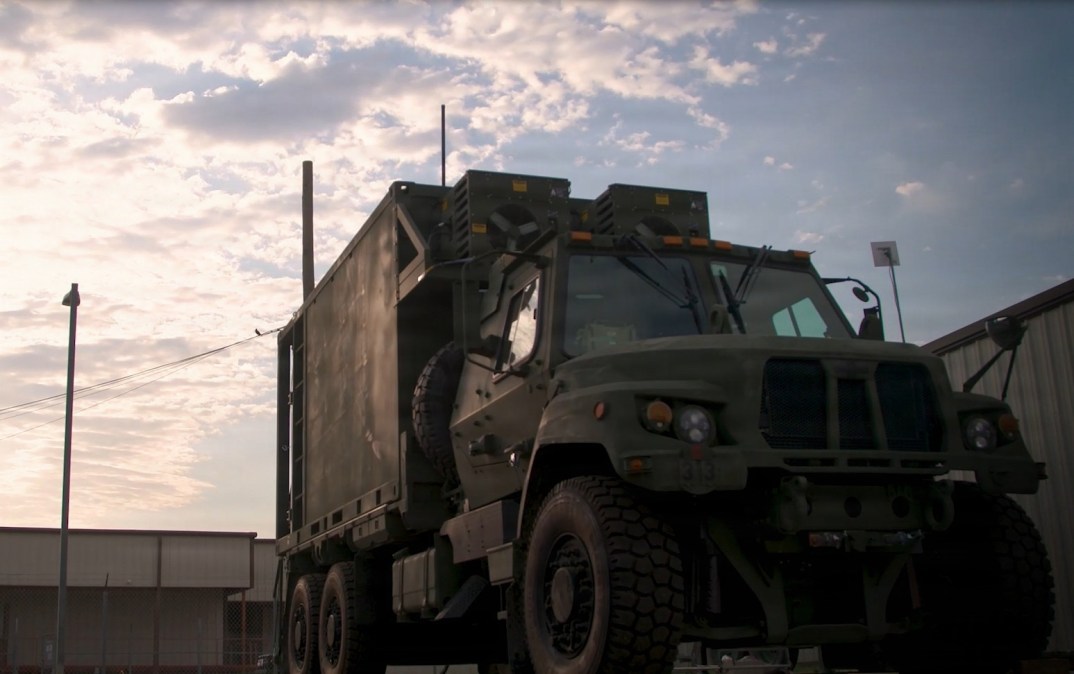
The TITAN currently comes in an “advanced” version, which is mounted on the back of an Army medium-sized tactical vehicle. Another primarily goes onto a Joint Light Tactical Vehicle, or JLTV, and is known as the “basic” model.
Army officials told reporters at Aberdeen Proving Ground, Maryland, last week that the service got soldier feedback to make the TITAN system “vehicle agnostic” so commanders could plug it into a broader variety of vehicles. They said the service also put the TITAN Basic on the lighter Infantry Squad Vehicle – Utility and that two ISV-U variants had already been delivered.
The idea behind the TITAN is for targeting analysts to quickly move across the battlefield — in or alongside the platform in a separate vehicle — while they hoover up geospatial or signals intelligence from ground-based sensors, drones, aircraft and satellites to then turn into target packages using on-board AI and machine learning tools.
“Imagine you’re an analyst, and in front of you, you have a large basket of needles, and you’re trying to find one needle in particular,” said Maj. Dell Barnes, a product manager, using an analogy for finding enemy targets. “You would utilize your sensors, get some intelligence data, which would leverage the AI and the ML to filter out all of the irrelevant needles and find certain ones that meet certain characteristics and attributes of the one specific needle that you’re looking for.”
He said TITAN AI programs would then present recommendations that are of “higher probability” and analysts would approve or deny which targets get passed on to units capable of striking them. Barnes used a euphemism to describe where the human sits in the AI-enabled decision making process, which means that the system can run on its own within a set of parameters, but an analyst can intervene.
“Say 10 years ago, an analyst would have to look at every needle in that basket to assess those various characteristics and attributes,” he added. “There will always be a human on the loop within this workflow of target identification and nomination. So, as an analyst, you will always be the approving authority of the target being sent to fires to enable a commander to make a decision or not.”
Officials said the Army tested the TITAN system at Project Convergence Capstone 6, an exercise in the Mojave desert last month meant to pressure test the service’s prototype command and control ecosystem.
They said TITAN’s AI systems were able to fuse geospatial and signals intelligence there for increased targeting accuracy, and that different system variants dispersed across the training area were able to connect and cover a larger number of targets through the Next Generation Command and Control prototype’s data mesh known as Lattice and developed by Anduril.
“The targets were able to get over, get into, be considered by, and they could be nominated and executed by the units,” Lipscomb told reporters. When asked about what needed to be improved, he was vague but said “some of it” may be tactics, techniques and procedures.
“How can we take technology and then change culture to say, ‘okay, we now accept, and we’re going to process this through?’” Lipscomb added. “I think there’s some technicalities from that aspect that we got to work through.” He didn’t define what those issues were or how the service intended to work through them.
He also said the Army was looking to start a rapid prototyping phase soon to explore different TITAN configurations and transport modes.
The recent order intends to deliver four advanced versions and four basic versions. Of the 10 that have already been delivered, half are on the medium-sized tactical vehicle, three are on the JLTV and two are on the ISV-U, Barnes said.
Palantir, working alongside L3 Harris, the Sierra Nevada Corporation, Strategic Technology Consulting and World Wide Technology, received $127 million for the production contract, according to the Army. Anduril, responsible for delivering hardware and “shelter integration,” received $65 million.
“Anduril will manufacture the ruggedized, vehicle-mounted systems and integrate the power, thermal, control, and operator subsystems that enable TITAN to function in the demanding environments in which soldiers operate,” the company said in a release on Tuesday.
In a press release, Palantir said it will continue to sustain the existing prototype platforms “currently fielded with the operational force” while supporting the development and production of new capabilities.
“TITAN was shaped by the Soldiers who used it, in the conditions they used it in, against the standard they set. That is the only way a system like this earns its place in the field,” Akash Jain, president and CTO of Palantir USG, said in a statement. “We are honored by the Army’s trust, grateful for a partner team that shared the same commitment, and clear-eyed about the work still ahead.”
The Army said it expects additional production awards in fiscal 2027.
Updated on Sept. 1 and Sept. 4, 2026: This story has been updated to include information from a Palantir press release and to correct the spelling of the name of a company (World Wide Technology) that was mentioned in the story.