Air Force begins testing mission autonomy package for CCA prototypes
The Air Force announced Thursday that it is integrating and testing the mission autonomy package for its Collaborative Combat Aircraft (CCA) prototypes — moving the program one step closer to a production decision this year.
The service is currently integrating a government-owned Autonomy Government Reference Architecture (A-GRA) onto loyal wingman drones built by both General Atomics and Anduril, according to an Air Force news release. The work is being done by RTX-subsidiary Collins Aerospace and Shield AI, which are contracted by the service to provide the CCA platforms’ mission autonomy.
Along with retrofitting the A-GRA onto both CCA prototypes, Collins and Shield AI are also tasked with conducting semi-autonomous flight tests alongside the two platform vendors, according to the Air Force.
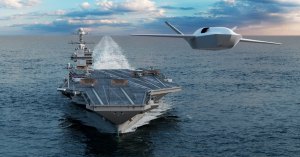
The drones are part of the Air Force’s Next-Generation Air Dominance (NGAD) family of systems. The service is developing the robotic wingmen to fly alongside sixth– and fifth-generation fighter jets, augmenting its manned fleet with additional offensive strike and intelligence-gathering capabilities.
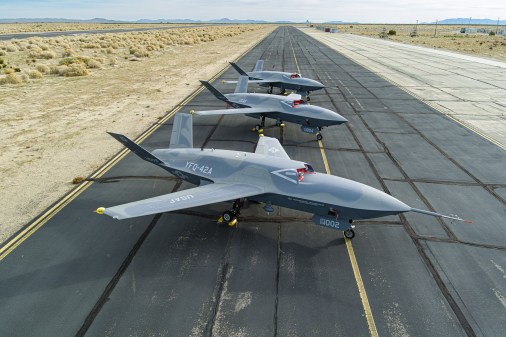
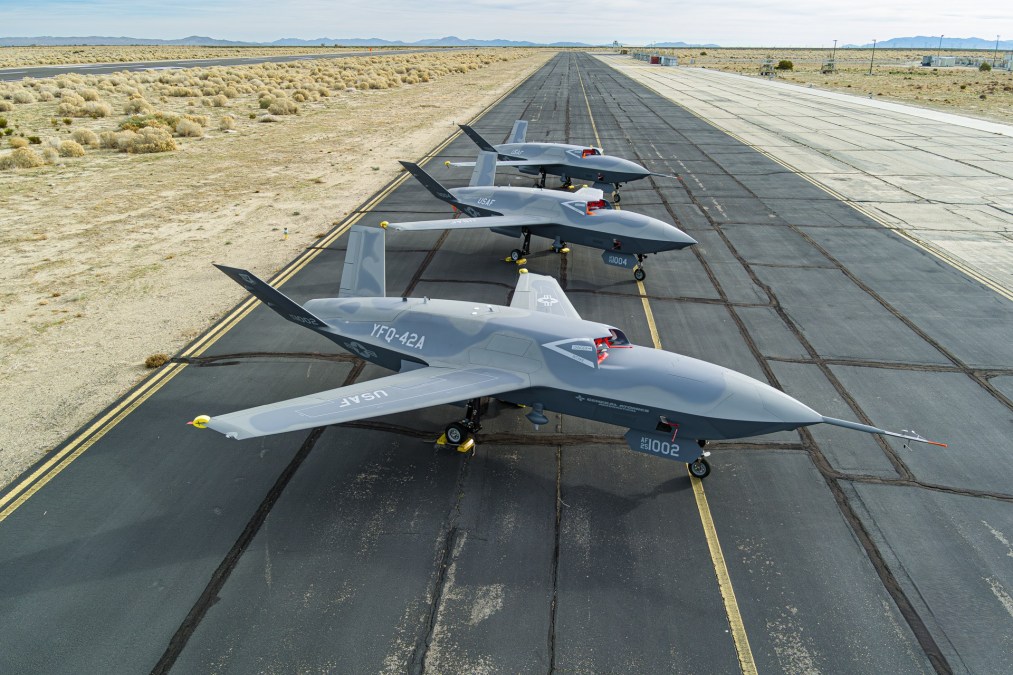
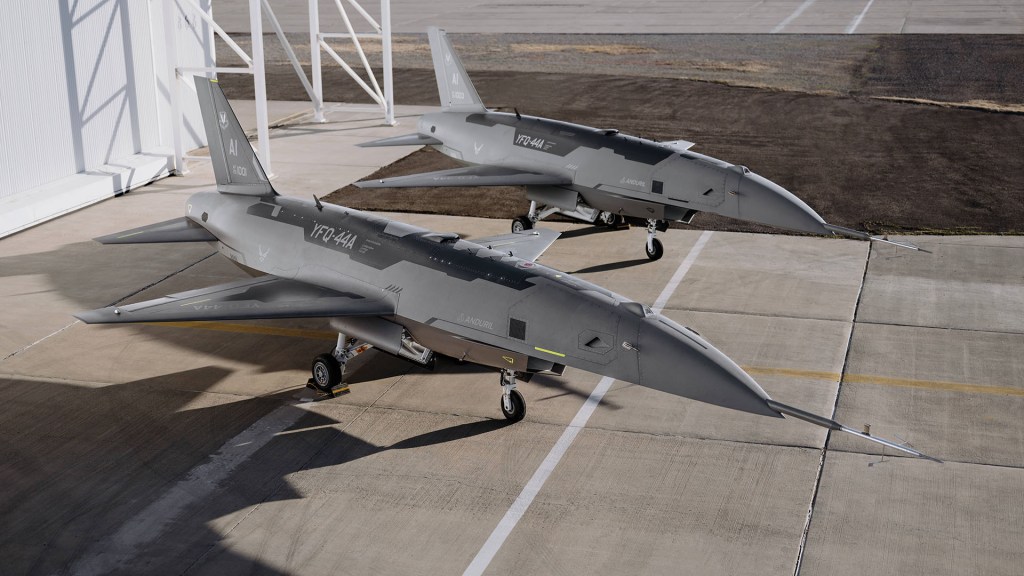
General Atomics and Anduril both received contracts for Increment 1 of the CCA program in 2024, and the companies began conducting live flight tests in August and October of 2025, respectively. General Atomics’ prototype has been dubbed the YFQ-42A, while Anduril’s is known as the YFQ-44A.
The Air Force’s announcement marks the first time the service has publicly acknowledged that Shield AI and Collins are contracted on the program. The two companies won contracts to develop the CCA mission autonomy software — also known as the “brains” of the drones — last year, according to a report from Aviation Week.
General Atomics is integrating Collins Aerospace’s Sidekick Collaborative Mission Autonomy software onto the YFQ-42A’s flight control system via the A-GRA. During a recent test, the companies activated “autonomy mode” that allowed a ground-based operator to send different commands directly to the prototype, according to a General Atomics news release.
“The autonomy capabilities showcased in this flight highlight our dedicated investment to advance collaborative mission autonomy,” Ryan Bunge, vice president and general manager for strategic defense solutions at Collins Aerospace, said in a statement. “The rapid integration of Sidekick onto this General Atomics platform and its immediate ability to support a broad spectrum of combat-relevant behaviors underscores the strength and flexibility of our open systems approach.”
Meanwhile, Anduril is similarly working with Shield AI to retrofit its CCA prototype with autonomous flight software. The companies have yet to demonstrate live semi-autonomous flights through the A-GRA, but expect to do so “very soon,” Jason Levin, senior vice president of engineering at Anduril, said in a statement.
“Integrating mission autonomy into the CCA program represents a meaningful step towards fielding a real operational capability by the end of the decade,” he said. “The U.S. Air Force deserves a lot of credit for designing the program in a manner that emphasizes speed, constant competition, modularity, and ongoing, rapid integration of best-of-breed hardware and software capabilities.”
According to the service, the A-GRA will prevent vendor lock by establishing a single standard for the CCA platforms’ mission autonomy system. Throughout the program’s development, the Air Force’s strategy has focused on leveraging modular open systems architectures to allow the service to install new software and capabilities from multiple vendors onto the drones.
“Verifying A-GRA across multiple partners is critical to our acquisition strategy,” Col. Timothy Helfrich, portfolio acquisition executive for fighters and advanced aircraft, said in a statement. “It proves that we are not locked into a single solution or a single vendor. We are instead building a competitive ecosystem where the best algorithms can be deployed rapidly to the warfighter on any A-GRA compliant platform, regardless of the vendor providing the algorithm.”
The Air Force is developing the CCA drones in spiral increments, with each iteration featuring the latest upgrades and capabilities. The prototypes going through flight testing now are for Increment 1, and the service expects to make a final production decision sometime this year.
Other companies are eligible to compete on the upcoming Increment 1 production contract — albeit likely with their own research-and-development dollars. The service has previously stated it wants to purchase at least 1,000 Increment 1 CCA drones and begin fielding before the end of the decade.