Pentagon memo outlines plan to operationalize new ‘FORTRESS America’ program office
As part of the government’s new plan to quickly secure domestic military assets and infrastructure against cyberattacks, sabotage, power grid failures, and foreign supply chain disruptions, the Pentagon’s acquisition chief on Tuesday initiated the process to set up the new FORTRESS America Program Office.
Under Secretary of Defense for Acquisition and Sustainment Michael Duffey instructed eight senior officials to take concrete steps to begin operationalizing the initiative, according to an official memorandum obtained by DefenseScoop on Wednesday.
It builds on Defense Secretary Pete Hegseth’s FORTRESS America announcement last week.
Introduced as part of a package of new policies, the program has been billed as the Pentagon’s new “national insurance policy” to protect the American homeland.
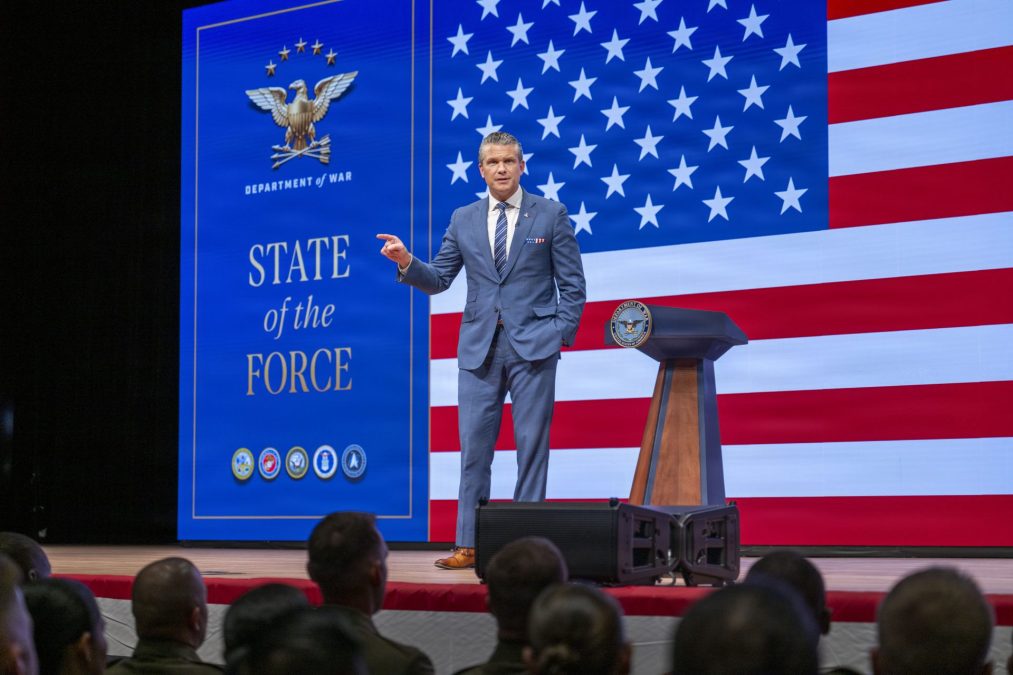
“Now, FORTRESS stands for Federal Operations for Resilience, Troop Resources, Energy, Supply and Survivability,” Hegseth said in his “State of the Force” address on Sept. 30. “And here’s what FORTRESS calls for: Every major military installation in America is going to generate its own power, independent of the civilian grid. If an adversary takes down the grid — by cyberattack, by sabotage, or by any means — our bases stay lit. Our aircraft keep flying. Our command centers never go dark. We’re bringing our critical supply chains home.”
The secretary added that the Defense Department will be “hardening every installation on American soil against cyber intrusions, sabotage and drones.” His vision also includes securing the nation’s airwaves, satellites, and spectrum, to protect the military’s ability to see, navigate and communicate.
“To organize stakeholder direct support, I am designating Mr. Richard “Matt” O’Malley as the Interim Director, FORTRESS America Program Office,” Duffey wrote in the implementation directive, dated Oct. 6. “The Interim Director will oversee strategic milestone tracking and serve as the principal integrator among all stakeholders as we develop the implementation plan for FORTRESS America.”
The under secretary indicated that a two-star military advisor will be appointed to assist O’Malley in this work.
President Donald Trump nominated O’Malley to serve as deputy under secretary of defense for acquisition and sustainment earlier this year, but he has not been confirmed by the Senate.
Per Duffey’s memo, the program office will concentrate on “selective implementation efforts” across the five foundational pillars set forth in Hegseth’s prior directive:
- Space and spectrum resilience: Securing end-to-end mission assurance across space and electromagnetic domains by hardening satellite links; boosting positioning, navigation, and timing resilience; and integrating agile electronic protection to deny adversary interference.
- Installation hardening and cyber resilience: Modernizing force protection, structural fortification, zero-trust industrial control systems, command-and-control, and continuity-of-operations architectures.
- Energy independence: Ensuring resilient, sovereign, and uninterrupted power generation, distribution, and microgrid autonomy across all critical installations and operational nodes.
- Supply chain and defense industrial base (DIB) resilience: Securing domestic and allied supply lines, mitigating single points of failure, and insulating critical materiel pipelines from disruption.
- Strategic defense reserve: Building robust inventories, emergency capacity, and stockpile depth to sustain protracted military contingencies.
Duffey’s implementation instructions were delivered to the secretary of the Air Force; the under secretary of defense for personnel and readiness; the assistant secretaries of defense for sustainment, industrial base policy, and energy, installations and environment; the Pentagon’s chief information officer, director of administration and management, and the comptroller.
He directed those eight officials to designate one “Senior Executive” representative and one action officer “authorized to coordinate directly” with O’Malley — and share contacts with the FORTRESS America Program Office — no later than Wednesday.
A U.S. official told DefenseScoop that Assistant to the Secretary of Defense for Public Affairs Sean Parnell “was the brain child behind FORTRESS becoming a reality,” in his capacity as Hegseth’s senior advisor.
Parnell is reportedly Hegseth’s preferred candidate to serve as the next secretary of the Army.