Advertisement

Showing 10 of 47 results

  • A target is hit by a first-person view small unmanned aircraft system strike during an FPV sUAS live fire demonstration at Marine Corps Base Camp Pendleton, California, Jan. 29, 2026. I Marine Expeditionary Force, in partnership with Defense Innovation Unit, evaluated fiber-optic drones for use in signal-degraded environments. (U.S. Marine Corps photo by Cpl. Joshua Bustamante)
    Tech

    In its next chapter, DIU aims to reduce the military’s ‘cost per kill’

    In an exclusive interview with DefenseScoop, Owen West shared new details about his vision to reshape DIU’s operational structure to fit its modern mission.

  • The Defense Advanced Research Projects Agency (DARPA) Manta Ray Uncrewed Undersea Vehicle (UUV) prototype, completed full-scale, in-water testing in the Naval Base Ventura County (NBVC) Point Mugu Sea Range, March 2024. (Photo courtesy of Northrop Grumman via DVIDS)
    Weapons

    CNO outlines vision for unmanned systems in Navy’s new ‘hedge strategy’

    Chief of Naval Operations Adm. Daryl Caudle officially announced Tuesday the Navy’s latest approach to investing in and then deploying capabilities for conflict.

  • An instructor with Expeditionary Operations Training Group, I Marine Expeditionary Force, engages targets from a U.S. Army UH-60 Black Hawk assigned to Bravo Company, 1-140th Aviation Regiment, during Advanced Sniper Course 25-2 hosted by EOTG, I MEF, on Marine Corps Base Camp Pendleton, California, Sept. 19, 2025. ASC is designed to train personnel in the marksmanship skills necessary to provide sniper support to expeditionary operations. (U.S. Marine Corps photo by Cpl. Oliver Nisbet)
    AI

    Marines’ Force Design plan urges modernization to tackle ‘the changing character of war’

    The Marine Corps commandant’s 24-page plan was released Thursday.

  • A rendering of what someone using the new Project Overmatch capability known as Maven would look like. A unified tactical display that provides insight on vessels across the world, the Maven program overlays real-time ship readiness and sustainment data right at the user’s fingertips by utilizing artificial intelligence. It was created by Project Overmatch and Palantir in collaboration. (Image found on DVIDS as stock photo courtesy of Palantir)
    AI

    Marine Corps names leadership for Project Dynamis amid push for new AI capabilities

    Col. Arlon Smith was tapped to direct the project.

  • A U.S. Army soldier assigned to 1st Armored Division inspects an antenna as he prepares for Project Convergence – Capstone 5 (PC-C5) at Fort Irwin, Calif., in early March 2025. (U.S. Army photo by Sgt. Kelvin Johnson)
    Tech

    Army awards $100M contract for Next-Gen command and control prototype

    Anduril and its team of vendors secured a $99.6 million OTA to continue prototyping effort for the Army’s Next Generation Command and Control.

  • GULF OF ALASKA (June 15, 2009) Operations Specialist 1st Class Lee Tran, from Portland, Oregon, monitors links in the tactical flag command center aboard the aircraft carrier USS John C. Stennis (CVN 74). (U.S. Navy photo by Mass Communication Specialist 3rd Class Josue L. Escobosa/ Released)
    Tech

    Updated information environment blueprint helping Navy architect maritime operations centers

    The Navy has made fighting from the maritime operations center a key tenet of future fights.
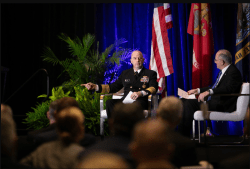
  • Acting Chief of Naval Operations Adm. James Kilby participates in a fireside chat with U.S. Army Gen. (Ret.) Curtis M. Scaparrotti during the Sea-Air-Space 2025 maritime exposition at the Gaylord National Convention Center, National Harbor, Maryland, April 7, 2025. (U.S. Navy Photo by Mass Communication Specialist 1st Class Vanessa White/Released)
    Tech

    How the Navy’s vision to enhance readiness and lethality by 2027 hinges on technology

    Adm. James Kilby briefed a small group of reporters on some of the sea service’s associated near-term modernization efforts.
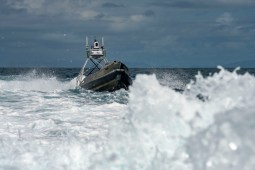
  • PACIFIC OCEAN (May 3, 2023) A global advanced reconnaissance craft is deployed in the Pacific Ocean during the U.S. Pacific Fleet’s Integrated Battle Problem (IBP) 23.1. IBP 23.1 is a U.S. Pacific Fleet experiment, executed by U.S. 3rd Fleet, operationalizing multi-domain employment of unmanned systems to create fleet warfighting advantages. (U.S. Navy photo by Mass Communication Specialist 3rd Class Derek Kelley)
    Tech

    Navy CNO unveils ‘Project 33’ with a heavy emphasis on robotic systems, information dominance

    The forthcoming push is part of Adm. Lisa Franchetti’s “CNO Navigation Plan.”
Advertisement
Advertisement