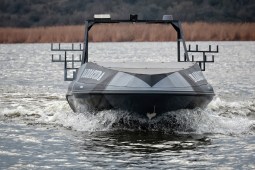
A Barracuda unmanned surface vessel undergoes testing in southern Ukraine, on March 30, 2026. The multifunctional drone boat is developed by the Barracuda unit of the 40th Separate Coastal Defense Brigade, part of the 30th Marine Corps of the Ukrainian Navy. It features a modern tracking system, remote control, and artificial intelligence elements. (Photo by Nina Liashonok/Ukrinform/NurPhoto via Getty Images)
The American military’s recent success with autonomous platforms — as well as the unmanned advances of partners like Israel, Ukraine and Taiwan — offers three main lessons…
Gen. Dagvin Anderson, commander of U.S. Africa Command, participates in a small unmanned aircraft system demonstration with U.S. soldiers from the 1st Squadron, 2nd Cavalry Regiment, at Rose Barracks, Vilseck, Germany, Sept. 1, 2026. As the pace of innovation accelerates and tactics continue to evolve, sAUS integration is becoming increasingly critical to adaptation on the modern battlefield by improving how units coordinate detection, tracking and response capabilities against emerging aerial threats. (U.S. Army photo by Sgt. 1st Class Kenneth Tucceri, AFRICOM public affairs)
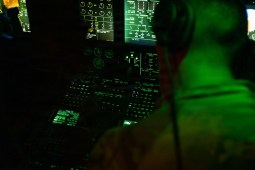
A U.S. Air Force pilot enters data in a C-130J Super Hercules aircraft in the Central Command area of responsibility, March 3, 2026. (U.S. Air Force photo)
“We want industry to understand the mission problem, bring their best ideas, and be prepared to deliver interoperable and adaptive capability," Brig. Gen. Joshua Williams said.
An American flag is flown outside of the Pentagon, headquarters for the United States Department of Defense on July 29, 2026 in Arlington, Virginia. (Photo by Kevin Carter/Getty Images)
U.S. Air Force airmen, U.S. Space Force guardians, and industry partners participate in the Department of the Air Force’s Multi-Decision Advantage Sprint for Human-Machine Teaming experiment led by the Advanced Battle Management System Cross-Functional Team in partnership with the Air Force Research Lab, the U.S. Space Force, and the 805th Combat Training Squadron, in Las Vegas, Nev., May 13, 2026. This user-producer co-creation environment allows operators to provide immediate feedback to developers, significantly accelerating the software development cycle for the joint force. (The image has been cropped to focus on the subjects.) (U.S. Air Force photo by Deb Henley)
The Multi-Decision Advantage Sprint for Human-Machine Teaming wargame demonstrated that AI tools can significantly improve the Air Force's command-and-control operations.
U.S. Army Capt. Zach Marise, a deliberate operations team with the National Guard Bureau, uses the Maven Smart System in Arlington, Virginia, Feb. 20, 2026. Marise teaches the MSS and its capability to process vast amounts of data from weather to troop locations. (U.S. Army Photo by Master Sgt. Whitney Hughes)
Chairman of the Joint Chiefs of Staff Gen.
Dan Caine presents an Operation Epic Fury
ceasefire timeline to members of the media
during a press briefing at the Pentagon in
Arlington, Virginia, May 5, 2026. The U.S.
military began supporting Operation Project
Freedom in the Strait of Hormuz on May 4.
(DoD photo by Benjamin Applebaum)
U.S. Secretary of Defense Pete Hegseth arrives to testify before the House Armed Services Committee in the Rayburn House Office Building on April 29, 2026 in Washington, DC. Hegseth testified on the Department of Defense Fiscal Year 2027 Budget Request. (Photo by Kevin Dietsch/Getty Images)
The Space Data Network has multiple components and will support a number of Pentagon-wide efforts, including the Golden Dome for America missile defense architecture.
U.S. East coast-based Naval Special Warfare Operators (SEALs) conduct dive operations to increase maritime lethality during training off the coast of Key Largo, Florida, Feb. 18, 2025. Naval Special Warfare Group TWO produces, supports, and deploys the world’s most lethal maritime special operation forces to ensure the United States will deter and win wars. (U.S. Navy photo by Mass Communication Specialist 1st Class Katie Cox)