Hegseth: Autonomous warfare sub-unified command coming soon

The U.S. military will soon have a new sub-unified command focused on autonomous warfare, Secretary of Defense Pete Hegseth told lawmakers Wednesday.
Sub-unified commands, which combatant commanders can set up with the approval of the SecDef, are joint organizations designed to conduct operations and certain missions assigned to the geographic or functional combatant command that they fall under. The designation typically signifies that the organization’s mission is enduring and a high priority for military leadership.
Examples of sub-unified commands include Joint Special Operations Command (JSCOC), which falls under U.S. Special Operations Command, and the Department of Defense Cyber Defense Command (DCDC), which falls under U.S. Cyber Command.
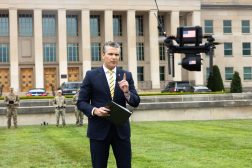
“We will shortly announce a sub-unified command for autonomous warfare,” Hegseth said Wednesday at a House Armed Services Committee hearing on the Defense Department’s fiscal 2027 budget request.
“Drones are so central to the future of warfare and where we get them from, that we have to be able to both make the exquisite ones better than anybody else, and also the attritable swarm, and then the ability to defeat them ahead of our adversary, learning from battlefields like Ukraine and [Operation] Epic Fury,” he said, referring to the Iran war. “It is front and center in this budget.”
Last week, U.S. Southern Command announced that it had initiated the launch of a new Southcom Autonomous Warfare Command (SAWC). It wasn’t immediately clear if Hegseth intends to designate the SAWC as a sub-unified command or if he was referring to plans for a different entity. DefenseScoop reached out to the Pentagon seeking clarity on that point. “We refer you to Secretary Hegseth’s April 29, 2026 HASC testimony,” a Pentagon official said.
Southcom’s announcement last week did not explicitly say whether the SAWC would be designated as a sub-unified command.
“Ultimately, SAWC will employ autonomous, semi-autonomous, and unmanned platforms in direct support of the National Defense Strategy’s call for a ready, capable, and lethal fighting force. It will maximize the efficient fielding of autonomous systems to increase lethality, domain awareness and build partner capabilities, in accordance with SOUTHCOM imperatives,” a Southcom command spokesperson told DefenseScoop in an email last week.
Hegseth and other senior Pentagon officials under the second Trump administration are gung-ho on AI and unmanned systems.
The Defense Department’s fiscal 2027 funding request includes $58.5 billion for AI and Combined Joint All-Domain Command and Control (CJADC2), according to budget documents.
About $54 billion would be allotted for “autonomous and remotely operated systems across air, land, and above and below the sea,” including $39.2 billion associated with the “Drone Dominance” mandatory funding request, which would provide a “multi-year investment in autonomous systems procurement, domestic production capacity, and advanced capabilities,” per the budget documents.
The Pentagon last year established a Defense Autonomous Warfare Group. The department requested $54.6 billion in research, development, test and evaluation funding for the DAWG in fiscal 2027, according to budget documents. That funding level would be a massive increase from fiscal 2026, when the group only received $225.9 million.
“I think of the DAWG as a pathfinder. They’re out there finding the best technology for us and working on integration. They’re with these companies live, right now, testing different systems and orchestration tools for autonomy, and they’re giving them live feedback,” Jules “Jay” Hurst III, the official performing the duties of comptroller and undersecretary of defense, said at a budget briefing last week. “So it’s a very agile process, and a lot of the programs themselves will be executed with the services.”
In a press release last week, Southcom said that the SAWC will work with the DAWG and the military services to “identify available expertise and capabilities required for the new command to commence operations and fully integrate” them into Southcom’s missions.