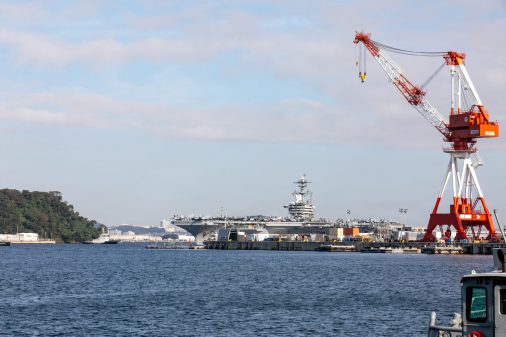
Unmanned warfare has now expanded to the high seas. Is the U.S. ready?
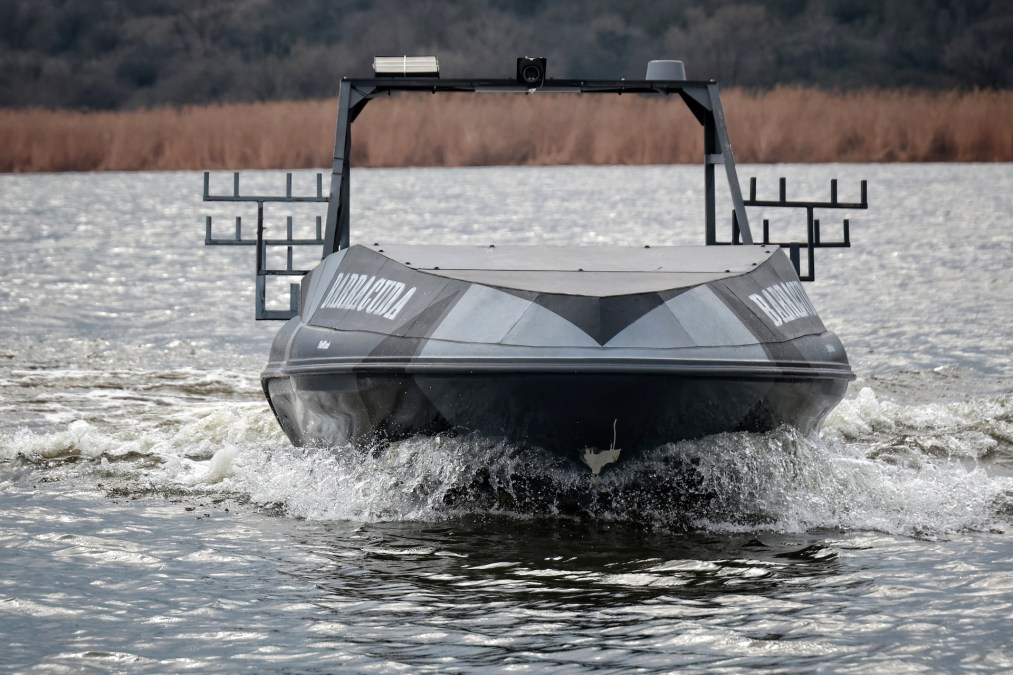
Drone warfare is expanding from the skies to the seas, and the United States must be ready. The Russia-Ukraine war, which has become synonymous with aerial drone warfare, has now featured the “first naval battle in history between unmanned boats,” according to the Ukrainian Navy. On Sept. 14, a Ukrainian Sargan 300 drone boat fired at and sank a Russian unmanned surface vessel (USV) in the Black Sea — a significant milestone in warfare’s rapid evolution.
Unmanned naval platforms are also starting to see combat beyond the battlefield laboratory of Eastern Europe. During the Iran war, in July, three American one-way attack USVs struck an Iranian submarine and naval facility — the first-ever U.S. use of USVs to strike enemy targets. Just weeks prior, a USV rescued two U.S. Army pilots from nearby waters after an Iranian drone struck their helicopter.
Nor are recent U.S. unmanned successes confined to the Middle East. They have occurred right in America’s backyard. Reporting from Aug. 5 indicated that an American USV recently detected, tracked, and helped intercept a U.S.-bound narcotics shipment worth $81 million in the Caribbean Sea.
Now, accelerated U.S. efforts, not complacency, are needed to build on this recent tactical success. Greater strategic imagination is the first step. The Pentagon needs to think bigger about unmanned military platforms — but also smaller. Thinking smaller means complementing high-end platforms with inexpensive, expendable ones. Thinking bigger means integrating them into a single network with manned assets and human warfighters. Today, the U.S. military does neither at scale.
The American military’s recent success with autonomous platforms — as well as the unmanned advances of partners like Israel, Ukraine and Taiwan — offers three main lessons for generating the Pentagon’s next unmanned leap forward.
First, expendability has its own currency. Ukraine has achieved outsized battlefield effects with lower-end, expendable unmanned platforms — as have Iran and Russia. This is true for sea-based autonomous systems too. However, one-way attack USVs, like those American forces used against Iran, remain in short supply.
That shortfall stems from bureaucratic, not technological, reasons. The Pentagon applies the same rigid standards to unmanned, expendable platforms as to high-end, manned surface combatants. Yet overly rigorous testing and evaluation inhibits production at the pace which the battlefield demands.
Second, as the recent USV rescue of U.S. aviators from the Arabian Gulf demonstrates, unmanned platforms offer more than strike or surveillance functions. In fact, those lower-tech functions may have greater upside involving less rigorous testing and faster deployment timetables.
Take, for example, the since-axed UCLASS program to build carrier-based surveillance-and-strike drones. Due to a lengthy requirements list, the project became unsustainable. That is subtraction by addition. Now, the Navy is developing the MQ-25 Stingray, an unmanned aerial refueler — a simpler platform meeting a more fundamental need.
Unmanned platforms offer additional types of unconventional utility, like logistics resupply and forward basing. An Israeli firm is exploring turning commercial ships into camouflaged floating drone bases. Another has developed heavy-lift drones to move materiel to the battlefield. These concepts are relevant to a primary challenge America would face in a future Pacific war: contested logistics across a broad geographic area far from the homeland and near the enemy’s turf. Fortunately, unmanned systems could ease those logistical headaches by offering greater concealment, dispersal, and flexibility while preserving manpower.
Another potential evolution is now on the horizon: unmanned amphibious landings. A Ukrainian startup has a prototype for an autonomous amphibious vehicle, resembling a small truck. It can carry drones, travel underwater with a low radar profile, and drive onto enemy shores. The United States, by acquiring that capability, could facilitate a naval version of Operation Spiderweb, where Ukrainian drones hidden inside cargo trucks infiltrated Russia and neutralized strategic Russian bombers across the country.
Third, the Pentagon’s unmanned advances must be complementary, but currently are not. This is the “think bigger” half of the equation, and what makes the first two lessons pay off. Expendable autonomous mass, low-cost single-purpose platforms, and distributed unmanned hubs reach their potential only by working as a team. Recognizing this, Taiwan is seeking over 200,000 one-way attack drones and over 1,200 USVs, but also the systems architecture to link them together.
To prevail in a hypothetical Pacific war, American forces must have persistent adversary surveillance. Currently, that interconnectivity is lacking, impeding readiness. Surveillance drones cannot directly communicate with nearby submarines or USVs, nor fuse data into a common operating picture.
Linking autonomous platforms, manned assets, and human warfighters in a shared data mesh and command-and-control system would close those gaps. The U.S. military’s Combined Joint All-Domain Command and Control (CJADC2) aims to forge that very integration. Yet CJADC2 remains limited to “fragmented deployments,” according to the Pentagon. Fixing that is a critical next step.
Innovating in the unmanned domain will require the Pentagon to be more imaginative in how it acquires, tests, and links its manned and unmanned platforms. That requires thinking smaller, by acquiring more expendable unmanned systems, and thinking bigger, about operationalizing a joint-domain network. It also should involve Washington acquiring Israeli, Taiwanese, and Ukrainian unmanned technology, and expanding co-production with those U.S. partners at the cutting edge of warfare.
Successful adaptation also requires re-examining of how the Pentagon allocates resources. Currently, the Pentagon’s unmanned capabilities are constrained by cost overruns on large, manned surface combatants that are not well calibrated to today’s threat landscape. Studies indicate that guided-missile destroyers would be highly vulnerable in a Pacific war, and that reliably fixing and returning them to battle would be nearly impossible. Spending on these platforms, while important, represents a disproportionately large portion of the Navy’s budget — crowding out unmanned innovation and acquisition.
The Pentagon’s recent unmanned successes show it is not completely outpaced by warfare’s rapid evolution. Yet this race is a marathon, not a sprint.
Vice Admiral Michael Connor, USN (ret.) is former Commander, U.S. Submarine Forces, and a Jewish Institute for National Security of America (JINSA) Generals and Admirals Program participant. Vice Admiral Connor also previously served as director of the Pentagon’s Naval Warfare Integration Group.
Yoni Tobin is a senior policy analyst at JINSA.