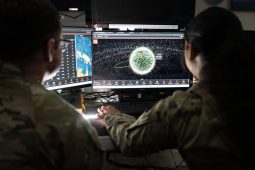
U.S. Space Force Guardians assigned to Space Delta 5 monitor computer workstations Dec. 18, 2025, at Vandenberg Space Force Base, Calif. (Photo by David Dozoretz)
Along with four new portfolio acquisition executives announced Tuesday, the Space Force is in the process of establishing three additional organizations, according to Tom Ainsworth.
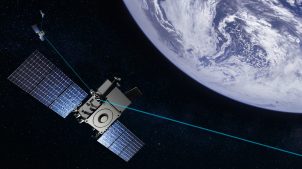
The MEO Epoch 2 mission will provide resilient, space-based missile warning and tracking of ballistic missiles and advanced threats, such as hypersonic glide vehicles. (BAE Systems photo)
U.S. Space Force Guardians assigned to Space Delta 5 monitor computer workstations Dec. 18, 2025, at Vandenberg Space Force Base, Calif. (Photo by David Dozoretz)
Lt. Gen. Gregory Gagnon provided new details about how Space Force guardians supported the joint force during Operation Midnight Hammer and Operation Absolute Resolve.
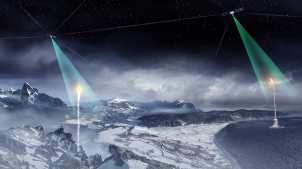
Northrop Grumman’s TRKT3 will build on the Tracking Layer capabilities of Tranche 1 and Tranche 2 with targeted technology enhancements, expanded coverage and increased integration including precision fire-control sensing. (Photo Credit: Northrop Grumman)
The Tranche 3 tracking layer will comprise 72 satellites to provide near-continuous global coverage, with half featuring payloads able to create fire-control data.
The MEO Epoch 2 mission will provide resilient, space-based missile warning and tracking of ballistic missiles and advanced threats, such as hypersonic glide vehicles. (BAE Systems photo)
The new units — known as System Deltas — will consolidate Space Systems Command program offices for missile warning and space-based sensing and targeting.
United States Space Force General Stephen N. Whiting speaks during a hearing with the Senate Armed Services Committee at the Hart Senate Office Building on February 29, 2024 in Washington, DC. (Photo by Anna Moneymaker/Getty Images)
The efforts include operationalizing a nascent data-fusion pilot effort and supporting research and development of on-orbit maneuverability technologies.
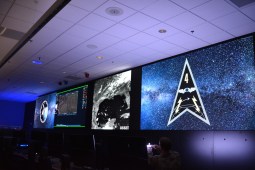
Located in the Mission Control Station at Buckley Space Force Base, Colorado, the Overhead Persistent Infrared (OPIR) Battlespace Awareness Center (OBAC) provides near-real-time OPIR data exploitation products that deliver situational awareness to Space Delta 4 operators and other users. (Space Force photo)
Space Systems Command expects to continue delivering new capabilities for the Future Operationally Resilient Ground Evolution (FORGE) on a yearly basis, according to the program's executive officer.
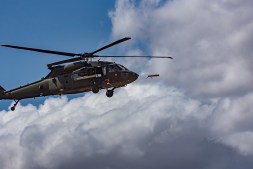
An Area-I Air-Launched, Tube-Integrated, Unmanned System, or ALTIUS, is launched from a UH-60 Black Hawk at Yuma Proving Ground, Ariz., March 4, 2020. (Courtesy photo provided by Yuma Proving Ground)
Space Systems Command dropped RTX from the Resilient Missile Warning and Tracking — MEO program in May due to cost growth, schedule slips and design challenges.