The contract marks the latest signal for the Army’s expansion of NGC2, an ecosystem of interconnected hardware and software underpinned by Anduril’s Lattice software platform.
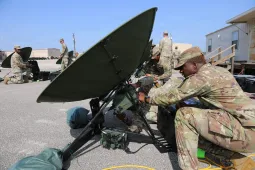
Soldiers from the 57th Expeditionary Signal Battalion-Enhanced (ESB-E), 11th Corps Signal Brigade (BDE), train on expeditionary geosynchronous Earth orbit (GEO) satellite terminals as part of their new command and control network baseline equipment package. (U.S. Army photo by Amy Walker, Project Manager C2 Transport, CPE C2IN)
The fielding comes after two Army divisions experimented with NGC2 for more than a year and nearly two months after the service tested the architecture at a…
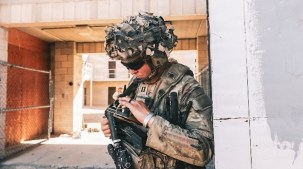
U.S. Army Capt. Alex Bayer, mechanized infantry company commander in the 4th Infantry Division, coordinates with her unit on a Next Generation Command and Control end-user device during Project Convergence-Capstone 6 (PC-C6) at Fort Irwin, California, July 24, 2026. (U.S. Army photo by Sgt. Nathan Arellano Tlaczani)
Army Pfc. Eric Searcy, an electronic warfare specialist assigned to the 3rd Infantry Division, searches for electronic signals using a Terrestrial Layered System Manpack (TLS Manpack) during a field training exercise at Fort Stewart, Georgia, April 19, 2026. (U.S. Army photo by Sgt. 1st Class Rakeem Carter)
The officers recently served in advisory roles for the Security Assistance Group-Ukraine, a Germany-based, U.S.-led organization founded after Russia’s invasion in 2022 that oversees support for Kyiv.
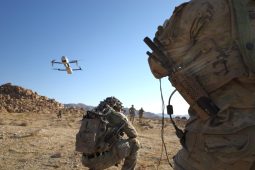
Scouts with the 4th Squadron, 10th Cavalry Regiment, fly a Rogue 1 drone by Teledyne FLIR Defense during Project Convergence Capstone 6 at Fort Irwin, California, July 22, 2026. (DefenseScoop photo by Drew F. Lawrence).
Project Convergence Capstone 6 produced lessons that soldiers measured in capability, reliability, weight and the oppressive desert conditions that pervaded all of it.
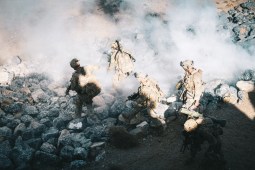
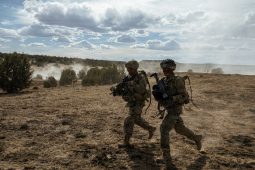
U.S. Soldiers assigned to 4th Infantry Division engage opposing forces during Project Convergence Capstone 6 at Fort Irwin, California, July 24, 2026. (U.S. Army photo by Sgt. Nathan Arellano Tlaczani)
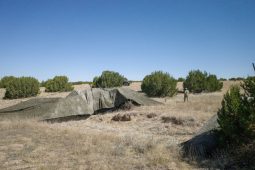
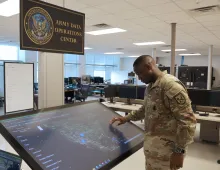
A “command post node” run by the 4th Infantry Division during exercise Ivy Mass at the the Piñon Canyon Maneuver Site, Colorado, May 12, 2026. (DefenseScoop photo by Drew F. Lawrence).
During the Global War on Terror, the Army established large, static and complicated command posts. Army officials wrote in a doctrine note earlier this year that should…
Soldiers assigned 4th Infantry Division maneuver to the objective during a Combined Arms Live-Fire Exercise as part of Ivy Mass at Piñon Canyon Maneuver Site, Colorado, May 17, 2026. (U.S. Army photo by Staff Sgt. Richard Stewart)
Now, as the Army looks to scale NGC2 across the force, it has settled on Anduril to help shepherd data, applications, AI models and other military systems…
Since its launch, the 25-person task force has received 68 requests, or “tickets” for data help from Army units across the world, including at least one supporting…