Army taps Anduril as lead for NGC2 common data layer baseline as service sets ‘groundwork for rapid scaling’
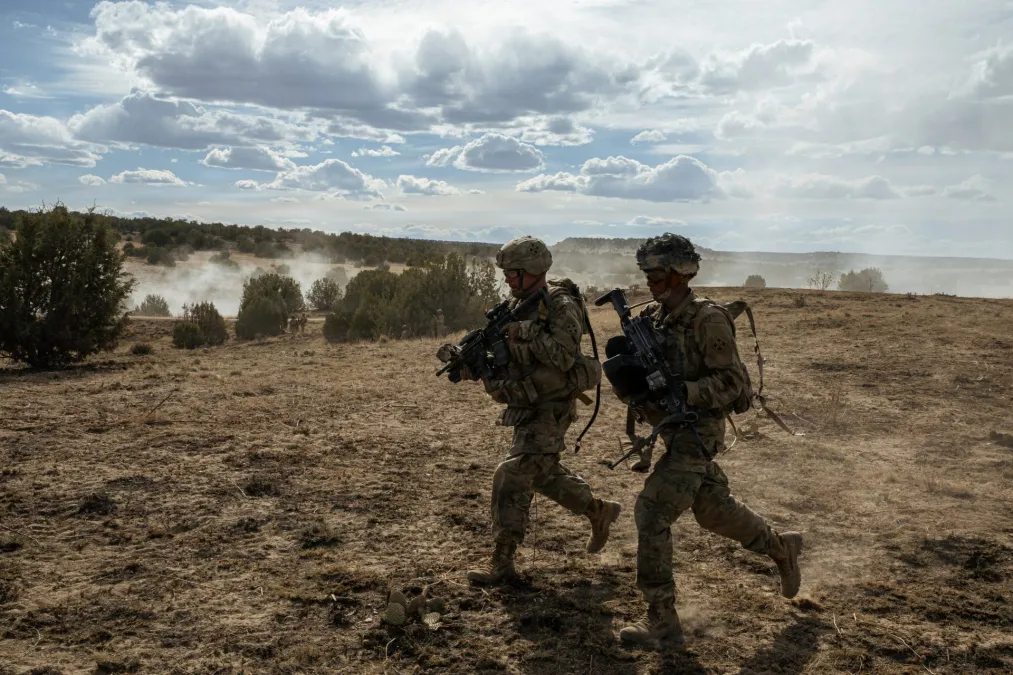
After months of testing between two major defense companies, the Army has picked Anduril to lead its common data layer baseline for its Next Generation Command and Control initiative, officials announced Monday, boosting the California-based company’s role as a key integrator in the service’s crusade to get its systems to talk to each other.
Since last year, Anduril and Lockheed Martin have been testing parallel mission command systems meant to help Army commanders make faster, more informed decisions through an accessible network that quickly exchanges data between the service’s military platforms.
Army officials have long-decried that its equipment — from drones to air defense platforms to vehicles — could not seamlessly transmit critical battlefield data. They’ve said modern conflict has demonstrated quick access to information across a unified suite of systems will define military success, and the service wasn’t moving fast enough to get there.
NGC2, a top priority for the Army, is a significant part of the service’s effort to bring those systems together. Now, as the Army looks to scale NGC2 across the force, it has settled on Anduril to help shepherd data, applications, AI models and other military systems through the company’s Lattice software.
“We are already moving out with the converged data layer architecture,” said Joseph Welch, portfolio acquisition executive for Command and Control (C2)/Counter C2, according to an Army press release on Monday. “Our vendor partners have demonstrated great teamwork and flexibility in helping us establish this baseline and set the groundwork for rapid scaling.”
The announcement — which did not include a dollar amount — is part of a massive, 10-year enterprise contract worth up to $20 billion the Army awarded to Anduril in March. Service officials said Anduril will remain partnered with Palantir for an edge-to-cloud data mesh that incorporates Lattice and the Florida-based company’s Foundry system.
Both industry and Army officials have billed the NGC2 work between Anduril and Lockheed as complementary, rather than competitive. Lockheed served as the NGC2 team lead for the 25th Infantry Division out of Hawaii and Anduril did the same for the 4th Infantry Division out of Colorado.
In May, Anduril and 4th ID completed an exercise for NGC2 at Fort Carson, Colorado, called Ivy Mass, the last of six modernization “sprints” before the unit goes to the the National Training Center to test their work during Project Convergence-Capstone 6 (PC-C6) next month.
Lockheed and 25th ID integrated sensors, fires platforms and airspace management systems through a unified data platform during the Philippines-based Balikatan 2026 exercise that also ended last month, the Army said.
But while Lockheed will continue to spearhead the “full stack” implementation for 25th ID and its ongoing Lightning Surge series, Anduril’s role as the lead for NGC2’s common data base layer means its Lattice software will serve as the command-and-control backbone for the capability, and not just at 4th ID.
Following the decision, both divisions will begin to incorporate NGC2 “common components” as they continue to participate in training exercises, the Army said. Zach Kramer, Anduril’s Mission Command lead, told reporters Monday the company has already started integrating their baseline layer for 25th ID and hopes to finish by the end of the year, “if not sooner.”
Lockheed will now help implement Anduril’s baseline data layer.
“The idea is that nothing is one-size-fits-all,” Kramer said. He said that 25th ID and 4th ID, where Anduril has done most of its NGC2 work, have different operational needs and characteristics.
“[What] they are doing is taking that common data layer, helping to tailor the applications to the mission needs, and then working with the unit on the transformation as to how do they update their fight, how do they do these things and use it,” Kramer added. “And that is where the powerful partnership is coming in.”
In a statement, Lockheed Martin said that it will continue to play “an integral role as the designated lead driving coordination and implementation with the 25th ID.” It will customize applications, algorithms and hardware while collaborating with Anduril as the data layer baseline lead, according to the statement, though it did not name Anduril.
“The development of an integrated command and control (C2) ecosystem in close collaboration with industry partners – which has been proven to connect soldiers across the battlefield in contested and denied zones – remains our top focus,” the statement said. And while Lockheed will continue to implement the full stack architecture at 25th ID, the contractor “will continue to evaluate other opportunities within the NGC2 ecosystem.”