Army’s new data operations center may stay ‘lean’ on people, expecting automation to help pick up growing workload
ABERDEEN, Md. — The Army Data Operations Center — a new, centralized hub to help the service manage data flows — will employ minimal human staffing and require automation to keep up with growing force-wide demands, officials anticipate, key factors that may determine the organization’s future.
The service launched the ADOC in April in response to changes on the modern battlefield and frustrations from data teams across the Army that were struggling to connect disparate military systems. ADOC is housed under Army Cyber Command, a higher echelon meant to help fill a “gap” between the service’s operational units and the data connectivity issues they face.
Division-level data staff and above can now tap the ADOC to help latent targeting processes, access weather data, onboard new communication equipment and get enterprise systems to reach tactical units — examples that illustrate the connectivity requirements officials believe are crucial to outpacing increasingly sophisticated adversaries in contemporary conflicts.
Since its launch, the 25-person task force has received 68 requests, or “tickets” for data help from Army units across the world, including at least one supporting the Iran war. Officials expect requests to grow and are already seeing a surge in tickets from training exercises. Now, nearly two months into its 180-day prototype pilot, the task force is exploring AI tools to reduce workload and hasten ticket closures in anticipation of more.
“I think that the ADOC will remain relatively lean, and we’re going to have to do magnitudes higher work with maybe just a fraction more of the people,” Brig. Gen. Michael Kaloostian, the ADOC task force director, told reporters during a press visit on Wednesday. “That’s where automation is going to become so very important.”
Those developments, along with identifying skills required by human members of the task force and defining the ADOC’s structure and authorities, are up against the clock — how they shake out and how much they might cost will largely determine the prototype’s future. The Army will decide by Oct. 1 whether the ADOC, or a version of it, stays alive.
“Is the Army willing to continue to invest and grow the ADOC based on what we’ve accomplished in six months?” Kaloostian said. “The Army could say, ‘you know what, this has been a great experiment, but we’re not going to move forward with it’ — that’s absolutely something that could happen.”
“My instinct, my hunch is that this will continue in some new capacity,” he added. “I don’t know what that looks like. We will continue to grow the ADOC, maybe into a next phase beyond the pilot, but I think this will certainly continue post-1 October.”
Currently, the task force is composed of civilian and uniformed data experts pulled from other organizations, such as the Army Communications-Electronics Command and the service’s AI integration center, units that Kaloostian said recognized the importance of the ADOC and therefore “committed their best people to this project.”
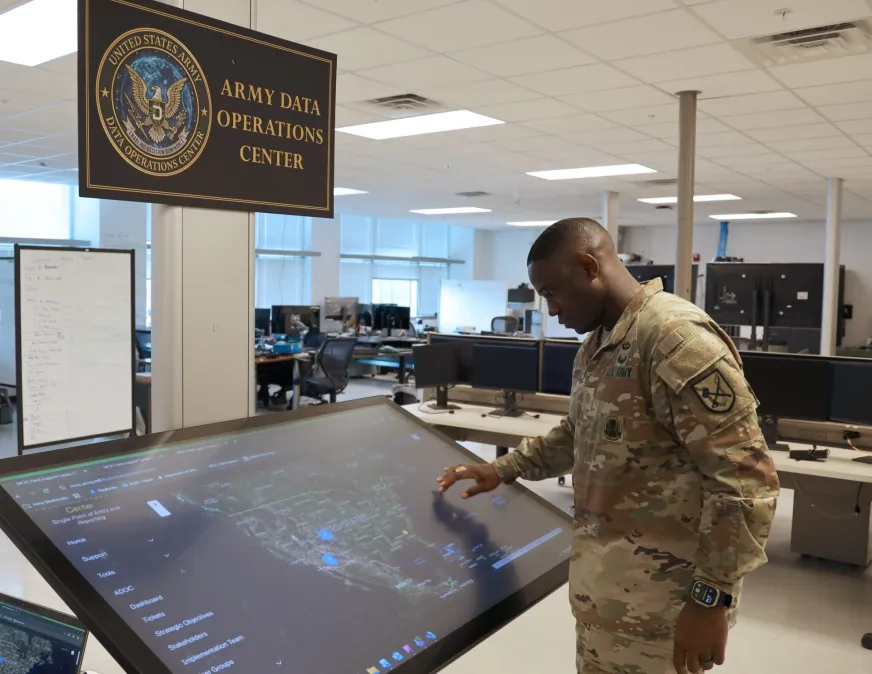
Located in an office building at Aberdeen Proving Ground, the ADOC looks much like any other workspace, with the exception of a secret space to review classified information and a large display that showed metrics from unit help requests (some members joked about commandeering the screen).
Because the personnel aren’t organic to the task force, it is unclear which AI or automation tools it may need to pay for, and the fact that the workspace is on loan from the DEVCOM C5ISR center, officials didn’t have an estimate for how much the ADOC may eventually cost to run. The Army, however, is asking for that number, Kaloostian said.
“It’s free right now, but it isn’t expected that it’ll be free come 1 October,” he said. “I think there will be costs. I think it’s minimal when you think about the larger picture, but I think there will be a cost.”
The way it works right now looks like this: units can submit help requests through an online ticketing system or direct call to the center, after which requests flow through three cells.
The Warfighter Engagement Cell is on-call 24/7 to intake and triage incoming data issues. A “FINISH” cell is part of those initial engagements, but can take over and refine solutions to the issue. A third tier, known as the Data Management Cell, documents the solutions so they can be applied to future requests of a similar nature. That cell also identifies trending issues and packages them for broader Army consumption.
The time it takes to solve these issues could take days, sometimes weeks, according to Chad Nash, the FINISH Cell’s lead principal engineer. They are tracked on the interactive dashboard that monitors the requests, including by urgency. Real-world operational issues take precedence over training exercises, for example.
Much of this process, from scheduling intake interviews to scraping historical data for trend monitoring and ticket resolution, can be automated, officials said.
“We see a lot of potential and a lot of additional opportunity to implement things like AI agents as well, to automate some of these processes to now take it from days to minutes,” Nash said.
Meanwhile, the ADOC is also participating or supporting a slew of Army initiatives intended to wrestle its data management woes. Officials were quick to say the Army’s Next-Generation Command and Control units weren’t its sole customers. In fact, one of ADOC’s first tickets was from the office of the Surgeon General.
That said, two staff officers from NGC2’s prototype units — 4th Infantry Division and 25th Infantry Division, charged with experimenting with the Army’s new command and control network — called into the press briefing to describe the ADOC’s role in helping fix their data issues. And Kaloostian has been long-tied to NGC2 efforts.
The ADOC is also involved in Operation Jailbreak, a Colorado-based effort alongside the defense industry focused on dismantling software barriers so military systems can share data.
Officials said that the effort is expected to produce an Application Programming Interface marketplace where vendors publish their full API so the Army can better integrate its systems without constantly having to go back to industry for changes. The vision, Kaloostian explained, would be for the ADOC to maintain that marketplace for the Army.
Amid all of this work, Kaloostian also envisions a world where the ADOC, or something similar, may not exist at all. Given the acceleration of AI, its function may be fully automated. He said that younger members of the force — including the two staff officers who called into the meeting — are largely self-taught, but expertise to self-handle data issues across the Army will grow.
“I think that’s certainly attainable in the future, just based on the pace of technological advancement. But I would tell you right now, that doesn’t exist,” Kaloostian said when fielding a question about whether the proliferation of deconflicted systems and AI may outgrow the need for the ADOC. “We’re not going to get to that level in the next two to three years, so I think this capability is absolutely necessary, at least in the near term.”