More reach, more to carry, more to learn: How soldiers wrestled with drones in the Mojave Desert
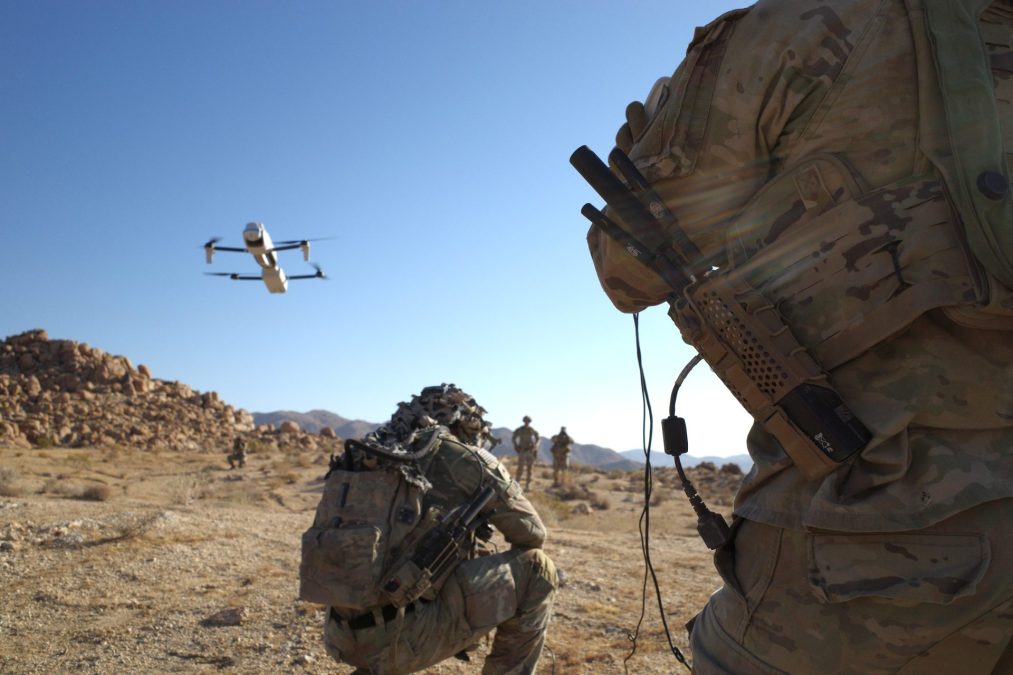
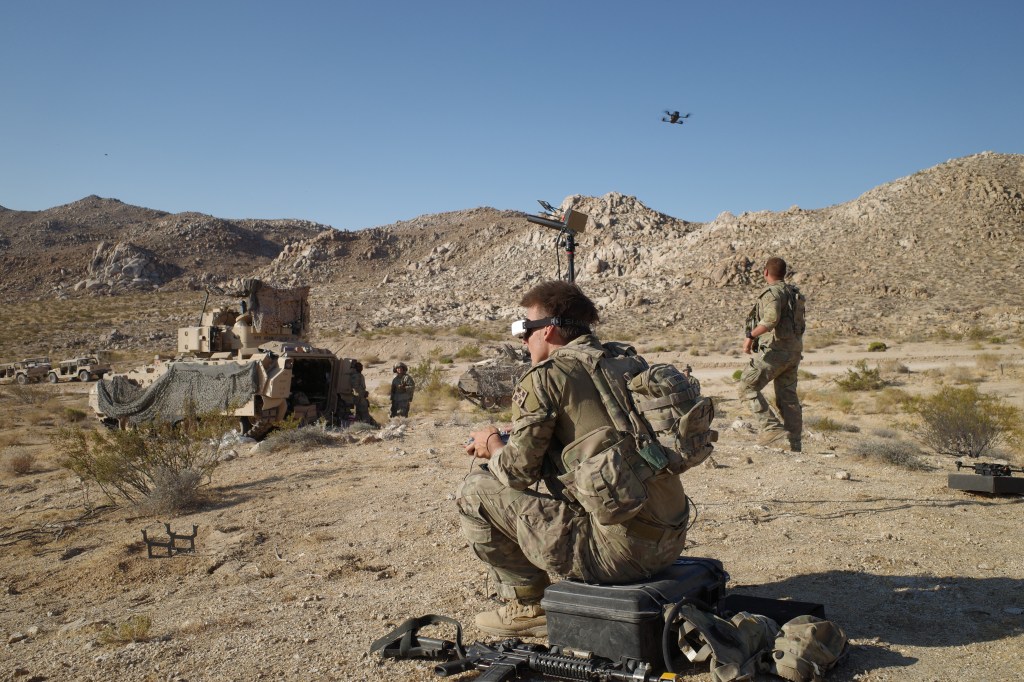
FORT IRWIN, Calif. — Spc. Christopher Frank donned bright white goggles that stuck out against the desert valley. The scouts were surrounded by rocky hills like the ones they had been humping new drone gear up over the past few days. It would be over 100 degrees by the afternoon, and the soldiers were already covered in a thin film of dirt and sweat.
Frank sat on a bulky black case, looking through the first-person view headset. He told Sgt. Gabe Tedrow to wipe “moon dust” — which clings to everything across the Army’s National Training Center — from the lens of the Neros Archer drone baking in the sun before them.
Its rotors spun and the Archer flew a few wide coils before returning to the pair of soldiers, surrounded by or using a tripod-mounted antenna, the Fat Shark goggles and the drone’s carrying case under Frank. Out of sight were nearly a dozen batteries soldiers described having for this one system, plus spare parts and payloads.
“The wind is picking up, hold on,” Frank said on the approach. His thumbs toggled the controller and the drone looped around a few times. “Kill it,” Tedrow said. The rotor whine stopped and the drone thudded to the dirt, having flown for exactly two minutes and several hundred yards away from its operator. Some soldiers offered scattered applause.
The demo — a customary practice for public consumption since the military began adopting FPV drones in earnest two years ago — wasn’t illustrative of the lessons soldiers described learning here. Alongside more than half a dozen soldier interviews, however, it set the baseline stakes for what the new tech did and did not do for them. Their presence in the valley also represented a data point in the winding Army system meant to collect those lessons.
“From here, I could reach out to those rocks, no sweat,” Frank said after a reporter questioned the brevity of the flight. He pointed to a ridge far enough away that its features became obscured by distance and the morning desert haze.
Frank was one of more than 8,500 soldiers from the 4th Infantry Division sent to NTC for Project Convergence Capstone 6. The event lasted 10 days and marked a critical point in the Army’s experimentation with its Next Generation Command and Control prototype, and one meant to “push the boundaries” of platforms like the one Frank was using against the center’s resident enemy force, the 11th Armored Cavalry Regiment known as “Blackhorse.”
One vendor, Anduril — which owns the data layer for NGC2 — told DefenseScoop its Bolt-M drone was connected to the prototype ecosystem. But no soldier the publication interviewed during PC-C6 said the drones they tested were on the network. They either said the systems weren’t connected or they didn’t know whether they were.
The exercise produced other lessons for the soldiers, ones measured in capability, reliability, weight and the oppressive desert conditions that pervaded all of it. DefenseScoop spent four days there, interviewing dozens of sources as part of a series exploring the event, and what it means for the Army’s adaptation to the modern way of war.
From a sheer drone employment perspective, what soldiers described amounted to a math problem troops have contended with for millennia, one in which few variables can be raised without diminishing others.
“It depends on how much time I have, what the capabilities are that I need to bring to the fight in order to accomplish the mission,” said Lt. Col. Shawn Scott, commander of 4th Squadron, 10th Cavalry Regiment. He was describing considerations regarding how light or heavy, or fast or slow, or far or quietly, he deployed his reconnaissance force. His drone teams were making the same considerations on a smaller scale.
“That’s the trade-off,” Scott said. “That’s the balance, and it’s always going to be hard to find.”
What the drones did
1st Lt. Nicholas LeClair was down to one Bradley Fighting Vehicle and a handful of dismounts by day one. Two of his tracks had been destroyed after his platoon knocked out multiple enemy Strykers, and his small team was hunkered down in the valley. They were probably finished.
But “we were able to set up the drone over in the corner,” he said, “and we were able to engage and destroy vehicles as they were coming by without exposing [ourselves].”
Their loud, easily seen Bradleys kicked up plumes of moon dust and sent engine din miles across the battlefield, making any last stand in the valley that much deadlier. With the unmanned aerial systems, though, “you’ll get a small little poof, and then nothing,” LeClair said.
In comparison to older tools, soldiers said the drones generally expanded their ability to see beyond what they were used to without exposing their positions. They tested the Neros Archer, Anduril’s Bolt-M and Teledyne FLIR Defense’s Rogue 1, which they said came with a range of surveillance and strike options to make that extra distance matter more. Neros did not respond to inquiries.
“Now my capabilities are just exponentially increasing. I can see further. I can continuously see,” said Capt. Dominic Sparkling, commander of “Blackfoot” troop. His unit was using 11 drones, including the Archer, Rogue 1 and a trio of systems connected by swarm software, meaning one operator could fly all three, freeing them and other soldiers up for different tasks, Sparkling said.
Unlike the tiny Black Hornet, which “struggled in the wind” or the retiring RQ-11 Raven, the new systems can come armed, so a commander like Sparkling “can launch that munition and destroy whatever target I see.”
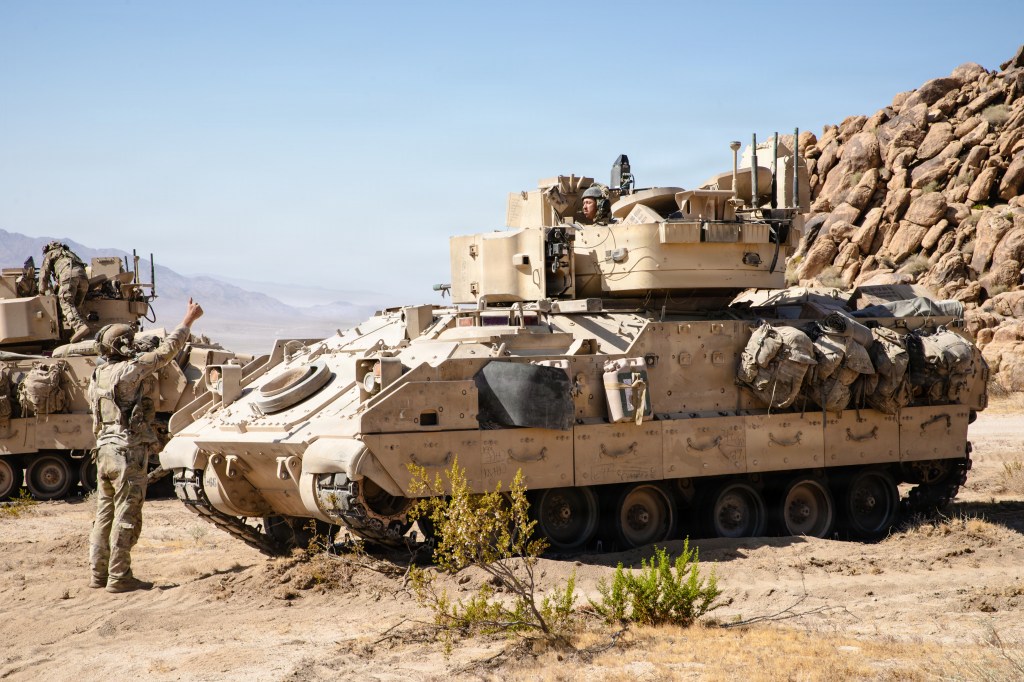
Hunkered behind ridgelines, LeClair’s scout platoon had been launching drones from their Bradleys. Typically, scouts dismount ahead of the vehicles to identify targets or clear routes in a “hunter-killer” tactic, but now they were using UAS to supplement those movements.
“It’s the same concept we’ve had as scouts for decades: our Bradley is our killer, our dismounts are our hunters, but we’re getting modernized,” Frank said. Soldiers said they launched one drone to spot a target and another to destroy it. Some systems did both at once.
A result: “we don’t have to dismount as much,” said Cpl. Emiliano Lopez. He held a Rogue 1, which the Army selected for its Low Altitude Stalking and Strike Ordnance program in May.
The Rogue 1 has interchangeable payloads to surveil a target, destroy it, or both, including anti-armor payloads or a fragmentation round with an adjustable blast area, Lopez said. Soldiers can launch the fragmentation round, or the “fan favorite” as he calls it, without destroying the drone itself. In other words, it was both expendable and reusable.
“All you need to do is fly the drone, clear it, and then we can send the vehicles up,” he said.
Both vendors that responded to DefenseScoop about soldier feedback — Anduril and Teledyne — invoked the human-in-the-loop or on-the-loop concept when describing how soldiers used the drones for targeting. For the Bolt-M, the military required a human to be in the loop, actively engaged in each AI-enabled decision, by design.
To the soldiers flying them, the distinction was immaterial. Identification boiled down to what they could see on the feed via straight video, electro-optical, infrared or thermal cameras. Some drones offered automatic target tracking or were programmed to return on their own if they lost connection.
Outside of that, it was up to them to identify and decide which ones were worthy of striking.
“You have to just be able to describe what you see to give good positive identification of a target,” said to Sgt. Ramontez Bennett, an infantryman with an experimentation unit from Georgia, of the Bolt-M. He described an in-mission calculation, where he had to decide if it was actually worth using the Bolt-M as a one-shot kill when a conventional weapon might do.
“Say the mission continues and I run into a truck or an armored vehicle or something that [a rifle] is not going to work on, and I’ve already wasted the Bolt on personnel, it’s kind of a lose-lose,” Bennett said. He also wished the system had better optics to assess those targets, even as he used it as a reconnaissance asset a majority of the time.
“Bolt is designed to explode when an operator tasks it to engage a target,” an Anduril spokesperson said. They said the company was exploring solutions to “streamline and accelerate” the targeting process for future versions of the Bolt-M. It too, had its own calculations to make.
“Design trades are made based on that reality,” they said. “Exquisite sensors are often heavy or expensive, so we focused on finding the right balance between [intelligence, surveillance and reconnaissance] performance and the reality that the product is an attritable weapon system.”
Weight, ‘a killer’
“Weight has always been a killer in the Army,” LeClair, the platoon leader, said. In the last years of the Global War on Terror, an average soldier or Marine carried about 120 pounds of gear.
At NTC, soldiers were still carrying substantial loadouts: Javelin anti-tank weapons, their command launch units, AT-4 tubes, machine guns, rifles, radios, optics and their daily supplies of water and food. Adding drones and their accessories meant soldiers were making hard decisions on the fly about what they could — and could not — carry on dismounted missions.
When they did dismount, “it definitely feels heavier,” Lopez, the Rogue 1 operator, said.
Frank said roughly three- or four-man teams would ditch several batteries and leave behind the case the drones came in, opting to strap them to their rucks. The scouts considered leaving certain tools behind, like a marksmanship rifle, hoping the UAS could fill its role without having to bring both.
“If we have an FPV that reaches 4 [kilometers] and we have a private who’s never shot a marksman rifle or done any type of marksmanship, then there’s really no reason to bring a really heavy weapon up to an [observation post],” Frank said. Still, they opted to bring heavier Javelins and AT-4s.
“That stuff is where we’re trying to figure out how we can stretch it,” Frank said.
Ailinger, the Teledyne spokesperson, said the Rogue 1 was the lightest of the three systems in the Army’s LASSO program. A “recommended tactical load” includes two aircraft, a flight control unit, spare battery and antenna. Altogether, it weighs around 30 pounds.
“We have a lot of stuff to carry outside of this,” Bennett, the infantryman, said. The Bolt-M he was using can weigh between 13 and 16.8 pounds depending on the warhead, with a 4.4 pound ground control station, according to the Anduril spokesperson, who said the drone’s transport cases at PC-C6 were “designed for site-to-site transportation, and not fully optimized [for] soldiers to carry as part of their kit” like other packs the company offers.
The math problem around drones isn’t new. Ukrainians have forged ahead on these variables in the fight against Russia’s full-scale invasion.
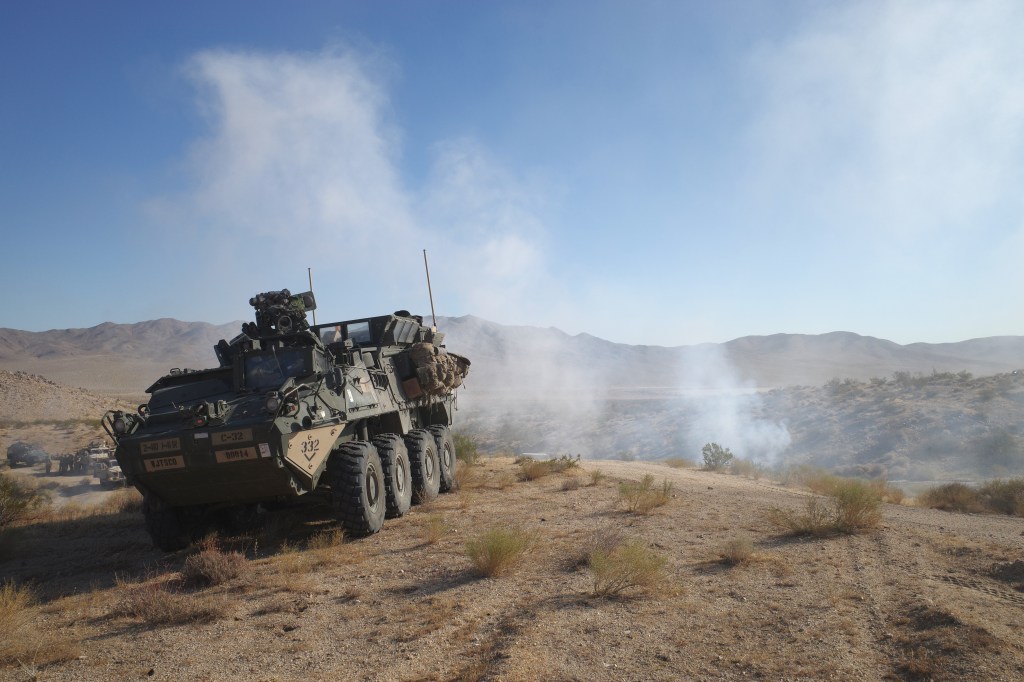
U.S. soldiers in the Mojave were clearly adopting, in some cases directly referencing, those lessons. For example, LeClair said his platoon was using sunshades over their Bradleys to thwart drones, an early adaption Russia and Ukraine made to their armored vehicles. Up and down the squadron, leaders identified UAS and the long-range targeting they helped spot as a top threat, which DefenseScoop will cover in another part of the series.
But the use of drones, as military officials increasingly concede, does not wholly apply to the American way of war. One example: unlike entrenched Ukrainian troops, soldiers here expected to move with their UAS as part of an expeditionary, American force.
The Ukrainians are “in a static position, they don’t have to carry these things around a lot, they know essentially where the adversary is,” said Mark Cancian, a retired Marine colonel and senior adviser with the Center for Strategic and International Studies. “In many situations, that would not be the case for an expeditionary force. The idea that everybody’s going to carry all of their regular stuff plus a drone, you’re asking a lot.”
The first day scouts arrived at the training area, they attempted to bring the Archer’s carrying case and 11 batteries to an observation post. “Everyone was drained,” Frank said. The team settled on two batteries, the “heaviest parts” of the system,” he added.
“Finding what load plans work, which is what we’re finding out right now, and realizing, ‘Yes, if it doesn’t have a reconnaissance purpose, then we don’t need to bring it to the OP,’” Frank said. “We don’t need to bring up this extra weight, because ounces equal pounds, and you’re gonna realize that when you’re hiking up a mountain.”
Heat, connectivity and scouts on the move
Anduril lists the Bolt-M’s range at more than 12 miles, about the same as other drones soldiers were using. But Bennet had only flown it at less than half that distance.
Multiple soldiers said they were flying their drones at a much shorter distance than what vendors advertise. For one, they were sharing airspace with 4th ID, meaning they had limited windows to launch their UAS until another air asset needed the sky. So, soldiers opted for more repetitions, but at shorter distances.
But some systems overheated in the pounding sun or lagged connection over desert ridges, causing soldiers to scramble for connectivity or terminate the platform’s mission. On the training end of PC-C6, soldiers said the simulated enemy was using jammers, making the feed “wonky” until they flew it higher than what the electromagnetic weapons’ effects could reach.
“The heat’s been a very big thing when it comes to this drone in particular,” Bennet said of the Bolt-M. He described the system hovering, searching for targets and needing to keep it moving, because “the longer you keep it around in the air, it’s gonna overheat.” Anduril vendors gave soldiers a “cheat sheet” on what to do when the drone overheats, according to Bennett.
Senior Army leaders acknowledged to reporters in late July that the heat was a significant constraint during PC-C6, and that soldiers were having to come up with ad hoc cooling solutions, like dunking T-shirts in ice to lay over hot hardware.
At NTC, “you’re going to find things that you didn’t know in a testing environment,” Scott said, adding that one of the drones they were using, a hybrid-electric Perimeter 8, had water cooling and worked during the day and night. Otherwise, “You’re going to find that the heat out here has a significant effect.”
The Anduril spokesperson acknowledged the overheating issues for the Bolt-M and said the company was “accelerating updates to operational procedures, software workflows, and hardware thermal management to maximize Bolt’s operational capabilities in extreme environments.”
Frank said that since they started using the transmitter — the tripod-mounted antenna that extends the range of the drone — they’ve had zero crashes at NTC. But heavy winds, desert ridges higher than what they’re used to in the flat plains of Colorado, and competing frequencies limit how far the drone can go, sometimes sending the scouts clambering to regain connection.
The scouts have learned to set their tripods away from their observation posts, “because obviously, you don’t want to shoot outside your house,” Frank said. But if the drone flies out of the antenna’s range, his spotter or another scout needs to visually guide him “back on target.” That also meant physically moving the Archer’s antenna up a hill or to another location to reestablish connection, according to Frank.
“It might not be the smartest thing,” he said, seeming to acknowledge the move could expose their position, “but if we’re trying to get rounds on target, we’re gonna do that.”
In some cases, soldiers gave different accounts about how the drones were used, ones that vendors conditioned or disputed. Lopez, for example, reported an up to 10-minute assembly and tear-down time and a 30-second buffer, prompting Teledyne spokesperson Joe Ailinger to call the latency issue “suspect” and question “what this user’s specific issue was” with set-up.
At PC-C6, DefenseScoop observed trade-offs between training and experimentation value. The Army was attempting to battle-test this new equipment against a “free-thinking” foe, but its soldiers were still learning how to use it.
Vendors were not allowed in the training area as part of 4th ID’s effort to let soldiers fight with new tech against a simulated enemy without contractor support. That made it difficult for defense contractors to immediately determine what was “operator error,” as Ailinger put it, a system malfunction or something else with the drones soldiers were experimenting with.
“I’m told we had very little time with the operators at PCC6 to provide them training, let alone become familiar with and proficient with operation, targeting and employment,” he told DefenseScoop in an email.
Where the lessons go
PC-C6 followed nearly a year of NGC2 and technological experimentation with the 4th and 25th ID, part of what the Army Test and Evaluation Command calls a “Continuous Evaluation Campaign.” The tests in the Mojave Desert marked the Army’s most complex and sprawling moment in the effort thus far: multinational units, special operations, nearly 100 technologies.
The day the event ended, senior Army leaders dubbed it a success and said they expected to ship some parts of the NGC2 ecosystem to more units. Still, there were lessons to be deciphered and choices to be made about what else went forward, and what wouldn’t.
ATEC focused its evaluation on NGC2. In-field evaluators collected input from soldiers and paired that feedback with “digital telemetry,” such as network metrics, pulled from the systems, a spokesperson for the command said. So if a soldier reported a buggy application, evaluators will also “isolate and analyze” digital logs from the system to “answer the ‘why,’” they added.
They said those insights entered a “feedback loop,” packaged and shared with senior leaders, developers, requirements personnel “and the end-users themselves” after each experiment, according to the spokesperson, as soldiers tweak their tactics and vendors tweak their systems. Feedback was collected regardless of if the technology was connected to NGC2, including the drones, a spokesperson for the Joint Modernization Command said.
Less than a week after Scott spoke to reporters, the squadron he led held its final formation in anticipation of its deactivation. They had been testing a new organizational concept, one that attached a mobile, squadron-sized reconnaissance force to the division as the Army downsizes its cavalry units at lower echelons.
Asked whether the scouts’ lesson would still be counted and applied across the force, JMC spokesperson Lt. Col. Bryce Gatrell said they would. For those subjective lessons they were learning, such as how many batteries to leave behind or overheating procedures, he said “Observer/Analysts” took them down and aggregated them for senior leader briefing where they “serve as the foundational evidence for all official reports.”
“From our perspective as independent evaluators, we see that vendors are addressing software challenges and onboarding new capabilities between events,” the ATEC spokesperson said. “The bottom line is that this feedback loop is working, the technology is evolving quickly, and soldiers are operating more capable and refined systems with every exercise.”
As for what PC-C6 showed about NGC2’s limitations and capabilities, ATEC said the Army was still working on the results, and didn’t have anything to share yet.