Army introduces sweeping reform of its acquisition structure
The Army is initiating massive organizational reforms for how it buys new weapons and capabilities in an effort to drastically shorten procurement timelines and promote innovation, according to top service officials.
Announced Friday, the Army’s acquisition portfolio overhaul will consolidate the service’s program executive offices (PEOs) responsible for buying new weapons into six new offices called “portfolio acquisition executives” (PAEs). The plan also creates a new office dedicated to rapidly injecting and scaling emerging technologies into Army formations.
The transformation comes after Secretary of Defense Pete Hegseth announced his intent to revamp acquisition processes across the entire Pentagon on Nov. 7, as well as an April directive from Hegseth that called on the Army to consolidate many aspects of the service — including its procurement organizations.
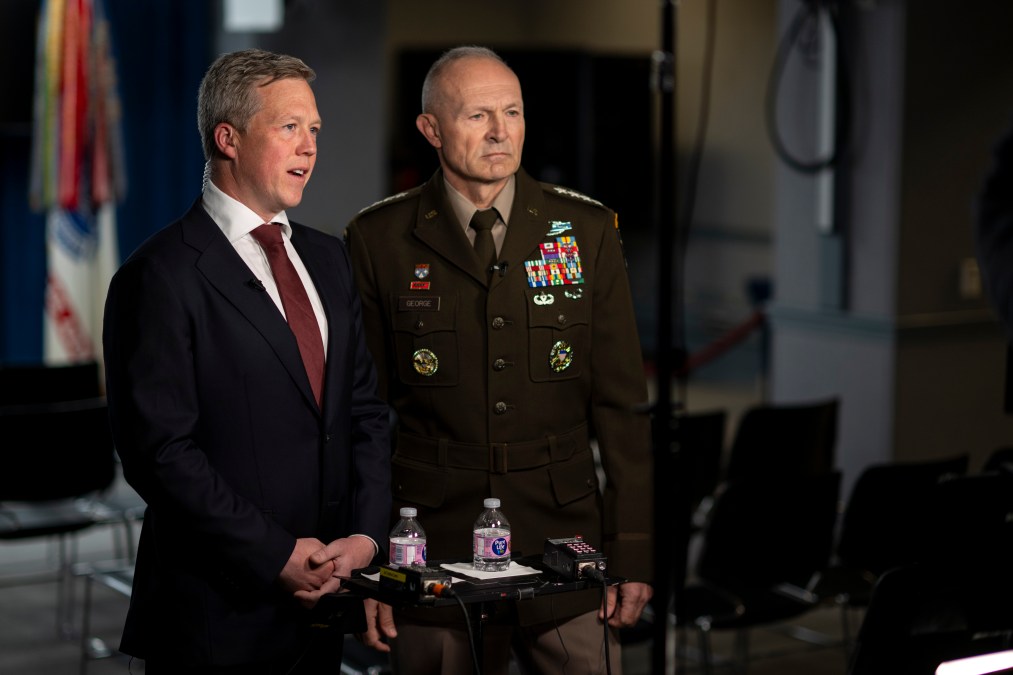
Army Secretary Dan Driscoll told reporters Wednesday ahead of the announcement that the new structure aims to mimic best practices from private industry, creating a new system that accepts risk and streamlines capability delivery.
“What we’re doing is taking … what private industry [does] when you have a profit and loss and a margin you have to achieve,” Driscoll said. “It drives efficiency in your system in a way that the government just has not had to historically do.”
The service began iteratively implementing the new PAEs in October and expects that the organizations will reach initial operating capability in January 2026. Rather than focus on individual programs, PAEs will own their own capability areas and oversee various related portfolios.
Reducing the time between requirement validation and capability delivery will be a key measure of success for the PAEs, Army Chief of Staff Gen. Randy George said. At the same time, having all of the key acquisition and sustainment leads under one organization will help the service make better decisions on specific capability trade-offs for its programs, he added.
“If you have a requirement, and somebody says it needs to weigh a certain amount and they have to go 100 miles an hour, and then somebody comes back to you and says, ‘Hey, it can go 90 miles an hour and weigh just a little bit differently, but you can get it for half the cost and in half the amount of time.’ That’s what we’re after,” George told reporters.
The six PAEs established are: Fires; Maneuver Ground; Maneuver Air; Command and Control and Counter-Command and Control; Agile Sustainment and Ammunition; and Layered Protection and Chemical, Biological, Radiological and Nuclear Defense.
Each organization will be led by a two-star general or civilian equivalent who will oversee personnel responsible for requirements, science and technology, contracting, acquisition, testing, programming, sustainment, and international sales, according to the Army.
The PAEs will offer dual support — reporting to the Army’s Transformation and Training Command (T2COM) for requirements generation and to Brent Ingraham, assistant secretary of the Army for acquisition, logistics and technology (ASA(ALT)), for acquisitions and material development.
“Consolidating functions under a single, accountable leader will streamline decision-making and remove barriers,” Ingraham said in a statement. “It will empower leaders to take calculated risk where appropriate, delivering capabilities faster and more effectively.”
Also part of the reorganization is the creation of the Pathway for Innovation and Technology (PIT) office, which will focus on accelerating emerging technology development and integration into the field. Reporting directly to ASA(ALT), the PIT will embed into other organizations across the Army to understand what technology soldiers immediately need and integrate it across the service, Ingraham told reporters.
“We [will] go and try to innovate tech in the field, and as it shows promise or as we get a capability, we’ll have the ability to scale it quickly across PAEs depending on which PAE that portfolio would fit in,” he said.
The PIT will consolidate work from a variety of organizations within and beyond the Army that focus on scaling new capabilities, Ingraham added. By establishing an overarching unit dedicated to innovation, the Army hopes to address bureaucratic challenges that have stalled innovation — such as the lack of concrete plans for fielding and lengthy budget cycles, he added.
Overall, officials stressed that implementing the new structure will not require a significant amount of funds or require large numbers of personnel to move. Furthermore, the Army plans to remain flexible as it phases in the new PAEs in the coming months in order to get it right.
“As we lay out the structure, we’re going to continue to refine it and update it as we move forward. But we feel like we’re on a really positive path,” George said.