Navy’s new Rapid Capabilities Office pursues disruption, with caution
As the Navy’s new Rapid Capabilities Office hustles to identify and field urgently-needed technologies at a speedier pace than ever before, senior leaders recognize how the plans have potential to introduce or magnify security, operational and ethical risks that can accompany experimental acceleration.
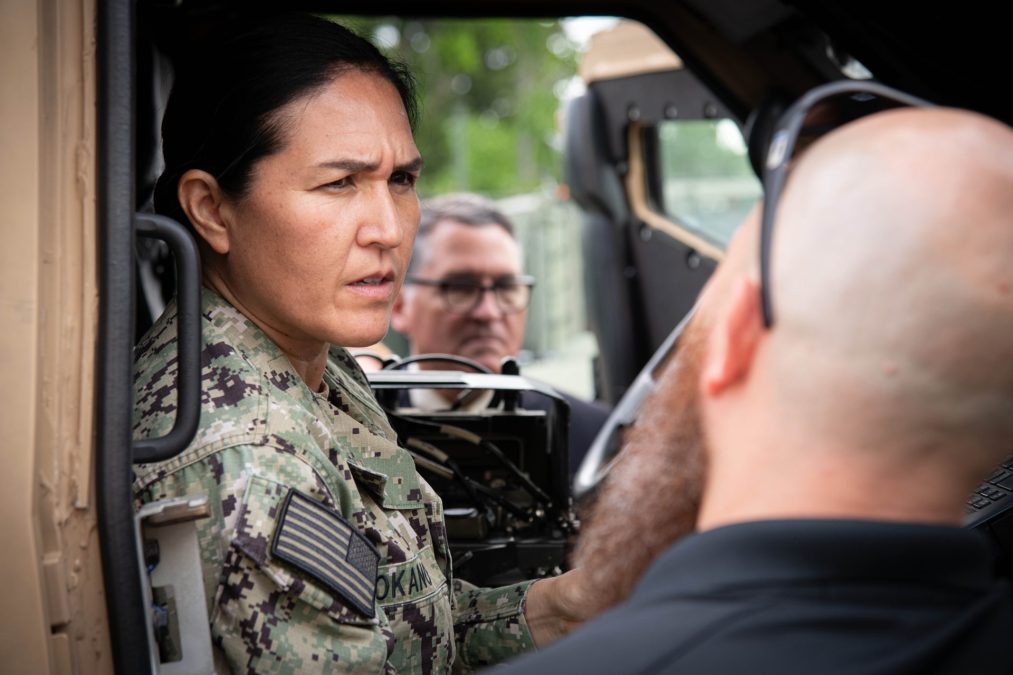
“I actually think we have to be more disciplined,” Vice Adm. Seiko Okano told DefenseScoop last week. “If we’re going to go fast, then we can’t do this recklessly — because, ultimately, if we do have catastrophic failures, that actually slows us down much more than if we were going to just go at our normal speed.”
A 1994 graduate of the U.S. Naval Academy, Okano was recently appointed as the NRCO’s first chief by Navy Secretary John Phelan.
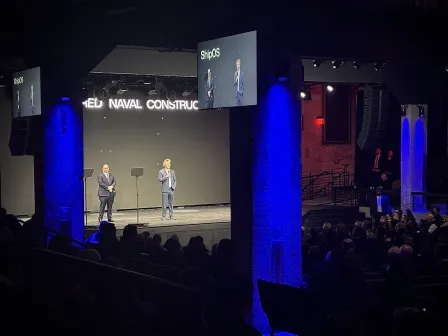
On the sidelines of the new office’s inaugural industry and investor day in Washington on Dec. 9, Okano and other senior Navy officials briefed a small group of reporters about this new hub and its vision to deliver technologies and software across the service, in a three-year timeframe, to ensure “U.S. maritime supremacy.”
“You’ve heard that the Navy is really hard to do business with, right?” Okano noted. “This is us kind of creating a bug light and saying, ‘Look, we are open for business, and we’re here, and we’re serious about having speed as that cornerstone.’”
Phelan officially launched the NRCO in August.
Multiple teams were consolidated and absorbed by this new unit, including those formerly known as the Maritime Accelerated Response Capability Cell; Disruptive Capabilities Office; NavalX; and the Navy’s execution of the Defense Department’s Replicator activities.
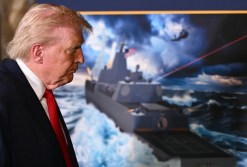
The NRCO was set up in support of the second Trump administration’s recent order and ongoing campaign to overhaul and modernize America’s defense acquisition system. This reorganization also marks one piece of a larger push by the Pentagon to revamp its approach to buying and selling modern military capabilities.
Senior Navy officials supplied new information about the NRCO’s configuration, execution mindset, and future opportunities for commercial engagement during presentations at last week’s industry day.
The office will leverage systems commands and program executive offices as the implementation and oversight organizations for its prototyping processes. Personnel from the NRCO will be embedded on the ground in PEOs and around the fleet — via rapid capability cells that will assist with high-priority projects and offer department-level stakeholders to help remove barriers and drive faster decision-making at the top.
“These small teams possess the authority and autonomy to disrupt bureaucratic inertia,” Phelan told the audience of sailors and company partners.
The ultimate aim is to deliver capabilities that get after the Navy’s most serious operational gaps. NRCO officials confirmed they’ll be prioritizing technology investments in multi-domain unmanned platforms, artificial intelligence, and other products to tackle three key challenges: non-traditional sea denial, terminal defense, and long-range fires.
The Budget Execution-year Technology Selection (BETS) Board reviews and endorses priorities for the Navy secretary’s approval. The NRCO operates in “bets,” or resources allocated against expected outcomes. There are both prototyping and scaling bets — and officials suggested that some, not all, will pay off handsomely.
“The business of the Navy is warfare. We need to act like we are at war. We should behave this way when it comes to procurement timelines, maintenance schedules, industrial base resilience. And anything that touches readiness should be at a wartime footing,” Phelan said.
According to the secretary, this speed will be “backed by structure, authority and accountability,” and the NRCO represents the service’s “operational engine for acquisition reform.”
“Accountability isn’t a talking point, it’s a requirement. When data shows problems, we acknowledge them and hold people responsible and we fix it. Some will argue that this change is too much, it’s too fast. The truth is we cannot afford to stay comfortable,” Phelan said. “The character of warfare is evolving. We must evolve faster.”
This culture shift, in his view, requires the Navy to pivot from a zero-defect mentality to one that involves calculated risk-taking.
“I’ve watched the media criticize us when we have failed tests. It’s a huge mistake. We’re learning that’s what makes us better. Something great gets better. That is something we have to build into our DNA, and I think you’re going to see that with us going forward,” Phelan said.
In talks with reporters after the unclassified portion of those industry day presentations, Okano and other NRCO officials acknowledged the need to balance risk management and safety assurance for Navy users, with their aims for accelerating development and delivery processes.
Notably, in one recent incident that predates the NRCO, Navy personnel had to urgently request help from the Coast Guard and local harbor patrol agents to rescue a tugboat captain, who was participating in a maritime drone test, from waters off the California coast. The captain’s support boat was reportedly thrusted and capsized by the large unmanned watercraft, after it received an inadvertent command.
That accident forced the service to call off that maritime drone test earlier than planned.
“Nobody’s life was at risk on that,” Okano told DefenseScoop.
She noted that in that “failed” test, the local harbor had a specific rule that forced the captain to pull the drone in that particular location, a move that contributed greatly to the mishap. Okano said she expects to see changes as American society continues to learn about and adopt autonomous vehicles at scale.
More broadly though, the NRCO leader said the Navy will need to be more “disciplined” and enforce “certain guardrails” as it enables rapid prototyping and technology fielding over the next few years.
“But we’ve got to be allowed to fail within that space,” Okano said. “And I’m not going to go into that specific example, but I will say, when we are testing autonomous vehicles, I think that we have to understand that things are going to crash into each other.”
NRCO’s next event for industry is set for Jan. 22 in New York City.