Coast Guard embraces new tech, but leaders say regulations need to keep up
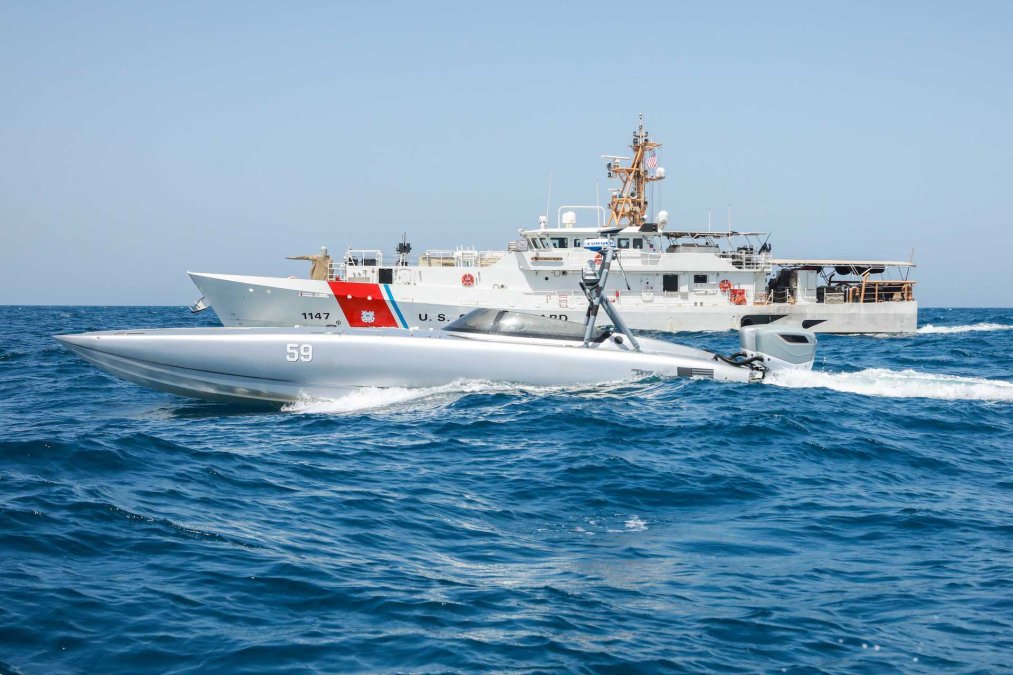
The Coast Guard is keen on expanding its use of drones and autonomous vessels, but service leaders and government officials foreshadowed to lawmakers this week the need to update regulations on their use, specifically in the face of cyber threats, questions over crew requirements and safety.
In a hearing Tuesday with a House subcommittee on Coast Guard and Maritime Transportation, top uniformed officers told lawmakers that the service already uses short, medium and long-range unmanned aerial systems for drug interdiction or to help find distressed mariners, for example, as well as autonomous surface vessels.
But officials — including a top member of the Government Accountability Office, Andrew Von Ah — also warned that as new technologies develop, they might present security and safety risks, including under current statutes that require Coast Guard vessels to employ human lookouts to help prevent collisions, for example.
Rear Adm. David Barata, the Coast Guard’s deputy commandant for operations policy and assistant commandant for intelligence, said that the International Maritime Organization — a United Nations “specialized” agency tasked with standardizing global shipping — was in the process of finalizing regulations for autonomous use by late next year.
“These technologies represent opportunities to strengthen America’s maritime dominance and the Coast Guard is taking active steps to ensure their safety while providing and promoting innovation,” he said.
Over the summer, the Coast Guard announced its Force Design 2028 plan, a sweeping revamp meant to address “decades of underinvestment and severe readiness challenges,” according to the program.
Part of that effort includes an embrace of robotics and autonomous systems. Since the plan’s launch, the service has established a new program executive office dedicated to rapidly expanding its use of unmanned platforms. In November, the Coast Guard also announced a new “robotics mission specialist” rating which will see select members starting to operate and maintain drones, underwater vehicles, surface craft and robots.
The One Big Beautiful Bill Act, which was signed into law in July, includes $266 million for Coast Guard procurement and acquisition of long-range UAS and $75 million to contract the services of, acquire, or procure autonomous maritime systems, according to officials.
Meanwhile, the Coast Guard said it has offloaded hundreds of thousands of pounds of narcotics in recent months during interdiction operations in the Eastern Pacific and Caribbean. Business Insider reported in November that the service was using a new drone known as the V-BAT to help spot alleged drug boats.
As the Coast Guard embraces these new systems in what it has deemed historic drug hauls, leaders are also wary about how its expansive, but tech-reliant maritime domain would fare against adversaries in cyberspace.
“While the Coast Guard is committed to supporting and facilitating the adoption of innovative commercial technologies, we must remain clear-eyed about the potential for new technologies to also introduce new vulnerabilities that can be exploited by our adversaries, particularly in cyberspace,” said Rear Adm. Jason Tama, who leads the Coast Guard’s Cyber Command.
He told lawmakers that the service’s cyber protection teams have conducted over 150 missions, including incident responses on critical infrastructure in the U.S. and overseas.
“While those missions are improving the cyber security posture in our ports, they are also revealing persistent cyber risks such as compromised passwords, known vulnerabilities, outdated systems, as well as new cyber attack paths that our adversaries can and will attempt to exploit,” Tama said.