Navy ramping up sea drone arsenal as officials aim for half of the surface fleet to be unmanned by 2045
Sailors are currently making key strides on the path toward achieving the Navy’s long-term goals for integrating robotic platforms, according to some of the top officials leading high-stakes complementary drone initiatives.
Surface Force Vision 2045 explicitly directs the sea service to create and operationalize unmanned surface vessel squadrons in every fleet, as part of a broader push to rapidly enable a hybrid force and equip personnel with emerging maritime drone technologies that can expand the U.S. military’s capacity, flexibility and reach.
“[There’s] an incredible pace of change happening right now,” said Rear Adm. Christopher Alexander, who currently serves as special assistant to the commander of Naval Surface Forces.
On multiple panels this week at the annual SNA Symposium, he and other senior officials shed new light on a variety of moves the Navy is making to normalize operations that integrate robotic platforms and autonomous capabilities across the surface force.
Advantages of uncrewed systems in contemporary naval ops have increasingly been demonstrated by their range, endurance and affordability, among other characteristics. As drone technologies quickly mature, the Navy is increasingly deploying them to support manned ships and aircraft for intelligence, surveillance, reconnaissance, logistics, targeting and more.
Broadly, USVs and other maritime drones like unmanned underwater vehicles (UUVs) can be outfitted with sensors, weapons, or other payloads.
The sea service’s drone strategies, experimentation venues and vision for enterprise-wide adoption have been shaped and reshaped over the last decade. But under the current guidance, the Navy is hustling to grow its workforce’s expertise and drone arsenal to encompass hundreds of connected manned and unmanned vessels.
“In 2025, the U.S. Navy inventory of small USVs was four. By the end of the year, it was close to 400. Incredible change in [fiscal year 2026]. The U.S. Navy is investing almost $7 billion in unmanned systems — and that’s $3.7 billion that are going to head over to the surface force 2027,” Alexander said on Thursday. “The U.S. Navy’s inventory of medium USVs, also referred to as [Modular Attack Surface Craft] will be at about 11, with the small USVs numbering somewhere close to 500. And then looking at some projections — moving out over the future — by 2045, we expect about 45% of the surface force to be unmanned systems.”
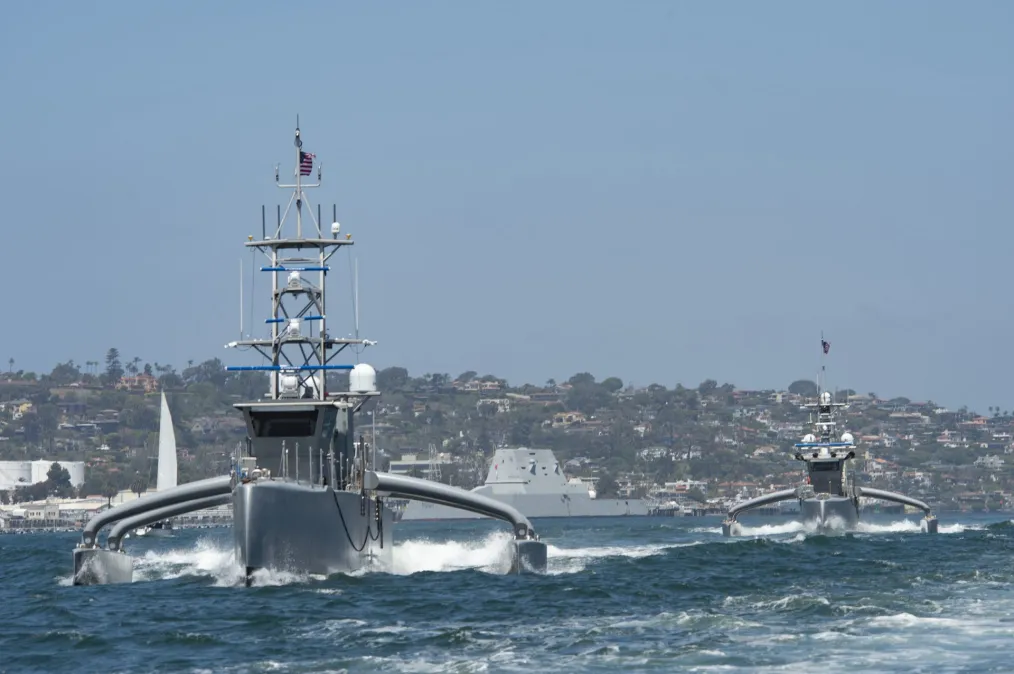
Speaking at the conference on Wednesday, Capt. Garrett Miller, who commands Surface Development Group One, or USVRON 1, also announced that the service is planning to soon deliver its two “upgraded prototype medium USVs,” Sea Hawk and Sea Hunter, for real-world surface fleet missions.
“Those will no longer be experimental vessels. They will actually be under fleet control, assigned to surface forces to be able to actually go out and do great things. We are going to integrate and deploy one of those MUSVs with a carrier strike group in 2026,” Miller said.
Officials are also working to finalize concepts of operations for small and medium USVs in the next several months.